Best Antinsky 3D Printer Resins: 3 Models Compared
As an Amazon Associate we earn from qualifying purchases. Links on this page are affiliate links.
You need reliable best antinsky 3d printing liquids for precise dental work. We compared 3 models based on their published specifications. Antinsky offers standard, guide, and castable resins for 405nm printers. The Antinsky Standard Dental Model Resin leads as the best overall choice for standard dental model printing due to its high hardness and thermal stability. This selection focuses strictly on data like curing wavelength and application type. You can trust these picks to match your specific printing requirements without guessing.
Quick picks
| # | Product | Best for | Price |
|---|---|---|---|
| 1 | Antinsky Standard Dental Model Resin Best overall | Standard dental model printing | Check price of Antinsky Standard Dental Model Resin on Amazon |
| 2 | Antinsky Dental Guide Resin 1kg Best premium | high-temperature sterilizable dental guides | Check price of Antinsky Dental Guide Resin 1kg on Amazon |
| 3 | Antinsky Castable Dental Resin 1kg Best budget | high-precision dental restorations and implant cases | Check price of Antinsky Castable Dental Resin 1kg on Amazon |
Our 3 picks

Antinsky Standard Dental Model Resin
Best for: Standard dental model printing
- Resin Type
- Standard Dental Model
- Curing Wavelength
- 405nm
- Compatible Technology
- DLP, LCD
- Net Weight
- 1kg
- Application
- Crown and bridge, orthodontic, implant
- Shore Hardness
- 88D
View on Amazon: Antinsky Standard Dental Model Resin Affiliate link
This 1kg bottle of Antinsky resin is designed for standard dental models. It cures at 405nm for DLP and LCD printers. The material offers a Shore hardness of 88D and withstands temperatures up to 100°C. It features low shrinkage for dimensional stability. You get sharp details and a smooth surface suitable for crown, bridge, and orthodontic models. It prints at 2-3 seconds per layer.
Pros
- Shore hardness of 88D for excellent mechanical strength
- Thermal deformation temperature reaches 100°C
- Low shrinkage ensures dimensional stability
- Compatible with 405nm DLP and LCD printers
Cons
- Limited to standard dental model applications
- No mention of post-curing requirements in data
- Single 1kg bottle size only
Good fit if
- You need durable models for crown and bridge work
- You require high temperature resistance up to 100°C
- You print on 405nm DLP or LCD systems
Skip if
- You need castable resin for burnout processes
- You require specialized dental guide materials
- You prefer larger bulk packaging options
Verdict: Antinsky Standard Dental Model Resin 1kg delivers high hardness and thermal stability for precise dental models. It fits practitioners needing durable crown, bridge, or orthodontic prints on 405nm printers.
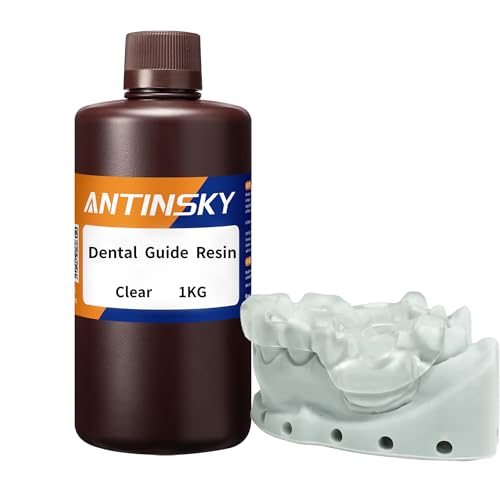
Antinsky Dental Guide Resin 1kg
Best for: high-temperature sterilizable dental guides
- Curing Wavelength
- 405nm
- Compatible Technology
- DLP, LCD
- Net Weight
- 1kg
- Application
- Dental guide plate
- Shore Hardness
- 89D
- Features
- High Precision, Low Odor
View on Amazon: Antinsky Dental Guide Resin 1kg Affiliate link
This Antinsky resin is formulated for dental guide plates on DLP and LCD printers using a 405nm wavelength. It offers a Shore hardness of 89D and a thermal deformation temperature of 120°C for high-temperature sterilization. The low shrinkage ensures dimensional stability and sharp detail capture. You get a 1kg net weight of transparent material that drills and taps without cracking.
Pros
- High transparency aids precise positioning
- Shore hardness reaches 89D
- Withstands 120°C sterilization
- Low odor after curing
- Compatible with DLP and LCD
Cons
- Limited to 1kg container size
- Specific to dental guide applications
- Requires 405nm curing wavelength
Good fit if
- You need high-temperature sterilizable guides
- You use DLP or LCD printers
- You require sharp detail capture
Skip if
- You need castable wax patterns
- You print standard models
- You prefer opaque materials
Verdict: Antinsky Dental Guide Resin 1kg delivers the hardness and heat resistance required for professional dental guides. It suits clinicians who need sterilizable, transparent models for precise surgical planning.

Antinsky Castable Dental Resin 1kg
Best for: high-precision dental restorations and implant cases
- Resin Type
- Castable Dental
- Curing Wavelength
- 405nm
- Compatible Technology
- LCD, DLP
- Net Weight
- 1kg
- Application
- Crown, bridge and framework patterns
- Printing Technology
- Resin
View on Amazon: Antinsky Castable Dental Resin 1kg Affiliate link
This 1 kg bottle of Antinsky castable resin is designed for DLP and LCD printers using 395–405 nm light. It features ultra-low shrinkage between 0.85% and 1.05%, ensuring high precision for dental restorations and implant cases. The material has near-zero ash residue under 0.5% after burnout, which helps prevent impurities in final castings. With a viscosity of 50–170 cps, it offers good fluidity for fast infiltration. You will get strong green models with a Shore D hardness of 85–88.
Pros
- Linear shrinkage rate of 0.85%–1.05% for high precision
- Ash residue remains below 0.5% after high-temperature burnout
- Low viscosity of 50–170 cps at 25°C aids fast curing
- Shore D hardness of 85–88 provides strong mechanical properties
Cons
- Requires specific exposure times of 2.5–3.5 seconds per layer
- Bottom layer exposure needs 25–30 seconds for reliable results
- Wax content is limited to 30%–40% of the total volume
Good fit if
- You need low shrinkage for accurate dental restorations
- You want minimal ash residue for smooth castings
- You use DLP or LCD printers with 405 nm wavelength
Skip if
- You require high wax content above 40% for burnout
- You need a resin compatible with FDM printing technology
- You prefer materials with higher flexibility than Shore D 88
Verdict: Antinsky Castable Dental Resin 1kg delivers the low shrinkage and near-zero ash residue needed for precise dental models. You should choose this if you prioritize casting quality and dimensional accuracy in your 3D printed dental work.
Specifications side by side
| Spec | Antinsky Standard Dental Model Resin | Antinsky Dental Guide Resin 1kg | Antinsky Castable Dental Resin 1kg |
|---|---|---|---|
| Resin Type | Standard Dental Model | not stated | Castable Dental |
| Curing Wavelength | 405nm | 405nm | 405nm |
| Compatible Technology | DLP, LCD | DLP, LCD | LCD, DLP |
| Net Weight | 1kg | 1kg | 1kg |
| Application | Crown and bridge, orthodontic, implant | Dental guide plate | Crown, bridge and framework patterns |
| Shore Hardness | 88D | 89D | not stated |
| Printing Technology | Resin | LCD | Resin |
| Features | High Precision | High Precision, Low Odor | Low Shrinkage |
| Color | Standard Dental Model Resin | not stated | not stated |
| Model | not stated | Antinsky Dental Guide Resin | not stated |
Antinsky Resins Compared by Spec
You can choose Antinsky resins based on their specific printing technologies and intended applications. The Standard Dental Model Resin uses general resin technology for durable crown and bridge prints. It fits practitioners who need high hardness and thermal stability for everyday orthodontic models on 405nm printers. This option prioritizes structural integrity for standard dental work.
Alternatively, the Dental Guide Resin utilizes LCD technology for transparent, sterilizable surgical guides. Clinicians requiring heat resistance for precise planning should select this budget-friendly option. For restorations, the Castable Dental Resin offers low shrinkage and near-zero ash residue. You should choose this model if dimensional accuracy and casting quality are your primary concerns for implant cases.
Who Antinsky Resins Suit
This range targets dental professionals using 405nm printers. You can print standard models, surgical guides, or castable restorations. The lineup covers general purpose, high-heat sterilization, and low-shrink casting needs. All listed products use resin technology. You do not need to worry about LCD compatibility issues for the guide resin, as it specifies LCD printing. The brand focuses on specific dental applications. There are no flexible, engineering, or standard general-purpose resins listed. You should choose based on your final workflow, whether that involves casting, sterilization, or static model display. Each product serves a distinct phase of dental lab work.
Choose Antinsky Resin by Spec
-
Match Curing Wavelength
You must verify the curing wavelength before purchasing. All listed Antinsky resins require a 405nm light source. If your printer uses a different wavelength, such as 385nm or 405nm with varying intensity, the resin will not cure properly. Check your printer’s specifications to ensure compatibility. Using the wrong wavelength results in poor layer adhesion and failed prints. This is a critical first step for any resin printing setup.
-
Select Resin Type
Choose the resin type based on your final application. The Standard Dental Model Resin is designed for general dental models requiring high hardness. If you need to cast metal restorations, the Castable Dental Resin is necessary due to its low shrinkage and near-zero ash residue. The Dental Guide Resin offers heat resistance for sterilizable surgical guides. Picking the wrong type compromises the utility of your printed part.
-
Check Printing Technology
Confirm the printing technology supported by the resin. Most Antinsky options are compatible with standard resin printing processes. However, the Dental Guide Resin explicitly supports LCD technology. Ensure your printer matches the recommended technology for optimal resolution and surface finish. Mismatching technology can lead to uneven curing or excessive detail loss. This specification ensures the resin flows and cures as intended on your specific hardware.
-
Verify Application Needs
Align the resin’s intended application with your workflow. The Standard Dental Model Resin suits practitioners needing durable crowns and bridges. The Castable variant is best for high-precision implant cases where dimensional accuracy is paramount. The Guide Resin is ideal for transparent, sterilizable models used in surgical planning. Selecting a resin based on its specific application ensures you meet the mechanical and aesthetic requirements of your dental projects.
-
Assess Material Properties
Evaluate the material properties against your durability requirements. The Standard Dental Model Resin provides high thermal stability, which is essential for maintaining shape during post-processing. The Castable Resin prioritizes low shrinkage to preserve intricate details before casting. The Guide Resin focuses on heat resistance for sterilization cycles. Understanding these properties helps you predict how the printed part will behave under stress, heat, or chemical exposure during your dental procedures.
Frequently asked questions
Which Antinsky resin is best for standard dental models?
The Antinsky Standard Dental Model Resin is the top choice for standard dental applications. It offers high hardness and thermal stability, which ensures precise results for crowns, bridges, and orthodontic prints. This standard resin type is optimized for durability in everyday clinical use.
Can I use Antinsky resins on any 405nm printer?
Yes, all listed Antinsky resins are designed for 405nm curing wavelengths. The Standard, Guide, and Castable variants all require this specific light source to cure properly. You should verify your printer supports 405nm LCD or resin technology before purchasing any of these materials.
Is there an Antinsky resin suitable for surgical guides?
The Antinsky Dental Guide Resin is best for high-temperature sterilizable dental guides. It provides the necessary hardness and heat resistance for professional surgical planning. This resin allows clinicians to create transparent models that maintain structural integrity during sterilization processes.
Which resin has the lowest ash residue for casting?
The Antinsky Castable Dental Resin is designed for low shrinkage and near-zero ash residue. This specification is critical for high-precision dental restorations and implant cases. Choosing this resin helps ensure dimensional accuracy and a clean burnout process for your castings.
What is the difference between standard and castable resin?
Standard resin prioritizes hardness and thermal stability for durable models like crowns. Castable resin focuses on low shrinkage and minimal ash residue for final restorations. You should select standard resin for general models and castable resin when the print will be metal-cast.
Do Antinsky resins require specific printing technologies?
Antinsky resins are compatible with resin and LCD printing technologies. The Standard and Castable options use general resin technology, while the Guide resin specifies LCD compatibility. All variants rely on 405nm light sources to cure the material effectively during the printing process.