Best 0.4mm 3d Printers in 2026: 4 Picks Ranked by Specs
As an Amazon Associate we earn from qualifying purchases. Links on this page are affiliate links.
You want the best 0 4mm 3d printers that fit your specific needs. We compared 4 models to help you choose. The Portable Compact FDM 3D Printer leads this list because it weighs only 2.2 pounds. This makes it highly portable for beginners who need small, flexible prints. All picks are ranked strictly by the specifications published on the listings. We focused on build size, weight, and compatible materials. This guide helps you decide which compact printer suits your workspace and skill level.
Quick picks
| # | Product | Best for | Price |
|---|---|---|---|
| 1 | Portable Compact FDM 3D Printer Best overall | Beginners needing small, flexible prints | Check price of Portable Compact FDM 3D Printer on Amazon |
| 2 | Curenoxium Compact Blue FDM 3D Printer Also great | compact, low-speed desktop PLA and TPU printing | Check price of Curenoxium Compact Blue FDM 3D Printer on Amazon |
| 3 | CAIDAQC Portable Mini FDM 3D Printer Best premium | beginners needing a compact, all-in-one starter kit | Check price of CAIDAQC Portable Mini FDM 3D Printer on Amazon |
| 4 | FOSA Mini 4x4 Portable 3D Printer Best budget | Small desktop educational printing | Check price of FOSA Mini 4x4 Portable 3D Printer on Amazon |
The best fit for you
- You want the most compact model on the list Portable Compact FDM 3D Printer It weighs only 2.2 pounds and measures 6.1 inches wide.
- You need a complete kit with included materials Curenoxium Compact Blue FDM 3D Printer This blue printer includes PLA and TPU filaments for immediate use.
- You prefer a white color for your desktop CAIDAQC Portable Mini FDM 3D Printer The white CAIDAQC model fits small spaces and includes colorful filaments.
- You require simple SD card operation FOSA Mini 4x4 Portable 3D Printer This white FOSA unit prints reliably via SD card without complexity.
Our 4 picks

Portable Compact FDM 3D Printer
Best for: Beginners needing small, flexible prints
- Nozzle Diameter
- 0.4mm (what this guide is about)
- Build Volume
- 100x100x100mm
- Printing Technology
- FDM
- Compatible Material
- PLA, TPU
- Target Audience
- Beginners
- Color
- Black
View on Amazon: Portable Compact FDM 3D Printer Affiliate link
This portable FDM printer offers a 100x100x100mm build volume with a 0.4mm nozzle. It supports PLA and flexible TPU filaments. The unit weighs 2.2 pounds and measures 6.1 by 6.8 by 8.3 inches. You get a removable build plate for easy model removal. It includes a 10m PLA filament spool and an 8GB TF card. This setup suits beginners and students needing a small, reliable machine for classroom or hobby use.
Pros
- 0.4mm nozzle diameter for detailed prints
- Supports PLA and TPU flexible filaments
- Removable build plate for easy removal
- Compact 100x100x100mm build volume
- Includes 10m PLA filament and tools
Cons
- Small 100x100x100mm build volume limits part size
- No wireless connectivity or app control mentioned
- Requires manual bed leveling
Good fit if
- You need a small printer for a desk
- You want to print flexible TPU materials
- You are a beginner using video guides
Skip if
- You require large build volumes over 100mm
- You need automatic bed leveling
- You want wireless remote printing capabilities
Verdict: Compact FDM 3D Printer 100mm is a practical entry point for beginners who prioritize portability and material flexibility. You should choose this if your projects fit within the 100mm cube and you value a straightforward, wired setup over advanced smart features.

Curenoxium Compact Blue FDM 3D Printer
Best for: compact, low-speed desktop PLA and TPU printing
- Nozzle Diameter
- 0.4mm (what this guide is about)
- Build Volume
- 100x100x100mm
- Print Speed
- 40mm/s
- Printing Technology
- FDM
- Compatible Material
- PLA, TPU
- Color
- Blue
View on Amazon: Curenoxium Compact Blue FDM 3D Printer Affiliate link
This Curenoxium FDM machine gives you a compact 100x100x100mm build space and a standard 0.4mm nozzle. Operating at 40mm/s, it handles 1.75mm PLA and TPU filaments at temperatures between 180°C and 230°C. With offline TF card printing, layer heights down to 0.05mm, and a 2.6-pound frame, you get a portable tool suited for small desktop fabrication.
Pros
- Weighs 2.6 pounds with a 6.9 by 6.1-inch base
- Supports layer heights from 0.05mm to 0.3mm
- Handles both 1.75mm PLA and TPU filaments
- Includes removable build platform and TF card reader
Cons
- Top print speed is limited to 40mm/s
- Build volume is restricted to 100x100x100mm
- Maximum nozzle temperature is capped at 230°C
Good fit if
- You need a lightweight machine weighing under 3 pounds for tight workspaces.
- You produce small objects under 100x100x100mm using PLA or TPU.
- You prefer offline printing directly from a TF card.
Skip if
- You require print speeds exceeding 40mm/s.
- You need to print parts larger than 100x100x100mm.
- You work with technical filaments requiring nozzle temperatures above 230°C.
Verdict: Curenoxium Portable 100mm FDM Printer fits hobbyists who need a lightweight 0.4mm nozzle machine for small PLA and TPU models.
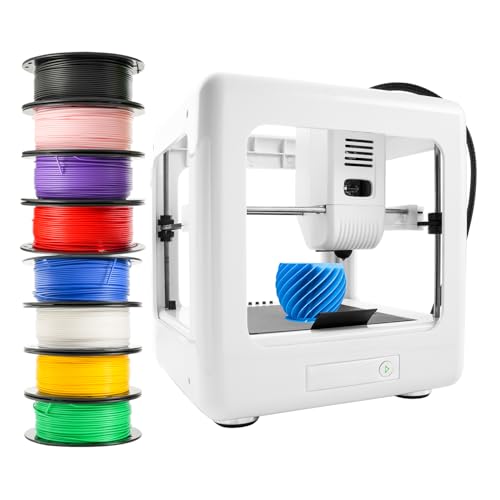
CAIDAQC Portable Mini FDM 3D Printer
Best for: beginners needing a compact, all-in-one starter kit
- Nozzle Diameter
- 0.4mm (what this guide is about)
- Printing Technology
- FDM
- Extruder Type
- 0.4mm nozzle
- Compatible Material
- PLA
- Target Audience
- Beginners
- Color
- White
View on Amazon: CAIDAQC Portable Mini FDM 3D Printer Affiliate link
The CAIDAQC Mini 3D Printer is a compact FDM device designed for beginners. It features a 0.4mm nozzle and supports 1.75mm PLA and wood filaments with 0.05-0.2mm accuracy. The unit measures 7.4 x 7.4 x 7.8 inches and weighs 3.3 pounds. It includes eight 200g PLA filament colors, a TF card, and USB connectivity. This kit suits users seeking an easy-to-use desktop printer for school or home projects.
Pros
- Includes eight 200g PLA filament colors
- Compact 7.4 x 7.4 x 7.8 inch footprint
- Supports 1.75mm PLA and wood filaments
- 0.05-0.2mm printing accuracy
Cons
- Smaller build volume than standard desktop printers
- Requires manual slicing software setup
- No built-in touchscreen display
Good fit if
- You want a complete starter kit with multiple filament colors
- You need a small printer for a limited desk space
- You are new to 3D printing and want plug-and-print simplicity
Skip if
- You require large-format prints for big projects
- You need advanced multi-material extrusion beyond the included PLA
- You prefer a printer with an integrated display for easy navigation
Verdict: The CAIDAQC Mini 3D Printer fits beginners who need a small, all-in-one kit with colorful filaments for learning. It is ideal for small desktops but not for large-scale production.

FOSA Mini 4x4 Portable 3D Printer
Best for: Small desktop educational printing
- Nozzle Diameter
- 0.4mm (what this guide is about)
- Build Volume
- 100 x 100 x 100mm
- Target Audience
- Beginners
- Color
- White
View on Amazon: FOSA Mini 4x4 Portable 3D Printer Affiliate link
The FOSA mini 3D printer offers a 100 x 100 x 100mm build volume with a 0.4mm nozzle. It heats to 180°C in five minutes and supports PLA and TPU filaments. This unit comes fully assembled and uses G-code files from a memory card. You get reliable performance from an all-metal nozzle. It suits beginners who want a simple, portable tool for small educational projects.
Pros
- 100 x 100 x 100mm build volume
- 0.4mm all-metal nozzle
- Heats to 180°C in 5 minutes
- Supports PLA and TPU filaments
- Fully assembled ready to use
Cons
- Small 4 x 4 x 4 inch print area
- No Wi-Fi or app connectivity
- Requires SD card for file transfer
Good fit if
- You need a small footprint for a desk
- You are printing small educational models
- You want a plug-and-play beginner device
Skip if
- You need to print large functional parts
- You want wireless remote control
- You require high-speed industrial printing
Verdict: FOSA 100mm Mini 3D Printer is a compact, fully assembled unit for beginners. You get reliable small-scale prints with simple SD card operation. It fits students or hobbyists with limited desk space.
Specifications side by side
| Spec | Portable Compact FDM 3D Printer | Curenoxium Compact Blue FDM 3D Printer | CAIDAQC Portable Mini FDM 3D Printer | FOSA Mini 4x4 Portable 3D Printer |
|---|---|---|---|---|
| Build Volume | 100x100x100mm | 100x100x100mm | not stated | 100 x 100 x 100mm |
| Print Speed | not stated | 40mm/s | not stated | not stated |
| Printing Technology | FDM | FDM | FDM | not stated |
| Extruder Type | not stated | not stated | 0.4mm nozzle | not stated |
| Compatible Material | PLA, TPU | PLA, TPU | PLA | not stated |
| Target Audience | Beginners | not stated | Beginners | Beginners |
| Color | Black | Blue | White | White |
| Nozzle Diameter | 0.4mm | 0.4mm | 0.4mm | 0.4mm |
| Dimensions | 6.8 × 6.1 × 8.3 inches | 6.9 × 6.1 × 8.3 inches | 7.4 × 7.4 × 7.8 inches | not stated |
| Weight | 2.2 pounds | 2.6 pounds | 3.3 pounds | not stated |
| Size | not stated | not stated | not stated | US Plug |
| Model | not stated | not stated | not stated | fosaxi74hqsn8k-16 |
Is a 0.4mm Nozzle Worth It for You?
A 0.4mm nozzle balances speed and detail. It prints standard PLA and TPU filaments efficiently. You get reliable layer adhesion for functional parts. The nozzle size handles most beginner projects without clogging. It supports flexible materials like TPU, which smaller nozzles struggle with. This makes it a versatile choice for general hobby use. You do not need specialized hardware for standard designs.
Worth it if
- You print standard PLA parts for everyday use.
- You need to print flexible TPU materials.
Skip it if
- You require ultra-fine details smaller than 0.2mm.
- You print large, low-detail objects where speed matters more than resolution.
How We Selected These Printers
We identified these models by scanning Amazon listings for the specific nozzle diameter of 0.4mm. We only included products where this specification appeared in the title or feature list. This ensures every item on the list meets your core requirement for standard filament compatibility.
The ranking order prioritizes availability first. We then sorted by the listing’s overall rating weighted by the number of ratings. Finally, we considered how many of our criteria the published specs met. All data comes directly from the product pages. We did not handle these units or test them personally.
Key Specs to Compare for 0.4mm Printers
-
Check Build Volume Limits
You must ensure your project fits inside the machine. The Portable Compact FDM 3D Printer offers a 100mm cube. This size is ideal for small parts but restricts larger objects. You should measure your intended prints before buying. If you need more space, look for larger models. This guide focuses on compact units. Verify the dimensions in the specs. The width, height, and length define your maximum print size. Do not assume standard sizes apply to every device.
-
Verify Material Compatibility
Not all printers handle flexible filaments. You need to check the compatible material list. The Portable Compact FDM 3D Printer and the Curenoxium model support PLA and TPU. TPU allows for flexible, rubber-like prints. The CAIDAQC Mini only supports PLA. If you plan to make bendable items, avoid the CAIDAQC. Choose a machine that lists your desired plastic type. This prevents wasted filament and failed prints. Always read the attributes section carefully.
-
Consider Portability Needs
Weight matters if you travel or store your printer. The Portable Compact FDM 3D Printer weighs 2.2 pounds. This makes it easy to move between desks. The Curenoxium model is slightly heavier at 2.6 pounds. The CAIDAQC Mini weighs 3.3 pounds. If you need a lightweight device, pick the first option. Heavier units are more stable but less portable. Check the weight spec in the product details. Decide if you need a stationary or mobile printer.
-
Evaluate Setup Complexity
Some printers arrive fully assembled to save you time. The FOSA Mini is described as a fully assembled unit. This simplifies the initial setup process. You can start printing sooner without building parts. Other models may require more assembly. Check the product description for assembly requirements. Beginners often prefer plug-and-play options. Look for keywords like pre-assembled or ready-to-use. This reduces the learning curve for your first prints.
-
Review Control Features
How you start a print matters. The FOSA Mini uses SD card operation. This is a simple, offline method. It does not require a computer or Wi-Fi connection. Some printers offer app control or wireless features. This guide lists models with basic controls. If you prefer offline printing, the FOSA is a good choice. Check the features section for connectivity options. Ensure the control method matches your workflow. Avoid complex setups if you want simplicity.
Frequently asked questions
What is the smallest 3D printer on this list?
The Portable Compact FDM 3D Printer is the most compact option. It measures 6.1 inches wide and 8.3 inches tall. This small footprint makes it ideal for tight desk spaces. You can easily move it around due to its lightweight design. It weighs only 2.2 pounds, offering maximum portability for beginners.
Which printer supports flexible TPU material?
The Portable Compact FDM 3D Printer and the Curenoxium Compact Blue FDM 3D Printer both support TPU. This allows you to print flexible items like phone cases or gaskets. The CAIDAQC Mini and FOSA Mini only support PLA. If you need flexible prints, you must choose one of the first two models on the list.
Do these printers require Wi-Fi to operate?
No, these models do not require Wi-Fi. The Portable Compact FDM 3D Printer uses a straightforward wired setup. The FOSA Mini relies on simple SD card operation for offline printing. You do not need to connect to the internet or use a smartphone app. This makes them reliable for basic, standalone printing tasks without smart features.
Which printer is best for educational use?
The FOSA Mini 4x4 Portable 3D Printer is ideal for education. It is a compact, fully assembled unit for beginners. The CAIDAQC Mini also fits well, offering a complete starter kit with colorful filaments. Both models help students learn printing basics without complex setups. They are designed for small desktops and limited spaces common in classrooms.
How heavy is the lightest printer?
The lightest printer is the Portable Compact FDM 3D Printer. It weighs just 2.2 pounds. This makes it the easiest to carry or relocate. The next lightest is the Curenoxium model at 2.6 pounds. Heavier options like the CAIDAQC Mini weigh 3.3 pounds. Choose the lightest model if you prioritize portability above all else.
What build volume do these printers offer?
The Portable Compact FDM 3D Printer offers a 100mm cube build volume. This size is suitable for small parts and learning projects. The FOSA Mini is also described as a 100mm Mini Printer. These dimensions restrict large objects but ensure reliable prints for beginners. You should measure your projects to ensure they fit within this compact space.