11 Best 3d Printers Under $300, Compared
As an Amazon Associate we earn from qualifying purchases. Links on this page are affiliate links.
Finding the right 3d printer under 300 requires evaluating motion mechanics, extrusion temperature, and setup automation. This comparison analyzes 11 models based strictly on the specifications published on their official listings. The FLASHFORGE Adventurer 5M CoreXY 3D Printer takes the top spot because of its 600mm/s print speed, CoreXY architecture, and direct-drive extruder.
Different options prioritize high-speed motion, multi-color setups, enclosed PLA chambers, or resin detail. This guide helps you decide which build volume, motion configuration, and filament compatibility match your fabrication projects.
Quick picks
The best fit for you
- You need high-speed prototyping with automated bed leveling FLASHFORGE Adventurer 5M CoreXY 3D Printer It pairs a CoreXY structure with 600mm/s print speeds and a 280°C direct-drive extruder.
- You want an enclosed printer designed for kids AOSEED Enclosed Kids 3D Printer Its enclosed body weighs 8.82 pounds and is configured specifically for PLA filament.
- You require ultra-fine detail for miniature resin prints ELEGOO Saturn 3 12K Resin 3D Printer The 12K screen delivers 19 by 24 micron resolution across a 250 mm vertical height.
- You want multi-color printing across larger dimensions Creality SPARKX Multi-Color 3D Printer It provides multi-color capability across a spacious 260 by 260 by 255 mm build volume.
Our 11 picks

FLASHFORGE Adventurer 5M CoreXY 3D Printer
Best for: high-speed CoreXY printing and automated setup
- Build Volume
- 220x220x220mm
- Print Speed
- Max 600mm/s
- Leveling Type
- Fully Auto Leveling
- Motion Structure
- CoreXY
- Extruder Type
- 280°C Direct Extruder
- Features
- High Speed
View on Amazon: FLASHFORGE Adventurer 5M CoreXY 3D Printer (paid link)
The FLASHFORGE Adventurer 5M is a CoreXY 3D printer built for fast production. You get travel speeds up to 600mm/s, 20000mm/s² acceleration, and fully automatic bed leveling with no manual adjustment required. Its 280°C direct-drive extruder reaches 200°C in 35 seconds and prints onto a dual-sided PEI platform. This machine suits you if you need rapid prototyping speeds, quick three-second nozzle swaps, and remote monitoring through mobile software.
Pros
- CoreXY structure supports 600mm/s travel speed and 20000mm/s² acceleration
- Fully automatic bed leveling requires no manual adjustment
- Direct-drive extruder heats to 200°C in 35 seconds with a 280°C maximum temperature
- Quick-release nozzle mechanism allows swaps in 3 seconds
Cons
- Alternative nozzle sizes from 0.25mm to 0.8mm are optional and sold separately
- Machine weighs 22 pounds and occupies a 15.83 by 14.29 inch footprint
Good fit if
- You want high-speed CoreXY printing with rapid 20000mm/s² acceleration.
- You prefer automated bed leveling and fast nozzle changes.
- You plan to monitor print jobs remotely using Flash Studio.
Skip if
- You need nozzle sizes other than the standard 0.4mm included in the box.
- You have limited workspace that cannot fit a 22-pound desktop machine.
Verdict: FLASHFORGE Adventurer 5M CoreXY 3D Printer delivers high-speed printing with automated leveling and a 280°C direct-drive extruder. It gives you dependable rapid prototyping with fast heating and minimal setup.

Bambu Lab A1 FDM 3D Printer
Best for: beginners wanting automated calibration and speed
- Printing Technology
- FDM
- Leveling Type
- Full-Auto Calibration
- Target Audience
- Beginners, Kids
- Color
- Grey
- Dimensions
- 21.8 × 20.8 × 12.9 inches
- Weight
- 22 pounds
View on Amazon: Bambu Lab A1 FDM 3D Printer (paid link)
The Bambu Lab A1 FDM 3D Printer is designed for beginners and kids. It delivers up to 10,000 mm/s² acceleration, full-auto calibration for Z-offset and bed leveling, and active flow rate compensation. You control prints through a touchscreen interface, while active motor noise canceling keeps operation quiet. If you want fast output and the option to add multi-color capabilities, this machine fits your desk.
Pros
- Acceleration up to 10,000 mm/s²
- Full-auto calibration for bed leveling and Z-offset
- Active flow rate compensation
- Quick-swap 1-clip nozzle design
- Active motor noise canceling
Cons
- Multi-color printing requires separate purchase of AMS lite
- Large desktop footprint at 21.76 inches long by 20.83 inches wide
Good fit if
- You want fully automated bed leveling and Z-offset setup.
- You prioritize quiet operation with motor noise canceling.
- You plan to add multi-color hardware in the future.
Skip if
- You need multi-color printing included directly in the box.
- You have limited workspace that cannot fit a 21.76-inch deep machine.
Verdict: Bambu Lab A1 FDM 3D Printer delivers high-speed printing with 10,000 mm/s² acceleration and automated calibration for hands-off setup. It provides a reliable platform if you want quiet operation and future multi-color expansion.

Bambu Lab A1 Mini with LED Lamp Kit
Best for: beginners making desktop DIY lighting projects
- Leveling Type
- Automatic calibration
- Target Audience
- Beginners
- Dimensions
- 15.2 × 16.8 × 17.9 inches
- Weight
- 12.1 pounds
View on Amazon: Bambu Lab A1 Mini with LED Lamp Kit (paid link)
The Bambu Lab A1 Mini with LED Lamp Kit is a compact desktop 3D printer built for beginners. It features automatic calibration to handle setup routines and connects with the Bambu Handy mobile app. With outer dimensions of 15.21 by 16.77 inches and a 12.13-pound weight, it fits small workspaces. This bundle includes hardware components to build functional decorative lamps.
Pros
- Automatic calibration system
- Included hardware for LED lamp projects
- Bambu Handy app and MakerWorld integration
- Compact frame weighing 12.13 pounds
Cons
- Does not include the AMS lite unit
- Outer frame size is limited to 17.94 inches tall
Good fit if
- You want automatic calibration to handle printer setup.
- You plan to assemble functional decorative light projects.
- You need a lightweight machine for a compact desk.
Skip if
- You need multi-color printing included with the AMS lite bundle.
- You require a larger frame than its 15.21 by 16.77-inch footprint.
Verdict: Bambu Lab A1 Mini with LED Lamp Kit delivers automated calibration and app connectivity in a compact 12.13-pound footprint. It gives you a reliable platform for desktop crafts and dedicated lamp builds.

AOSEED Enclosed Kids 3D Printer
Best for: young beginners wanting an enclosed PLA printer
- Print Speed
- Up to 400 mm/s
- Multicolor Capacity
- Single-color only
- Leveling Type
- Leveling-free
- Extruder Type
- Quick-release nozzle
- Compatible Material
- PLA
- Features
- Enclosed
View on Amazon: AOSEED Enclosed Kids 3D Printer (paid link)
The AOSEED Enclosed Kids 3D Printer is a compact, fully enclosed unit built for beginners and younger makers. It operates at speeds between 220 and 250 mm/s, peaking at 400 mm/s, with layer precision down to 0.05 mm. You get a leveling-free magnetic build plate, filament runout detection, and an integrated monitoring camera. This machine suits you if you want a safe, contained setup for printing standard PLA models without manual bed calibration.
Pros
- Enclosed, pinch-resistant chassis with built-in monitoring camera
- Speeds reach up to 400 mm/s with 0.05 mm precision
- Leveling-free platform with magnetic build plate
- Filament runout detection and quick-release nozzle
Cons
- Compatible only with PLA filament
- Supports single-color printing only
Good fit if
- You need an enclosed, pinch-resistant machine for home or classroom safety.
- You want a leveling-free platform with app-based Wi-Fi monitoring.
- You plan to produce single-color prints using PLA filament.
Skip if
- You need to print with high-temperature materials beyond PLA.
- You want automated multi-color extrusion in a single print job.
Verdict: AOSEED Enclosed Kids 3D Printer delivers safe, enclosed printing with high speeds, automated camera monitoring, and zero bed leveling. It offers a structured starting point for families, though material compatibility is limited strictly to PLA.
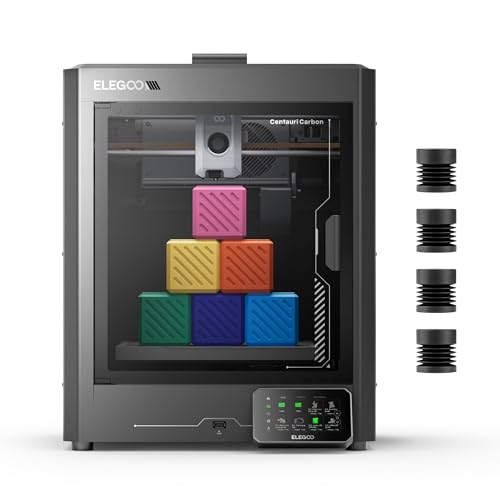
ELEGOO Centauri Carbon CoreXY 3D Printer
Best for: high-speed printing with carbon fiber filament
- Build Volume
- 256x256x256 mm
- Print Speed
- 500 mm/s
- Leveling Type
- Auto bed leveling
- Motion Structure
- CoreXY
- Extruder Type
- Brass-hardened steel nozzle
- Features
- High Speed, Built-in Camera
View on Amazon: ELEGOO Centauri Carbon CoreXY 3D Printer (paid link)
The ELEGOO Centauri Carbon is an enclosed CoreXY 3D printer that provides print speeds up to 500 mm/s with 20000 mm/s² acceleration. It features a 256x256x256 mm build volume and a 320°C brass-hardened steel nozzle capable of handling carbon-fiber-reinforced filaments. Fully assembled out of the box with auto-calibration and a built-in chamber camera, it suits you if you need high-speed output and high-temperature composite materials.
Pros
- CoreXY motion system reaching up to 500 mm/s speed and 20000 mm/s² acceleration
- 320°C brass-hardened steel nozzle handles carbon fiber reinforced filaments
- Enclosed chamber with built-in monitoring camera and dual LED lighting
- Fully assembled frame with automatic bed leveling and vibration compensation
Cons
- Heavy machine at 38.58 pounds
- Build volume capped at 256 x 256 x 256 mm
Good fit if
- You want fast 500 mm/s printing using an enclosed CoreXY setup.
- You plan to run abrasive or high-temperature carbon fiber filaments.
- You prefer a fully assembled machine with remote camera monitoring.
Skip if
- You need a build volume larger than 256 x 256 x 256 mm.
- You require a lightweight machine that weighs under 38 pounds.
Verdict: ELEGOO Centauri Carbon CoreXY 3D Printer delivers rigid CoreXY performance with 500 mm/s speeds and a 320°C nozzle. Its enclosed chamber and integrated camera make it a capable tool for technical filaments.

ELEGOO Saturn 3 12K Resin 3D Printer
Best for: high-detail resin prints requiring large build volume
- Build Volume
- 218.88 × 122.88 × 250 mm³
- Print Speed
- up to 70 mm/h
- Printing Technology
- MSLA
- Color
- Red
- Dimensions
- 12.1 × 10.8 × 22.1 inches
- Weight
- 33 pounds
View on Amazon: ELEGOO Saturn 3 12K Resin 3D Printer (paid link)
The ELEGOO Saturn 3 12K Resin 3D Printer delivers high-detail MSLA printing with a 10-inch 12K mono LCD screen. Its 11520 x 5120 resolution produces an XY resolution of 19 x 24 microns for intricate models. You get a 218.88 x 122.88 x 250 mm build volume and print speeds up to 70 mm/h. This machine suits you if you need fine miniature details on larger resin models.
Pros
- 10-inch 12K mono LCD with 11520 x 5120 resolution
- XY resolution of 19 x 24 microns for fine details
- Generous 218.88 x 122.88 x 250 mm build volume
- Fresnel collimating light source with over 90% uniformity
- 9H hardness tempered glass screen protector
Cons
- Heavy unit weight of 33 pounds
- Print speed limited to 70 mm/h
- Tall 22.13-inch height requires significant vertical clearance
Good fit if
- You need 19 x 24 micron precision for detailed miniature printing.
- You require a large 250 mm build height for bigger resin projects.
- You use third-party slicers like CHITUBOX or Lychee Slicer.
Skip if
- You need a lightweight 3D printer that weighs under 30 pounds.
- You have limited overhead space below 23 inches on your workbench.
Verdict: ELEGOO Saturn 3 12K Resin 3D Printer provides precise 19 x 24 micron resolution across a generous 250 mm vertical build area. It offers reliable resin output with a 9H glass-protected 12K display.

Flashforge Adventurer 5M CoreXY Printer
Best for: fast CoreXY printing with composite filaments
- Build Volume
- 220x220x220mm
- Print Speed
- 600mm/s
- Leveling Type
- Automatic Leveling
- Motion Structure
- Core XY
- Dimensions
- 14.2 × 14.8 × 16.2 inches
- Weight
- 22 pounds
View on Amazon: Flashforge Adventurer 5M CoreXY Printer (paid link)
The Flashforge Adventurer 5M CoreXY Printer provides a 220x220x220mm build volume paired with travel speeds up to 600mm/s and 20000mm/s² acceleration. It includes a 32mm³/s flow nozzle, one-click auto-leveling, and built-in vibration compensation for clean output. You can use standard or carbon-fiber filaments across multiple nozzle sizes. It suits home users who want fast fabrication without manual bed leveling.
Pros
- Maximum travel speed of 600mm/s with 20000mm/s² acceleration
- One-click automatic bed leveling with dual-sided PEI sheet
- 32mm³/s high-flow hotend heating to 200°C in 35 seconds
- Compatible with composite filaments including PLA-CF and PETG-CF
Cons
- Remote monitoring requires purchasing an optional camera kit
- Build volume is limited to 220x220x220mm
Good fit if
- You want CoreXY travel speeds up to 600mm/s.
- You need hands-free automatic bed leveling.
- You plan to print carbon-fiber filled filaments.
Skip if
- You need build dimensions larger than 220x220x220mm.
- You require built-in camera monitoring straight out of the box.
Verdict: Flashforge Adventurer 5M CoreXY Printer delivers high travel speeds and fully automatic leveling inside a compact footprint. It gives you flexible filament support and rapid heating for dependable daily making.

Creality SPARKX Multi-Color 3D Printer
Best for: multi-color projects needing automated calibration and monitoring
- Build Volume
- 260 x 260 x 255 mm
- Leveling Type
- Auto-leveling
- Color Printing
- Multi-Color
- Features
- High Speed, Built-in Camera
- Dimensions
- 16.6 × 17.9 × 18.5 inches
- Weight
- 20.1 pounds
View on Amazon: Creality SPARKX Multi-Color 3D Printer (paid link)
The Creality SPARKX Multi-Color 3D Printer is a high-speed machine designed for multi-material projects. You get a 260 by 260 by 255 mm build volume, automated pre-print calibration for bed leveling and nozzle Z-offset, and an integrated AI camera that monitors for print errors. It suits you if you want multi-color capability, vibration-canceling input shaping, and hands-free setup without manual bed adjustments on your desktop workspace.
Pros
- Build volume of 260 x 260 x 255 mm
- Built-in AI camera detects spaghetti failures and filament entanglement
- Automatic pre-print calibration handles leveling, Z-offset, and input shaping
- Cuts multi-color purging waste by 50 percent
Cons
- Multi-color printing requires an external CFS unit
- Substantial footprint at 17.9 by 16.6 inches and over 20 pounds
Good fit if
- You want automated calibration covering leveling, nozzle Z-offset, and input shaping.
- You need an integrated camera to alert you to spaghetti failures and tangles.
- You plan to print multi-color designs using a CFS unit.
Skip if
- You want standalone multi-color printing without adding a separate CFS accessory.
- You have limited workspace for a machine measuring 18.5 inches tall.
Verdict: Creality SPARKX Multi-Color 3D Printer delivers a spacious 260 by 260 by 255 mm build volume, automated calibration, and intelligent camera monitoring. It provides reliable error detection and smooth surface quality when paired with the required filament switching system.

FLASHFORGE Adventurer 5M PEI 3D Printer
Best for: high-speed printing on a flexible PEI plate
- Build Volume
- 220x220x220mm
- Print Speed
- 600mm/s
- Leveling Type
- 1 Click Fully Auto Leveling
- Motion Structure
- Core XY
- Extruder Type
- Direct extruder
- Features
- High Speed
View on Amazon: FLASHFORGE Adventurer 5M PEI 3D Printer (paid link)
This open-frame CoreXY machine delivers maximum print speeds up to 600mm/s with 20000 mm/s² acceleration. You get a direct drive extruder, one-click auto-leveling, and a flexible removable PEI steel build plate. Built-in vibration compensation, a run-out sensor, and power-loss recovery maintain print reliability. It suits you if you want fast printing with quick heat-up times and an easy-release bed in a ventilated work area.
Pros
- Flexible removable PEI steel build plate
- CoreXY motion system reaching up to 600mm/s print speed
- Direct drive extruder with 32mm³/s flow rate
- One-click fully auto-leveling system
Cons
- Open-frame construction requires a well-ventilated space
- Printing carbon-fiber blends requires changing to a 0.6mm nozzle
Good fit if
- You need a flexible PEI steel build plate for easy part removal.
- You want high-speed CoreXY printing with direct drive extrusion.
- You print standard filaments like PLA, PETG, and TPU.
Skip if
- You need an enclosed printer cabinet for heat retention.
- You want to print carbon fiber filaments without swapping nozzles.
Verdict: FLASHFORGE Adventurer 5M PEI 3D Printer combines high-speed CoreXY motion with a flexible PEI build surface and one-click auto-leveling. It provides fast extrusion and reliable bed adhesion for open setups.

FLASHFORGE AD5M CoreXY 3D Printer
Best for: high-speed printing with minimal setup calibration
- Build Volume
- 220 x 220 x 220 mm
- Print Speed
- Max 600 mm/s
- Leveling Type
- Fully automatic one-click leveling
- Motion Structure
- CoreXY
- Extruder Type
- Quick-release nozzle
- Color
- Grey
View on Amazon: FLASHFORGE AD5M CoreXY 3D Printer (paid link)
The FLASHFORGE AD5M CoreXY 3D Printer is a high-speed desktop machine built with an all-metal motion structure. It delivers print speeds up to 600mm/s and includes fully automatic one-click bed leveling to set your nozzle offsets. You get a double-sided flexible PEI build plate and quick-release nozzle swaps without tools. It suits you if you want fast printing speeds, remote app control, and low-maintenance hardware for standard filament projects.
Pros
- All-metal CoreXY structure reaching print speeds up to 600mm/s
- Fully automatic one-click bed leveling and calibration
- Tool-free quick-release nozzle swap mechanism
- Double-sided flexible PEI steel build plate
- Outage resume printing feature and remote app management
Cons
- Open-frame construction with no included enclosure
- Weighs 22 pounds with a 15.83 by 14.29-inch base
Good fit if
- You want high-speed printing up to 600mm/s on a stable CoreXY frame.
- You prefer automated one-click calibration without manual leveling steps.
- You want tool-free nozzle changes and easy print removal on PEI sheets.
Skip if
- You need a fully enclosed chamber for advanced engineering filaments.
- You have limited workspace to accommodate a 22-pound desktop machine.
Verdict: FLASHFORGE AD5M CoreXY 3D Printer delivers rigid all-metal motion and 600mm/s speeds alongside automated leveling. It is a solid choice for makers who prioritize rapid printing and low-maintenance calibration.

Flashforge Adventurer 5M CoreXY Printer
Best for: fast open-frame printing in white
- Build Volume
- 220x220x220mm
- Print Speed
- 600mm/s
- Leveling Type
- 1-Click Auto Leveling
- Motion Structure
- CoreXY
- Extruder Type
- Direct Drive Extruder
- Features
- High Speed
View on Amazon: Flashforge Adventurer 5M CoreXY Printer (paid link)
This white CoreXY 3D printer delivers speeds up to 600mm/s with 20000 mm/s² acceleration. You get a 220x220x220mm build volume, direct-drive extruder, and 1-click auto-leveling that skips manual Z-axis calibration. The open frame includes a dual-sided PEI steel plate and quick-change nozzles reaching 200°C in 35 seconds. It suits you if you want high-speed printing, basic filament support, and a clean white finish for your workspace.
Pros
- CoreXY motion structure reaching speeds up to 600mm/s
- Fully automatic one-click leveling with no manual Z-axis calibration
- Three-second quick-change nozzle with 35-second heat-up to 200°C
- Removable dual-sided flexible PEI steel build plate
Cons
- Open-frame construction lacks a protective enclosure
- Build volume is limited to 220x220x220mm
Good fit if
- You want high-speed CoreXY printing up to 600mm/s.
- You prefer fully automated bed leveling without manual adjustment.
- You want a white chassis that matches your workspace.
Skip if
- You need an enclosed build chamber for high-temperature filaments.
- You require a print volume larger than 220x220x220mm.
Verdict: FLASHFORGE Adventurer 5M White CoreXY Printer combines 600mm/s speeds with automated calibration in an open-frame design. It gives you dependable performance and rapid nozzle swaps in a sleek white finish.
Specifications side by side
| Spec | FLASHFORGE Adventurer 5M CoreXY 3D Printer | Bambu Lab A1 FDM 3D Printer | Bambu Lab A1 Mini with LED Lamp Kit | AOSEED Enclosed Kids 3D Printer | ELEGOO Centauri Carbon CoreXY 3D Printer | ELEGOO Saturn 3 12K Resin 3D Printer | Flashforge Adventurer 5M CoreXY Printer | Creality SPARKX Multi-Color 3D Printer | FLASHFORGE Adventurer 5M PEI 3D Printer | FLASHFORGE AD5M CoreXY 3D Printer | Flashforge Adventurer 5M CoreXY Printer |
|---|---|---|---|---|---|---|---|---|---|---|---|
| Build Volume | 220x220x220mm | not specified | not specified | not specified | 256x256x256 mm | 218.88 × 122.88 × 250 mm³ | 220x220x220mm | 260 x 260 x 255 mm | 220x220x220mm | 220 x 220 x 220 mm | 220x220x220mm |
| Print Speed | Max 600mm/s | not specified | not specified | Up to 400 mm/s | 500 mm/s | up to 70 mm/h | 600mm/s | not specified | 600mm/s | Max 600 mm/s | 600mm/s |
| Printing Technology | not specified | FDM | not specified | not specified | not specified | MSLA | not specified | not specified | not specified | not specified | not specified |
| Multicolor Capacity | not specified | not specified | not specified | Single-color only | not specified | not specified | not specified | not specified | not specified | not specified | not specified |
| Leveling Type | Fully Auto Leveling | Full-Auto Calibration | Automatic calibration | Leveling-free | Auto bed leveling | not specified | Automatic Leveling | Auto-leveling | 1 Click Fully Auto Leveling | Fully automatic one-click leveling | 1-Click Auto Leveling |
| Motion Structure | CoreXY | not specified | not specified | not specified | CoreXY | not specified | Core XY | not specified | Core XY | CoreXY | CoreXY |
| Extruder Type | 280°C Direct Extruder | not specified | not specified | Quick-release nozzle | Brass-hardened steel nozzle | not specified | not specified | not specified | Direct extruder | Quick-release nozzle | Direct Drive Extruder |
| Color Printing | not specified | not specified | not specified | not specified | not specified | not specified | not specified | Multi-Color | not specified | not specified | not specified |
| Compatible Material | not specified | not specified | not specified | PLA | not specified | not specified | not specified | not specified | not specified | not specified | not specified |
| Structure | CoreXY | not specified | not specified | not specified | CoreXY | not specified | not specified | not specified | not specified | CoreXY | CoreXY |
| Leveling | Auto Leveling | not specified | not specified | not specified | not specified | not specified | not specified | Auto Leveling | Auto Leveling | not specified | Auto Leveling |
| Features | High Speed | not specified | not specified | Enclosed | High Speed, Built-in Camera | not specified | not specified | High Speed, Built-in Camera | High Speed | not specified | High Speed |
| Target Audience | not specified | Beginners, Kids | Beginners | Kids | not specified | not specified | not specified | not specified | not specified | not specified | not specified |
| Color | Black | Grey | Silver | White (JOY AI+) + 8 PLA | Black | Red | Adventurer 5M | not specified | Black | Grey | White |
| Build Plate Material | not specified | not specified | not specified | not specified | not specified | not specified | not specified | not specified | PEI | not specified | not specified |
| Dimensions | 15.8 × 14.3 × 17.6 inches | 21.8 × 20.8 × 12.9 inches | 15.2 × 16.8 × 17.9 inches | 11.4 × 10.6 × 12.2 inches | 15.7 × 15.9 × 19.3 inches | 12.1 × 10.8 × 22.1 inches | 14.2 × 14.8 × 16.2 inches | 16.6 × 17.9 × 18.5 inches | 14.3 × 15.8 × 17.6 inches | 15.8 × 14.3 × 17.6 inches | 17.3 × 17.3 × 18.9 inches |
| Weight | 22 pounds | 22 pounds | 12.1 pounds | 8.82 pounds | 38.6 pounds | 33 pounds | 22 pounds | 20.1 pounds | 23.8 pounds | 22 pounds | 23.8 pounds |
| Model | Adventurer 5M | PF002-A | PF002-M-EU | not specified | Centauri Carbon | SATURN 3 | Adventurer 5M | not specified | Adventurer 5M | not specified | Adventurer 5M |
| Size | not specified | A1 | A1 mini + LED Kit | not specified | Centauri Carbon | Medium | 220x220x220mm Build Volume | not specified | Adventurer 5M | 5M | not specified |
Hardware Compromises In The Under $300 Category
Printers in the Under $300 category offer fast print speeds up to 600mm/s, direct drive extruders, and automated leveling. However, you must accept hardware constraints across these 11 models. Most configurations rely on open-frame structures rather than enclosed chambers. Integrated monitoring cameras appear on only three machines. Multi-color printing is absent from most base listings, requiring dedicated systems to operate. Additionally, material options remain narrow, with select units limited strictly to standard PLA filament.
- Structure: Open-frame layouts outnumber fully enclosed chambers across the lineup.
- Color Printing: Multi-color output requires dedicated add-on systems or specific models.
- Features: Built-in camera monitoring is omitted from most standard packages.
- Compatible Material: Filament compatibility on beginner units is limited strictly to PLA.
If you need audio gear to block workshop noise while printing, our separate guide on headphones under 300 evaluates driver and isolation specs.
How We Chose These Printers
This guide compares 11 3D printers that qualify for Under $300. You see options evaluated strictly through published manufacturer specifications and feature listings. Products are not physically handled. To keep comparisons straightforward, you will find only one representative model or size from each hardware family.
Products are ordered with items in stock first, then by Amazon sales rank, placing better-selling products first. Catalog details refresh at least daily to track current availability and status. Models move onto or off the lineup whenever qualifications shift, ensuring you always review an accurate selection.
How to Choose Your Next 3D Printer
-
Check Acceleration and Travel Speed
Raw print speed ratings show how fast the toolhead extrudes material during standard runs, but acceleration ratings dictate how quickly the carriage changes direction on detailed models. Printers advertising high travel speeds require matching acceleration to actually save time on small parts with frequent directional shifts. The Bambu Lab A1 FDM 3D Printer features 10,000 mm/s² acceleration to handle quick movements efficiently. If you primarily produce simple geometric shapes, basic velocity matters most. For complex models with intricate curves, evaluate the acceleration spec first.
-
Examine Extruder Temperature Limits
Extruder temperature ratings determine which technical materials your machine can melt safely without causing filament jams. Standard setups handle everyday plastics, but reinforced composites require much hotter hotends. The ELEGOO Centauri Carbon CoreXY 3D Printer features a 320°C nozzle alongside an enclosed chamber to handle carbon fiber filament. If you plan to print specialized technical plastics, inspect the listed maximum nozzle temperature. Make sure the hotend meets the thermal threshold required by your chosen filament spool before making your selection.
-
Evaluate Multi-Color Expansion Options
Some printers arrive configured for single-filament output, while others include native firmware and feeder support for multi-color projects. Choosing a unit with multi-color capabilities lets you assign distinct materials or pigments within a single automated print run. For instance, the Creality SPARKX Multi-Color 3D Printer lists multi-color printing support paired with automated calibration and camera monitoring. If you plan to produce artistic models, labels, or decorative pieces without manual filament swapping, verify that the unit specifically lists multi-color printing in its core specifications before deciding.
-
Look for PEI Build Plates
The build plate surface directly affects first-layer bed adhesion and how smoothly completed models detach after cooling. Flexible plates coated in PEI provide dependable grip during active printing and let you pop parts free by bending the surface. The FLASHFORGE Adventurer 5M PEI 3D Printer features a flexible PEI build plate alongside one-click automated leveling. If you want reliable adhesion without applying extra adhesive aids to bare beds, check the build plate material specification to ensure PEI is included.
-
Consider Physical Footprint and Weight
External dimensions and total machine mass determine where the printer can safely reside in your workspace. Heavy units remain planted during rapid directional changes, but smaller desktop workstations require lighter, compact hardware that fits tight desks. The Bambu Lab A1 Mini with LED Lamp Kit weighs just 12.1 pounds and measures 16.8 by 15.2 inches at its base. Check the width, depth, and vertical clearance against your available shelf space, especially if you need a lightweight system that is easy to relocate.
Frequently asked questions
Which 3D printer offers the largest build volume in this group?
The Creality SPARKX Multi-Color 3D Printer provides the largest total build volume among the listed options. Its build chamber measures 260 by 260 by 255 mm. By comparison, the Flashforge Adventurer 5M provides a 220 by 220 by 220 mm build volume, while the ELEGOO Saturn 3 resin printer offers 250 mm of vertical build height.
Can you print high-temperature and carbon fiber filaments on these printers?
Yes, certain models include hotends configured for high-temperature materials. The ELEGOO Centauri Carbon features a 320°C nozzle and an enclosed chamber designed for carbon fiber filament. Additionally, the FLASHFORGE Adventurer 5M uses a 280°C direct-drive extruder that handles composite filaments. Open-frame models without enclosed chambers remain better suited for standard materials like PLA.
Which printers include an integrated camera for monitoring prints?
Three printers on this list include built-in monitoring cameras directly in their factory specifications. The ELEGOO Centauri Carbon, Creality SPARKX, and AOSEED Enclosed Kids 3D Printer feature cameras for active monitoring. On the Creality SPARKX, this camera system handles intelligent monitoring and error detection, while the AOSEED uses automated camera monitoring to oversee safe printing.
How does multi-color 3D printing work on these machines?
Multi-color output requires compatible filament-management systems paired with the printer. The Creality SPARKX is built for multi-color printing when connected to its compatible filament switching system. The Bambu Lab A1 FDM printer also supports future multi-color expansion. Standard CoreXY and FDM models like the FLASHFORGE Adventurer 5M use single direct-drive extruders designed for one material spool at a time.
What is the main practical difference between the resin and FDM models?
The primary difference lies in print detail versus mechanical speed. The ELEGOO Saturn 3 is a resin printer that uses a 12K screen to deliver precise 19 by 24 micron layer resolution. In contrast, FDM models like the FLASHFORGE Adventurer 5M prioritize rapid output, utilizing direct-drive extruders and CoreXY frames to reach print speeds up to 600mm/s.
What are the lightest and most compact printers on this list?
The AOSEED Enclosed Kids 3D Printer is the lightest unit, weighing 8.82 pounds with a 10.6 by 11.4 by 12.2-inch footprint. The Bambu Lab A1 Mini with LED Lamp Kit is also lightweight, weighing 12.1 pounds. Heavier machines like the ELEGOO Centauri Carbon weigh 38.6 pounds and measure 15.9 by 15.7 by 19.3 inches.
Do these printers require manual bed leveling before printing?
Most FDM printers on this list use automated systems to eliminate manual leveling. The FLASHFORGE Adventurer 5M models, Creality SPARKX, and Bambu Lab A1 feature automated leveling or calibration routines. The AOSEED Enclosed Kids printer features zero bed leveling out of the box. Only dedicated resin systems like the ELEGOO Saturn 3 use traditional build plate alignment methods.