Antinsky Dental Guide Resin 1kg or Antinsky Castable Dental Resin 1kg? Which Antinsky Model to Buy
As an Amazon Associate we earn from qualifying purchases. Links on this page are affiliate links.
You are comparing antinsky dental guide resin dlp LCD 3d printer vs castable dental options for your workflow. Both Antinsky Dental Guide Resin and Antinsky Castable Dental Resin are 1kg UV-curing materials designed for DLP and LCD printers. They share a 405nm curing wavelength and low odor profiles. The main difference lies in their end use. One is for high-strength, reusable surgical guides. The other is for creating patterns that burn out completely for metal casting.
Key differences
| Aspect | Antinsky Dental Guide Resin 1kg | Antinsky Castable Dental Resin 1kg |
|---|---|---|
| Primary Application | Dental guide plate | Dental restorations, frames, crowns |
| Ash Residue | Not listed | <0.5% after burnout |
| Shore Hardness | 89D | Shore D 85–88 |
| Thermal Resistance | 120°C deformation temperature | Not listed |
| Viscosity | Not listed | 50–170 cps |
| Wax Content | Not listed | 30%–40% |
Which one should you choose?
Choose Antinsky Dental Guide Resin 1kg if
- You need to print reusable surgical guides that withstand high-temperature sterilization
- You require a hardened surface that resists cracking during drilling and tapping
- You want a transparent material for clear visibility of anatomical features
Choose Antinsky Castable Dental Resin 1kg if
- You are creating patterns for metal casting or welding
- You need ultra-low shrinkage for precise fit of crowns and bridges
- You require a resin that leaves minimal ash residue after burnout
Verdict: Choose the Dental Guide Resin if you need durable, sterilizable templates for surgery. Choose the Castable Resin if your goal is to produce patterns for casting metal restorations. Both serve distinct purposes in the dental lab.
Guide vs Castable Resin Specs
primary application
Product A is designed specifically for dental guide plates. It offers excellent drilling and tapping performance without cracking. The material is transparent, allowing doctors to observe positioning easily during procedures. It withstands high-temperature sterilization for hygienic safety. Product B targets dental restorations, frames, and crowns. It is formulated for implant cases and full-arch long-bridge patterns. The focus here is on creating patterns for casting rather than direct surgical use. You choose A for immediate clinical guides and B for laboratory casting workflows.
shrinkage and precision
Product A reduces volume shrinkage to ensure dimensional stability. It captures subtle features and fits closely with the diaphragm. This helps in maintaining sharpness for the guide. Product B specifies a linear shrinkage rate of 0.85%–1.05%. This ultra-low shrinkage delivers consistent accuracy for restorations. The data does not list a specific shrinkage percentage for Product A, only that it is reduced. Product B provides exact numerical ranges for linear shrinkage, which is critical for fitting metal castings precisely.
burnout residue
Product B is a castable resin with a wax content of 30%–40%. It leaves less than 0.5% ash residue after high-temperature burnout. This ensures smooth castings free of sand holes and impurities. Product A is a guide resin. The data does not mention ash residue or burnout characteristics for Product A. It is not intended for casting. If you need to cast metal or porcelain, Product B is the only suitable option due to its near-zero ash properties.
hardness and durability
Product A achieves a Shore Hardness of 89D after UV curing. The surface is smooth and can be drilled, tapped, and polished without breaking easily. Product B has a Shore D hardness of 85–88. It offers high tensile, bending, and impact strength for stable green models. Product A is slightly harder at 89D, which may benefit drilling. Product B focuses on mechanical strength for handling and cleaning. Both are durable, but A is optimized for drilling performance while B emphasizes overall mechanical integrity.
thermal resistance
Product A has a thermal deformation temperature of 120°C. This allows it to withstand high-temperature sterilization and disinfection directly. It is safe for placement in the mouth with no odor. Product B is designed for high-temperature burnout processes in a furnace. The data does not list a specific thermal deformation temperature for Product B. It is not described as suitable for direct high-heat sterilization in a clinical setting. Product A is superior for heat-resistant clinical guides.
fluidity and print settings
Product B has a low viscosity of 50–170 cps at 25°C. This allows fast infiltration and curing, reducing adhesion and release force. It includes specific print settings: standard layer exposure of 2.5–3.5 seconds and bottom layer 25–30 seconds. Product A does not list viscosity or specific exposure times in the data. Product B provides more detailed technical parameters for print optimization, which can help achieve higher success rates and cleaner prints.
Choose your Antinsky resin by use case
Surgeons needing reusable sterilizable guides
Select the Dental Guide Resin for surgical applications. It withstands high-temperature sterilization with a thermal deformation temperature of 120°C. The high transparency aids precise positioning during operations. Its 89D Shore hardness ensures excellent drilling and tapping performance without cracking, maintaining dimensional stability for hygienic safety.
Lab technicians creating castable restorations
Choose the Castable Dental Resin for restorations and crowns. It features ultra-low shrinkage of 0.85%–1.05% for high precision. The wax content of 30%–40% leaves less than 0.5% ash residue after burnout. This ensures smooth castings free of impurities, supporting stable green models for handling and direct casting.
Users prioritizing easy printing and flow
Pick the Castable Dental Resin for reliable printing results. Its low viscosity of 50–170 cps at 25°C allows fast infiltration and curing. This reduces adhesion and release force for cleaner prints. The wide compatibility with 395–405 nm LCD/DLP printers ensures stable parameters and high success rates for your workflow.
The products compared
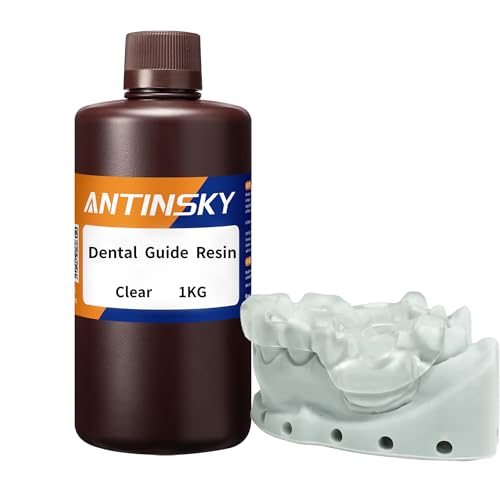
Antinsky Dental Guide Resin 1kg
Best for: High-temp sterilizable dental guides
- Curing Wavelength
- 405nm
- Compatible Technology
- DLP, LCD
- Net Weight
- 1kg
- Application
- Dental guide plate
- Shore Hardness
- 89D
- Features
- High Precision, Low Odor
View on Amazon: Antinsky Dental Guide Resin 1kg Affiliate link
Antinsky Dental Guide Resin is a 1kg UV-curing material for DLP and LCD printers. It targets dental guide plates with a 405nm curing wavelength. The resin offers high transparency and a Shore hardness of 89D. It withstands 120°C thermal deformation. This makes it suitable for high-temperature sterilization. You get low shrinkage for precise fit. It is designed for professional dental applications.
Pros
- High transparency for precise positioning
- Shore hardness reaches 89D
- Withstands 120°C sterilization
- Low shrinkage for dimensional stability
- Low odor after curing
Cons
- Limited to dental guide plate applications
- No mention of post-curing requirements
- Specific to 405nm wavelength only
Good fit if
- You need high-temperature resistant guides
- You use DLP or LCD printers
- You require high transparency for visibility
Skip if
- You need castable wax patterns
- You use different curing wavelengths
- You need general purpose resin
Verdict: Antinsky Dental Guide Resin 1kg provides high transparency and heat resistance for dental guides. You should buy it if you need sterilizable guides for DLP or LCD printers.

Antinsky Castable Dental Resin 1kg
Best for: precision dental restorations and castable patterns
- Resin Type
- Castable Dental
- Curing Wavelength
- 405nm
- Compatible Technology
- LCD, DLP
- Net Weight
- 1kg
- Application
- Crown, bridge and framework patterns
- Printing Technology
- Resin
View on Amazon: Antinsky Castable Dental Resin 1kg Affiliate link
This is a castable dental resin for DLP and LCD 3D printers using 405nm light. It offers ultra-low linear shrinkage of 0.85%–1.05% for high precision. The ash residue is under 0.5% after burnout. It has a low viscosity of 50–170 cps for easy printing. You get strong mechanical properties with Shore D 85–88 hardness. It fits dental restorations and crowns.
Pros
- Ultra-low linear shrinkage rate of 0.85%–1.05%
- Near-zero ash residue of less than 0.5%
- Low viscosity of 50–170 cps for fast curing
- Shore D 85–88 hardness for strong green models
Cons
- Limited to 395–405 nm curing wavelengths
- Requires specific exposure times of 2.5–3.5 seconds
- No mention of odor or ventilation requirements
Good fit if
- You need high precision for implant cases
- You require minimal ash residue for castings
- You use standard 405nm LCD or DLP printers
Skip if
- You print with 385nm or 450nm printers
- You need high flexibility or elastic parts
- You want a resin with no burnout residue
Verdict: Antinsky Castable Dental Resin 1kg delivers precise, low-shrinkage prints for dental professionals using 405nm printers. It is ideal for users who prioritize dimensional accuracy and clean burnout for restorations.
Specifications side by side
| Spec | Antinsky Dental Guide Resin 1kg | Antinsky Castable Dental Resin 1kg |
|---|---|---|
| Resin Type | not stated | Castable Dental |
| Curing Wavelength | 405nm | 405nm |
| Compatible Technology | DLP, LCD | LCD, DLP |
| Net Weight | 1kg | 1kg |
| Application | Dental guide plate | Crown, bridge and framework patterns |
| Shore Hardness | 89D | not stated |
| Printing Technology | LCD | Resin |
| Features | High Precision, Low Odor | Low Shrinkage |
| Model | Antinsky Dental Guide Resin | not stated |
Frequently asked questions
Is Antinsky Dental Guide Resin compatible with LCD printers?
Yes, this material is explicitly designed for LCD printing technology. It also works with DLP systems. Both Antinsky options share a 405nm curing wavelength, which is standard for most resin 3D printers. You can use either resin in your existing LCD setup without changing hardware.
Can I sterilize prints made with the Dental Guide Resin?
Yes, the Antinsky Dental Guide Resin supports high-temperature sterilization. This makes it suitable for creating reusable surgical guides that require hygienic safety. The castable variant is not described as heat-resistant for sterilization, so you should only use the guide resin for applications needing repeated cleaning.
Which resin is better for making dental crowns and bridges?
You should choose the Antinsky Castable Dental Resin for crowns and bridges. It is formulated for precision dental restorations and castable patterns. This material offers low shrinkage and clean burnout properties, which are essential for accurate metal casting. The guide resin lacks these specific castable attributes.
Do both Antinsky resins require a 405nm light source?
Yes, both materials require a 405nm curing wavelength. This specification is listed for both the Dental Guide Resin and the Castable Dental Resin. Ensure your printer uses UV LEDs or lasers emitting at this specific wavelength to achieve proper layer curing and dimensional accuracy.
Is the Dental Guide Resin transparent for better visibility?
Yes, the Antinsky Dental Guide Resin provides high transparency. This feature allows surgeons to observe positioning easily during procedures. Clear visibility helps in precise alignment. The castable resin is not described as transparent, so you should select the guide resin if visual confirmation of placement is critical.
What is the primary difference between these two 1kg resins?
The main difference is their end-use application. The Dental Guide Resin is optimized for high-temp sterilizable surgical guides. The Castable Dental Resin is designed for precision restorations and patterns that need burnout. Both are 1kg containers, but their chemical formulations target different dental workflows.
Can I use the Castable Resin for surgical guide plates?
It is not recommended for surgical guides. The Castable Dental Resin targets restorations and frames. The Dental Guide Resin is specifically designed for guide plates, offering drilling performance and sterilization resistance. Using the castable variant may compromise the hygiene and structural integrity required for surgical applications.