TINMORRY PETG-CF 1.75mm Filament Review (2026): A Spec-Based Look
As an Amazon Associate we earn from qualifying purchases. Links on this page are affiliate links.
This tinmorry petg cf carbon fiber petg review covers a 1.75mm filament designed for functional printing. It combines PETG with 15% short-cut carbon fiber to improve strength. The material supports high speeds up to 300 mm/s, making it faster than many competitors. It comes in a 1 KG spool, weighing 2.2 pounds total. The marble grey color offers a distinct look. You need a hardened steel nozzle to handle the abrasive fibers. This setup is ideal for users who need durable parts without excessive warping.
What stands out
- 15% short-cut carbon fiber masterbatch for enhanced torsional and tensile strength
- Maximum print speed of 300 mm/s, three to five times faster than standard options
- Compatible with major brands like Bambu Lab, Creality, and Prusa
- Requires hardened steel nozzles (≥ 0.4 mm) to prevent wear
- Low warping characteristics suitable for enclosed and open-frame printers
Who it fits
Good fit for
You should choose this filament if you print functional drone parts, racing models, or impact-resistant tools. It suits users with Bambu Lab, Creality K1C, or Prusa MK4 printers who want high-speed output. The low warping makes it safe for both enclosed and open setups. You will appreciate the improved Z-adhesion and durability. Ensure you have a hardened steel nozzle ready, as standard brass tips will wear down quickly when using this composite material.
Who should skip it
Skip this option if you only print decorative models or use standard brass nozzles. The abrasive carbon fibers will damage soft metal tips rapidly. You should also avoid this if you cannot maintain humidity below 20% or dry the filament at 65°C for eight hours before use. It is not ideal for beginners who lack protective gear for sanding or grinding, as carbon dust is hazardous. If you prefer easy maintenance over high strength, look for plain PETG instead.
Verdict: This filament delivers high strength and speed for functional prints. It requires specific hardware and handling but rewards you with durable, lightweight parts.
Key specs explained for you
Material Type: PETG-CF
This filament blends PETG with 15% short-cut carbon fiber. The composite structure reduces nozzle clogging and clumping compared to standard PETG. You get improved Z-adhesion and higher torsional strength. This makes it ideal for functional parts like drone components. The carbon fiber adds rigidity without significant weight gain, offering a durable alternative to plain plastic for engineering projects.
Max Print Speed: 300 mm/s
The listing supports high-speed printing up to 300 mm/s. This is three to five times faster than many other PETG-CF filaments. You can complete large functional prints in less time. This speed requires a capable printer, such as Bambu Lab or Creality models. It suits users who need rapid prototyping or high-volume production of durable parts without sacrificing structural integrity.
Filament Diameter: 1.75mm
The filament has a standard 1.75mm diameter. This is the most common size for FDM 3D printers. It ensures compatibility with most extruders and hotends. You do not need specialized hardware to use this material. Standard spools fit typical printer setups. This consistency helps maintain steady flow rates, which is critical for achieving the high print speeds and smooth surface finishes described in the specifications.
Net Weight: 1 KG
Each spool contains one kilogram of material. This is a standard unit for filament purchases. It provides enough material for multiple medium-sized functional prints. You can calculate usage based on part volume and infill density. This weight is manageable for storage and shipping. It allows you to test the material with a single spool before committing to larger bulk orders for extensive projects.
Design and build analysis
The TINMORRY PETG-CF filament is a composite material consisting of PETG and 15% professionally processed short-cut carbon fiber masterbatch. According to the listing, this formula improves printing quality by reducing nozzle clogging and clumping compared to traditional PETG. The inclusion of real carbon fibers requires you to use wear-resistant steel nozzles, typically 0.4 mm or larger, rather than conventional brass ones. You must also wear protective equipment when cutting or sanding printed parts, as carbon fiber dust is created during post-processing.
The product comes in a 1 KG spool, weighing 2.2 pounds according to the data. The packaging dimensions are listed as 8.27 inches in width, 2.76 inches in height, and 8.66 inches in length. The available color for this specific variation is Marble Grey. This compact spool size fits standard filament holders on most FDM printers. The material is designed for lightweight and durable applications, offering torsional, tensile, and impact strength suitable for drone parts and racing models.
You should store the filament in a sealed container with desiccant to keep humidity below 20% RH. Drying at 65 °C for 8 hours before use is recommended for the highest print quality. The design focuses on functional durability rather than aesthetic finish. The composite nature ensures that prints maintain structural integrity under stress, making it a practical choice for engineering tasks where strength-to-weight ratio matters most.
Setup and everyday use
Setting up this filament requires specific hardware adjustments. You must use a wear-resistant steel nozzle with a diameter of at least 0.4 mm, with 0.6 mm recommended. Conventional brass nozzles will degrade quickly due to the carbon fiber content. The listing advises drying the material at 65 °C for 8 hours before your first print to ensure quality. You should keep the filament in a sealed container with desiccant to maintain humidity below 20% relative humidity.
For printer settings, you need to adjust temperatures carefully. The recommended print temperature ranges from 240 °C to 270 °C. If you are using a Bambu P1P or X1 printer, keep the nozzle temperature above 260 °C. Set the build platform between 75 °C and 90 °C. For the first to third layers, turn off the cooling fan. To improve Z-adhesion, increase your infill density and reduce the fan percentage to prevent overcooling. Using an enclosed printer is also suggested for better results.
This material supports high-speed printing up to 300 mm/s, which is three to five times faster than many other PETG-CF filaments. It is compatible with major brands like Bambu Lab, Creality, QIDI, Flashforge, Prusa, VORON, and AnkerMake. The listing notes that warping is minimal, making it straightforward for drone parts or functional components. Always wear protective gear when cutting or sanding printed parts, as carbon fiber dust is generated during post-processing.
Preparation and Storage Tips
You need to prepare your workspace for this composite material. The listing warns that cutting, sanding, or grinding printed parts creates carbon fiber dust. You must wear protective equipment to avoid irritation. Storage is critical for maintaining print quality. You should dry the filament at 65 °C for eight hours before use. Keep it in a sealed container with desiccant to maintain humidity below 20%. You also need to verify printer compatibility. While it supports high speeds up to 300 mm/s, you should contact the manufacturer for profiles if your printer is not Bambu Lab, Creality, QIDI, FLASHFORGE, Prusa, VORON, or AnkerMake. This filament fits well in a setup focused on functional parts. It complements other tools by providing durable, lightweight components for drones or racing models. Ensure your enclosure is tight to help with Z-adhesion and reduce warping.
Check before you buy
- Use a hardened steel nozzle at least 0.4 mm wide.
- Dry filament at 65 °C for eight hours before printing.
- Store in a sealed container with desiccant below 20% humidity.
- Wear protective gear when post-processing printed parts.
- Confirm printer compatibility with the manufacturer if using non-listed brands.
The product at a glance
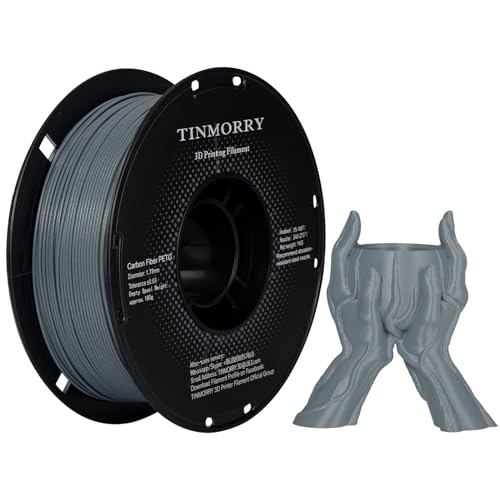
TINMORRY PETG-CF 1.75mm Filament
Best for: high-speed functional parts
- Material Type
- PETG-CF
- Filament Diameter
- 1.75mm
- Net Weight
- 1 KG
- Max Print Speed
- 300 mm/s
- Features
- High Speed, Carbon Fiber
- Dimensions
- 8.66 × 8.27 × 2.76 inches
View on Amazon: TINMORRY PETG-CF 1.75mm Filament Affiliate link
This is a 1.75mm PETG composite filament containing 15% short-cut carbon fiber. It supports high-speed printing up to 300 mm/s. The material offers improved Z-adhesion and reduced clogging compared to standard PETG. You need a hardened steel nozzle to handle the abrasive fibers. It is ideal for functional parts like drone components that require torsional and impact strength.
Pros
- Supports high-speed printing at 300 mm/s
- Contains 15% short-cut carbon fiber for strength
- Improved Z-adhesion over standard PETG
- Reduced nozzle clogging and clumping
Cons
- Requires hardened steel nozzle (brass will wear)
- Must dry filament before use for best quality
- Limited to 1 kg spool size in this listing
Good fit if
- You need high-speed printing capabilities
- You have a hardened steel nozzle installed
- You are printing functional drone or racing parts
Skip if
- You only use standard brass nozzles
- You cannot maintain humidity below 20% RH
- You prefer flexible TPU materials
Verdict: TINMORRY PETG-CF 1.75mm Marble Grey delivers high-speed performance and structural strength for users with hardened nozzles. It fits makers who prioritize print speed and functional durability over standard PETG flexibility.
Specifications side by side
| Spec | TINMORRY PETG-CF 1.75mm Filament |
|---|---|
| Material Type | PETG-CF |
| Filament Diameter | 1.75mm |
| Net Weight | 1 KG |
| Max Print Speed | 300 mm/s |
| Compatible Material | PETG |
| Features | High Speed, Carbon Fiber |
| Dimensions | 8.66 × 8.27 × 2.76 inches |
| Weight | 2.2 pounds |
| Size | PETG-CF |
| Color | Petg-cf-marble Grey |
| Model | PETGCF-Grey |
Frequently asked questions
What is the best nozzle material for printing this filament?
You must use a hardened steel nozzle. The 15% carbon fiber content will rapidly wear down standard brass nozzles. A diameter of at least 0.4 mm is required, with 0.6 mm being the recommended size for optimal performance and reduced clogging.
How fast can you print with TINMORRY PETG-CF?
This filament supports high-speed printing up to 300 mm/s. This speed allows for faster production of functional parts compared to many standard PETG options. It is designed for users who need to balance speed with structural integrity in their prints.
Is this filament suitable for functional parts?
Yes, it is ideal for high-speed functional parts. The carbon fiber composite provides higher torsional strength and improved Z-adhesion. This makes the printed objects more durable and structurally sound for practical applications rather than just decorative models.
What safety precautions are needed when post-processing prints?
You must wear protective equipment when cutting, sanding, or grinding printed parts. The process creates carbon fiber dust that can cause irritation. Proper ventilation and personal protective gear are essential to handle the composite material safely after printing is complete.
How does this compare to standard PETG in terms of strength?
It offers higher torsional strength and better Z-adhesion than standard PETG. The 15% short-cut carbon fiber reinforcement enhances the structural integrity. This makes it a better choice for parts that need to withstand mechanical stress or functional loads.
What color options are available for this specific model?
The listed model is available in Marble Grey. The specific product code is PETGCF-Grey. This color provides a distinct aesthetic while maintaining the functional properties of the carbon fiber composite material within the filament spool.