What Is Structure? A Guide for 3d Printers Buyers (2026)
As an Amazon Associate we earn from qualifying purchases. Links on this page are affiliate links.
CoreXY 3D Printer Structure Explained
When you look at 3D printer specifications, you will often see the term CoreXY listed under kinematics or frame design. This refers to a specific type of belt-driven movement system. Understanding this helps you predict how a machine will perform during long print jobs.
The CoreXY system uses two stepper motors to control movement in both the X and Y axes. Unlike traditional Cartesian printers that use one motor per axis, this design routes belts through a complex loop. The motors remain stationary on the frame, while the print head moves. This reduces the moving mass significantly.
You will find this labeled as CoreXY, H-Bot, or Delta on product pages. These terms describe the belt path geometry. CoreXY is the most common variant for high-speed printers. It allows for rapid acceleration and deceleration without sacrificing accuracy.
Buyers care about this because it directly impacts print speed and quality. Lighter moving parts mean the printer can change direction quickly. This results in smoother corners and less ringing on vertical edges. The stationary motors also keep the center of gravity low. This adds stability during high-speed operations.
The structure explained in this way shows why modern printers favor this design. It balances speed with precision. If you plan to print detailed miniatures or large functional parts, a CoreXY kinematic is a strong choice. It handles complex toolpaths efficiently.
Check the product specs for motor placement. If the motors are mounted on the frame and not on the moving carriage, it is likely a CoreXY or similar belt system. This setup requires precise belt tensioning. Look for models that mention auto-tensioning or idler adjustments. These features maintain performance over time.
Avoid systems with direct drive motors on the moving head if you want maximum speed. The added weight can limit acceleration. CoreXY solves this by keeping heavy components off the print head. This is a key advantage for serious makers who need reliability and speed.
CoreXY Structure Options
CoreXY
CoreXY is a belt-driven kinematic system where the X and Y axes share stepper motors. This design moves the motors to the frame base, reducing the mass of the moving printhead. Lower moving mass allows for higher acceleration and print speeds without sacrificing layer stability. You benefit from faster cycle times and sharper corners. The trade-off involves complex belt routing that requires precise tensioning. This structure suits users who prioritize speed and precision over simple mechanical setups. For example, the ELEGOO Centauri Carbon uses this architecture to achieve 500mm/s speeds in a compact form. It is ideal for detailed parts where rapid movement is critical.
CoreXY
This kinematic layout offers high-speed performance by decoupling motor weight from the print head. The Flashforge Adventurer 5M series demonstrates this with 600mm/s speeds. Users gain rapid output for single-material prints. The system relies on direct drive extruders for reliable filament pushing. Auto-leveling features often accompany this structure to ensure first-layer adhesion during fast moves. This setup fits small desktop users needing quick results. It sacrifices multi-toolhead flexibility for ease of use and speed. The compact footprint makes it suitable for limited workspace environments. You get consistent quality at high speeds without the complexity of dual extruders.
CoreXY
Industrial multi-material printing benefits from this robust belt system. The Flashforge Creator 5 Pro utilizes CoreXY kinematics to support four toolheads. This allows for engineering plastics and rapid material switching. The heated chamber works with the frame to manage thermal stability. Users prioritizing multi-color efficiency and material versatility choose this option. The trade-off is increased weight and size. At 39 pounds, it is heavier than standard models. This structure suits makers who need industrial stability and complex material workflows. It delivers precision even with multiple extruders moving simultaneously.
CoreXY
The Flashforge Adventurer 5M in white offers the same CoreXY benefits in a different color. It provides 600mm/s print speeds with auto-leveling. This model suits users who value quick setup and fast output. It is designed for small workspaces that do not require large build volumes. The direct drive extruder ensures reliable feeding. You get high-speed single-material printing without multi-toolhead complexity. This option is ideal for desktop users needing speed and ease. The compact dimensions fit easily on standard desks. It delivers consistent results for everyday printing tasks.
CoreXY
This black version of the Adventurer 5M delivers high-speed CoreXY printing. Automated leveling and quick nozzle changes are key features. It fits users who prioritize speed and ease over multi-material capabilities. The 600mm/s speed ensures rapid production of single-color parts. The direct drive extruder supports reliable filament handling. This structure is perfect for makers who want fast results without complex setups. The compact size makes it suitable for home offices. You get high performance in a user-friendly package. It is a practical choice for general-purpose printing.
CoreXY
The Flashforge Creator 5 Multi-Toolhead uses CoreXY kinematics for rapid multi-color printing. It is designed for efficient workflows with reduced filament waste. Users who prioritize rapid tool changes choose this option. The 600mm/s speed ensures fast production times. This structure supports multiple extruders moving in sync. It is ideal for complex projects requiring multiple colors. The trade-off is a larger footprint and higher weight. At 30.9 pounds, it is substantial. This option suits makers who need multi-material flexibility and high speed.
CoreXY Is Worth It
Who needs it
You should prioritize CoreXY if you plan to print at high speeds or handle large volumes. This kinematic system moves stepper motors from the print head to the base frame. That design significantly reduces the mass of the moving parts. Lower moving mass allows for much higher acceleration and faster print speeds without sacrificing accuracy. If you value rapid production cycles or frequently run long, complex prints, this structure is essential. It minimizes vibration and ringing artifacts that often plague other designs at high speeds. You will notice a tangible difference in print quality when pushing the limits of your machine. For hobbyists who want professional-grade speed and precision, CoreXY is the clear choice. It supports consistent results over time, making it ideal for serious makers who need reliability and performance in every layer.
Who can skip it
You can ignore CoreXY if you primarily print small, detailed models at slow speeds. Beginners often find simpler Cartesian printers easier to understand and maintain. Those machines often have a more straightforward belt setup. If your main goal is learning the basics of slicing and calibration, a simpler structure reduces initial complexity. You might also skip CoreXY if you have limited workspace or budget for a larger frame. CoreXY systems often require more physical space due to their belt routing. Instead, prioritize ease of use, compact footprint, or specific material compatibility. Focus on build volume and bed adhesion features first. These factors matter more for casual printing than kinematic structure. You do not need high acceleration for small, static objects. Choose a printer that matches your actual workflow, not theoretical speed limits.
CoreXY Glossary Terms
Kinematics
The study of motion in the printer frame. It defines how axes move relative to each other. CoreXY uses a specific belt arrangement to drive the X and Y axes simultaneously.
Belt-driven system
A movement method using toothed belts and pulleys. This replaces lead screws or rods. It allows for faster acceleration and higher print speeds by reducing friction and mechanical resistance.
Stepper motors
Electric motors that move in precise discrete steps. In CoreXY, these are mounted on the frame base. This reduces the weight of the moving print head significantly.
Moving mass
The total weight of parts that accelerate during printing. Lower moving mass allows for higher acceleration rates. This reduces vibration and improves print quality at faster speeds.
Acceleration
The rate at which the print head changes speed. CoreXY designs enable higher acceleration values. This allows the printer to reach target speeds quickly without losing positional accuracy.
Print head
The assembly holding the extruder and nozzle. In CoreXY, this unit is lighter because motors are fixed to the frame. A lighter head responds faster to movement commands.
Frame base
The stationary bottom part of the printer structure. CoreXY mounts stepper motors here. This keeps heavy components static, ensuring the moving parts remain light and agile.
Print speed
How fast the nozzle travels across the build plate. Higher speeds are possible with low moving mass. This reduces total print time while maintaining layer adhesion and detail.
Quick picks
| # | Product | Best for | Price |
|---|---|---|---|
| 1 | ELEGOO Centauri Carbon CoreXY 3D Printer | High-speed printing of small, detailed parts | Check price of ELEGOO Centauri Carbon CoreXY 3D Printer on Amazon |
| 2 | FLASHFORGE Adventurer 5M CoreXY 3D Printer | High-speed single-material printing | Check price of FLASHFORGE Adventurer 5M CoreXY 3D Printer on Amazon |
| 3 | FLASHFORGE Creator 5 Pro 4-Toolhead 3D Printer | Industrial multi-material printing | Check price of FLASHFORGE Creator 5 Pro 4-Toolhead 3D Printer on Amazon |
| 4 | Flashforge Adventurer 5M CoreXY Printer | Small desktop users needing speed | Check price of Flashforge Adventurer 5M CoreXY Printer on Amazon |
| 5 | Flashforge Adventurer 5M CoreXY 3D Printer | High-speed single-material CoreXY printing | Check price of Flashforge Adventurer 5M CoreXY 3D Printer on Amazon |
| 6 | Flashforge Creator 5 Multi-Toolhead 3D Printer | rapid multi-color printing workflows | Check price of Flashforge Creator 5 Multi-Toolhead 3D Printer on Amazon |
Our 6 picks
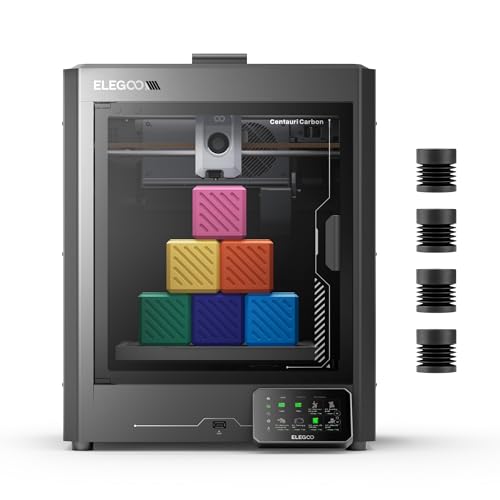
ELEGOO Centauri Carbon CoreXY 3D Printer
Best for: High-speed printing of small, detailed parts
- Structure
- CoreXY (what this guide is about)
- Build Volume
- 256x256x256 mm
- Print Speed
- 500 mm/s
- Leveling Type
- Auto bed leveling
- Motion Structure
- CoreXY
- Extruder Type
- Brass-hardened steel nozzle
View on Amazon: ELEGOO Centauri Carbon CoreXY 3D Printer Affiliate link
The ELEGOO Centauri Carbon is a CoreXY 3D printer with a 256x256x256 mm build volume. It reaches 500 mm/s print speeds and 20,000 mm/s² acceleration. The machine includes a 320°C nozzle for advanced materials. It arrives fully assembled with auto bed leveling. This setup suits users who need high speed and precision in a compact frame.
Pros
- CoreXY motion structure for stable high-speed printing
- 500 mm/s maximum print speed
- 320°C nozzle handles advanced filaments
- Fully assembled and pre-calibrated out of the box
Cons
- 256 mm build volume is small for large parts
- 38.6 pounds weight adds bulk to your workspace
- No mention of Wi-Fi or app control in specs
Good fit if
- You want a ready-to-print machine without assembly
- You need high speed for detailed prototypes
- You print with carbon fiber reinforced materials
Skip if
- You require a large build volume for big items
- You need remote monitoring via a mobile app
- You prefer a lightweight desktop printer
Verdict: ELEGOO Centauri Carbon 3D Printer delivers high-speed CoreXY performance in a compact, pre-assembled package. It fits makers who prioritize print speed and material versatility over large build sizes.

FLASHFORGE Adventurer 5M CoreXY 3D Printer
Best for: High-speed single-material printing
- Structure
- CoreXY (what this guide is about)
- Build Volume
- 220x220x220mm
- Print Speed
- Max 600mm/s
- Leveling Type
- Fully Auto Leveling
- Motion Structure
- CoreXY
- Extruder Type
- 280°C Direct Extruder
View on Amazon: FLASHFORGE Adventurer 5M CoreXY 3D Printer Affiliate link
The Flashforge Adventurer 5M is a CoreXY 3D printer built for speed and automation. It features a max print speed of 600mm/s and 20000mm/s² acceleration for rapid prototyping. The 220x220x220mm build volume fits standard projects. Fully automatic leveling and a 280°C direct extruder ensure consistent quality. This machine suits users who want high-speed output without manual calibration adjustments.
Pros
- CoreXY structure with 600mm/s travel speed
- 20000mm/s² acceleration for fast production
- Fully automatic bed leveling system
- 280°C direct drive extruder
- Real-time monitoring via Flash Studio app
Cons
- Smaller 220x220x220mm build volume
- No multi-toolhead capability
- Single nozzle configuration
Good fit if
- You need high-speed prototyping
- You want automated leveling
- You print standard-sized parts
Skip if
- You require large format printing
- You need multi-material printing
- You prefer manual calibration
Verdict: The Flashforge Adventurer 5M CoreXY delivers high-speed printing with full automation. It is the right choice for users who prioritize speed and ease of use over large build volumes or multi-toolhead flexibility.

FLASHFORGE Creator 5 Pro 4-Toolhead 3D Printer
Best for: Industrial multi-material printing
- Structure
- CoreXY (what this guide is about)
- Print Speed
- 600mm/s
- Multicolor Capacity
- 4 independent toolheads
- Motion Structure
- CoreXY
- Chamber Heating
- 65°C
- Features
- Heated Chamber
View on Amazon: FLASHFORGE Creator 5 Pro 4-Toolhead 3D Printer Affiliate link
The FLASHFORGE Creator 5 Pro is a CoreXY printer with a 65°C heated chamber and 600mm/s print speed. It features four independent toolheads with a 7-second FlashSwap changer for multi-color printing. The enclosed frame supports advanced materials like ABS and PC. You get automated calibration and real-time monitoring via an HD camera. This unit suits users needing industrial-grade stability and multi-material versatility.
Pros
- CoreXY motion structure for high-speed accuracy
- 4 independent toolheads with 7-second FlashSwap
- 65°C active heated chamber for engineering filaments
- Dual HEPA 13 and activated carbon filtration
Cons
- Large footprint at 14x16x18 inches
- Heavy at 39 pounds
- No mention of built-in touchscreen display
Good fit if
- You need to print advanced materials like ABS or PC
- You want to switch colors without filament flushing
- You require a fully enclosed printing environment
Skip if
- You have limited desk space
- You only print PLA and PETG
- You prefer a lightweight portable unit
Verdict: The FLASHFORGE Creator 5 Pro 4-Toolhead delivers industrial stability and multi-color efficiency. It is the right choice for makers who need to print engineering plastics and switch materials rapidly.

Flashforge Adventurer 5M CoreXY Printer
Best for: Small desktop users needing speed
- Structure
- CoreXY (what this guide is about)
- Build Volume
- 220x220x220mm
- Print Speed
- 600mm/s
- Leveling Type
- 1-Click Auto Leveling
- Motion Structure
- CoreXY
- Extruder Type
- Direct Drive Extruder
View on Amazon: Flashforge Adventurer 5M CoreXY Printer Affiliate link
The Flashforge Adventurer 5M is a CoreXY printer with a 220x220x220mm build volume. It reaches speeds of 600mm/s and accelerates at 20000 mm/s². The unit includes 1-click auto leveling and a direct drive extruder. It weighs 23.8 pounds and measures 17.3 inches on each side. You get a white finish and a removable PEI plate. This model suits users who want fast prints without manual Z-axis calibration.
Pros
- CoreXY motion structure for high speed
- Max print speed of 600mm/s
- 1-click auto leveling system
- Direct drive extruder type
- 220x220x220mm build volume
Cons
- Smaller 220mm build volume
- No enclosed chamber
- Direct drive extruder limits flexible filament
Good fit if
- You need fast printing speeds
- You want automatic bed leveling
- You prefer a compact desktop size
Skip if
- You require large format prints
- You need an enclosed chamber
- You want a belt-free frame
Verdict: The Flashforge Adventurer 5M CoreXY delivers high speed with 600mm/s and auto leveling for users who value quick setup and fast output. It fits small workspace users who do not need large build volumes.

Flashforge Adventurer 5M CoreXY 3D Printer
Best for: High-speed single-material CoreXY printing
- Structure
- CoreXY (what this guide is about)
- Print Speed
- Max 600mm/s
- Leveling Type
- Fully auto leveling system
- Motion Structure
- CoreXY
- Extruder Type
- 280℃ Quick-Detach Nozzle
- Features
- High Speed
View on Amazon: Flashforge Adventurer 5M CoreXY 3D Printer Affiliate link
The Flashforge Adventurer 5M uses a CoreXY motion structure to reach a maximum print speed of 600mm/s. It features a fully automatic leveling system that removes manual Z-axis calibration. The quick-detach nozzle allows tool-free changes in three seconds. This printer suits users who want high-speed printing with automated setup and easy maintenance.
Pros
- CoreXY motion structure for stable high-speed printing
- Maximum print speed of 600mm/s
- Fully automatic one-click leveling system
- Tool-free quick-detach nozzle changes in 3 seconds
Cons
- Single toolhead limits multi-material printing
- Standard 280°C nozzle temperature restricts high-temp materials
- No mention of enclosed chamber for temperature stability
Good fit if
- You want fast prints with automated leveling
- You need easy nozzle maintenance without tools
- You prefer CoreXY stability for high speeds
Skip if
- You require multi-toolhead material switching
- You need to print high-temperature engineering plastics
- You want an enclosed chamber for temperature control
Verdict: The Flashforge Adventurer 5M CoreXY delivers high-speed CoreXY printing with automated leveling and quick nozzle changes. It fits users who prioritize speed and ease of use over multi-material capabilities.
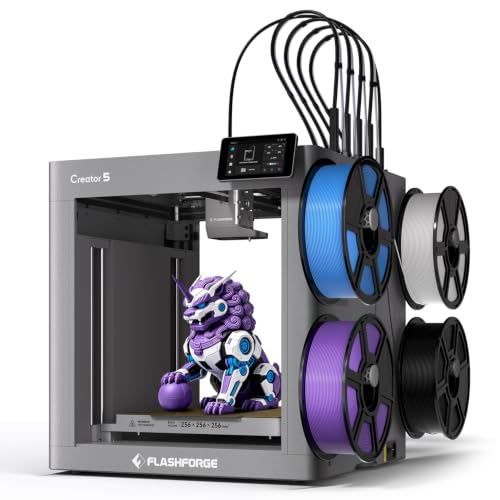
Flashforge Creator 5 Multi-Toolhead 3D Printer
Best for: rapid multi-color printing workflows
- Structure
- CoreXY (what this guide is about)
- Print Speed
- 600mm/s
- Multicolor Capacity
- four toolheads
- Leveling Type
- Auto Bed Leveling
- Motion Structure
- CoreXY
- Color
- Grey
View on Amazon: Flashforge Creator 5 Multi-Toolhead 3D Printer Affiliate link
The Flashforge Creator 5 uses a CoreXY motion structure to reach 600mm/s print speeds. It features a 7-second tool swapping system that keeps four toolheads loaded and preheated. This design minimizes filament waste during color changes. The printer includes auto bed leveling and vibration cancellation to maintain quality at high speeds. It suits makers who need rapid multi-material workflows without long changeover times.
Pros
- CoreXY structure enables 600mm/s print speeds
- 7-second toolhead swapping system
- Four toolheads stay loaded and preheated
- Auto bed leveling system
- Intelligent vibration cancellation for smooth finishes
Cons
- Heavier build at 30.9 pounds
- Larger footprint than single-head models
- Limited to four active toolheads
Good fit if
- You need rapid multi-color printing
- You want to minimize filament waste
- You require high-speed CoreXY motion
Skip if
- You prefer a compact desktop size
- You only print single-material parts
- You need more than four toolheads
Verdict: Flashforge Creator 5 Multi-Toolhead is a high-speed CoreXY printer designed for efficient multi-material workflows. It fits users who prioritize rapid tool changes and reduced filament waste over a compact footprint.
Specifications side by side
| Spec | ELEGOO Centauri Carbon CoreXY 3D Printer | FLASHFORGE Adventurer 5M CoreXY 3D Printer | FLASHFORGE Creator 5 Pro 4-Toolhead 3D Printer | Flashforge Adventurer 5M CoreXY Printer | Flashforge Adventurer 5M CoreXY 3D Printer | Flashforge Creator 5 Multi-Toolhead 3D Printer |
|---|---|---|---|---|---|---|
| Build Volume | 256x256x256 mm | 220x220x220mm | not stated | 220x220x220mm | not stated | not stated |
| Print Speed | 500 mm/s | Max 600mm/s | 600mm/s | 600mm/s | Max 600mm/s | 600mm/s |
| Multicolor Capacity | not stated | not stated | 4 independent toolheads | not stated | not stated | four toolheads |
| Leveling Type | Auto bed leveling | Fully Auto Leveling | not stated | 1-Click Auto Leveling | Fully auto leveling system | Auto Bed Leveling |
| Motion Structure | CoreXY | CoreXY | CoreXY | CoreXY | CoreXY | CoreXY |
| Extruder Type | Brass-hardened steel nozzle | 280°C Direct Extruder | not stated | Direct Drive Extruder | 280℃ Quick-Detach Nozzle | not stated |
| Chamber Heating | not stated | not stated | 65°C | not stated | not stated | not stated |
| Structure | CoreXY | CoreXY | CoreXY | CoreXY | CoreXY | CoreXY |
| Leveling | not stated | Auto Leveling | not stated | Auto Leveling | Auto Leveling | not stated |
| Features | High Speed, Built-in Camera | High Speed | Heated Chamber | High Speed | High Speed | not stated |
| Color | Black | Black | not stated | White | Black | Grey |
| Dimensions | 15.7 × 15.9 × 19.3 inches | 15.8 × 14.3 × 17.6 inches | 16 × 14 × 18 inches | 17.3 × 17.3 × 18.9 inches | 14.3 × 15.8 × 19.2 inches | 14.8 × 14.3 × 16.3 inches |
| Weight | 38.6 pounds | 22 pounds | 39 pounds | 23.8 pounds | 29.1 pounds | 30.9 pounds |
| Size | Centauri Carbon | not stated | not stated | not stated | Adventurer 5M | 436×432×480mm |
| Model | Centauri Carbon | Adventurer 5M | not stated | Adventurer 5M | not stated | not stated |
Frequently asked questions
Is CoreXY better than Cartesian for speed?
Yes, CoreXY is generally faster. This structure moves stepper motors to the base frame rather than the print head. Reduced moving mass allows for higher acceleration and print speeds. The ELEGOO Centauri Carbon and Flashforge Adventurer 5M both utilize this design to achieve speeds up to 600mm/s.
Does CoreXY require more maintenance than other structures?
CoreXY systems use a complex belt routing that requires periodic tensioning. You must check belt tightness to maintain print quality. However, the motors are stationary, which reduces wear on moving parts. Regular inspection of the belt path ensures consistent performance over time.
Can CoreXY printers handle large build volumes?
CoreXY kinematics scale well to larger sizes. The design supports stable movement across wide areas. The Flashforge Creator 5 Pro offers a substantial build volume for industrial multi-material printing. This structure provides the rigidity needed for larger prints without sacrificing precision.
Is CoreXY suitable for engineering plastics like ABS?
Yes, CoreXY printers can handle engineering plastics. The Flashforge Creator 5 Pro includes a heated chamber, which is critical for materials prone to warping. The stable movement of CoreXY helps maintain layer adhesion. This makes it a strong choice for printing ABS or PC.
How does CoreXY differ from i3 structure?
i3 structures have a moving Z-axis carriage, while CoreXY keeps the bed stationary in Z. CoreXY moves the X and Y axes via the printhead. This reduces inertia significantly. The ELEGOO Centauri Carbon uses this to deliver high-speed performance in a compact package.
Do CoreXY printers need auto-leveling?
Auto-leveling is not inherent to CoreXY but is common in modern models. The Flashforge Adventurer 5M includes auto-leveling for easier setup. This feature compensates for minor frame inconsistencies. It ensures a consistent first layer, which is vital for high-speed printing accuracy.
Is CoreXY noisy during operation?
CoreXY printers can be loud due to high acceleration. The rapid movement of the printhead generates noise. The ELEGOO Centauri Carbon and Flashforge models are designed for speed, which increases acoustic output. Some users may find the noise level higher than slower, belt-driven alternatives.