R QIDI Technology QIDI Q2 Combo 3D Printer Review: Specs, Pros and Cons
As an Amazon Associate we earn from qualifying purchases. Links on this page are affiliate links.
This r qidi technology qidi q2 combo 3d printer review focuses on a machine built for complex, multi-material workflows. It features a heated chamber that reaches 65℃ and a nozzle capable of 370℃. These specifications allow you to print advanced polymers like ABS, PC, and carbon-fiber composites with reduced warping. The system supports up to 16-color printing via dry-while-print technology, which keeps filaments stable during use. With a CoreXY motion structure and speeds up to 600mm/s, it aims to deliver high-quality results. You get a full-metal design with linear rails for precision. This overview breaks down how these specs translate to your printing tasks.
What stands out
- Supports up to 16-color multi-material printing with dry-while-print technology
- 65℃ heated chamber minimizes warping for engineering materials
- 370℃ high-temp nozzle handles advanced filaments like PC and carbon fiber
- CoreXY structure with linear rails achieves speeds up to 600mm/s
- Hardened steel dual-gear extruder ensures stable extrusion for abrasive materials
Who it fits
Good fit for
You should consider this printer if you need to print engineering-grade materials such as ABS, PETG, or carbon-fiber composites. The heated chamber is essential for preventing warping in these plastics. The multi-color capability suits users who want vibrant models without manual filament swaps. It also fits those who value speed, with CoreXY mechanics reaching 600mm/s. If you require a system that handles abrasive filaments reliably, the hardened steel extruder and dry-while-print feature provide the necessary stability for continuous production.
Who should skip it
You might look elsewhere if you primarily print basic PLA at home. The 65℃ chamber and high-temp nozzle are overkill for simple prototypes. The complexity of managing up to 16 colors and maintaining dry filaments adds setup time. If you prefer a compact desktop unit, the 20x21x23-inch footprint is large. Users who do not need advanced material handling or multi-color output may find the features unnecessary and the operation more involved than a standard single-extruder machine.
Verdict: The QIDI Q2 Combo is a robust solution for users requiring multi-color output and advanced material compatibility. Its heated chamber and high-speed CoreXY design make it suitable for professional-grade prototypes.
Key specs explained for Q2 Combo
Print Speed: Up to 600mm/s
This maximum speed allows the printer to move the extruder head very quickly across the build plate. You benefit from faster completion times for standard prints, though you may need to lower the speed for high-detail or fragile parts. When comparing 3D printers, this figure indicates how rapidly the machine can cover large areas, which is useful for prototyping or producing multiple items in a short window.
Extruder Type: Hardened steel dual-gear
The extruder uses two gears made of hardened steel to grip and push filament into the nozzle. This design provides strong traction, preventing slippage when printing abrasive materials like carbon fiber or glass-filled composites. You get more reliable feeding and consistent layer heights with tough filaments. This feature distinguishes the printer from models with standard plastic or soft metal extruders that may wear out quickly.
Leveling Type: Auto-leveling
The printer automatically adjusts the distance between the nozzle and the build plate before each print. You save time on setup and reduce the risk of failed prints caused by uneven beds. This feature ensures the first layer adheres properly without manual intervention. When shopping, auto-leveling is a practical convenience that simplifies the printing process for users who want consistent results without tedious manual calibration steps.
Chamber Heating: 65℃
The enclosed print area can be heated to 65℃ to maintain a stable temperature around the model. This reduces thermal gradients, which minimizes warping and cracking in materials like ABS, PC, or nylon. You achieve better layer adhesion and stronger mechanical properties. This spec is essential for engineering-grade filaments that cool too quickly in ambient air, allowing you to print larger, more complex parts with fewer failures.
Motion Structure: CoreXY
CoreXY is a belt-driven motion system that moves the print head in two dimensions while keeping the motors stationary on the frame. This design reduces moving mass, allowing for faster acceleration and smoother movements. You experience less vibration and higher precision at speed. When comparing printers, CoreXY structures are often preferred for high-speed performance and consistent quality over gantry-style systems with heavier moving heads.
Design and build analysis
The listing describes a full-metal CoreXY structure paired with precision linear rails. This mechanical layout directs motion along fixed axes, which helps maintain accuracy at high speeds. You get a print speed of up to 600mm/s, meaning the extruder head moves rapidly across the build plate. The design includes an upgraded 1.5GT synchronous belt to reduce vibration artifacts, aiming for smoother surface finishes during these fast movements.
Regarding physical dimensions, the Q2 Combo measures 20 inches in width, 21 inches in length, and 23 inches in height. These measurements indicate a substantial footprint for your workspace. The machine is finished in silver. The enclosed chamber is built from flame-retardant materials and features a triple filtration system, including a G3 pre-filter, H12 HEPA filter, and activated carbon. According to the listing, this setup effectively reduces odors and harmful particles, allowing for safer indoor operation.
The control and maintenance aspects are integrated into the hardware. A hardened steel dual-gear extruder ensures durable performance, particularly with abrasive materials like carbon fiber composites. The system includes an automatic filament reloading mechanism and an NFC reader for smart filament recognition. You also have access to an AI camera for monitoring and sensors for filament run-out detection. The nozzle doubles as the leveling sensor, simplifying the initial setup process by eliminating the need for separate hardware adjustments.
Setup and everyday use
Setting up the QIDI Q2 Combo involves connecting the unit to power and loading your chosen filaments. The printer includes an automatic filament reloading system, which reduces the need for manual intervention during long jobs. You benefit from NFC technology that recognizes QIDI Filament tags. This feature automatically applies the correct printing settings, simplifying the initial configuration process. The nozzle doubles as a leveling sensor. This design choice means you do not need separate hardware for first-layer calibration. The system delivers plug-and-play functionality, ensuring accurate bed leveling without complex manual adjustments. Daily use centers on the QIDI BOX dry-while-print system. This integrated 65℃ drying system keeps filaments dry during the printing process. Stable extrusion and smooth surfaces result from maintaining optimal filament conditions. The hardened steel dual-gear extruder provides durable performance when using challenging materials like carbon fiber composites. You can print up to 16 colors by utilizing the multi-material capabilities. The printer supports a wide range of polymers, including PLA, ABS, PETG, TPU, PA, and PC. Safety features include a triple filtration system with G3 pre-filter, H12 HEPA, and activated carbon. This setup effectively reduces odors and harmful particles for indoor use. Real-time monitoring and automatic power cutoff provide essential protection. AI camera monitoring and filament run-out detection ensure reliable operation. If power is lost, the printer recovers automatically. The 2nd-generation PTC heated chamber minimizes warping and ensures strong layer adhesion. Upgraded 1.5GT synchronous belts reduce vibration artifacts, delivering ultra-smooth surfaces. These specifications combine to create a workflow that prioritizes precision and stability for complex projects.
Before You Buy QIDI Q2 Combo
Owning the QIDI QIDI Q2 Combo requires planning for its multi-material workflow. You will need to ensure your workspace has adequate ventilation, as the triple filtration system manages odors but does not eliminate them entirely. The heated chamber and high-temperature nozzle support advanced materials like PC and carbon-fiber composites, so verify that your existing slicer software handles these profiles correctly. Upkeep involves maintaining the dry-while-print environment; the built-in drying system helps, but you must keep the filament dry to prevent extrusion issues. Regularly check the hardened steel dual-gear extruder for wear, especially if using abrasive fibers. This printer fits into a professional or serious hobbyist setup rather than a casual starter kit. It complements simpler machines by handling complex, multi-color jobs that standard printers cannot. You should also consider the physical footprint, as the unit measures 20 by 21 by 23 inches, requiring a dedicated bench space separate from lighter, smaller models.
Check before you buy
- Verify slicer software supports multi-color profiles for up to 16 colors.
- Ensure your workspace has enough room for the 20x21x23 inch footprint.
- Confirm your filament storage stays dry to complement the drying system.
- Check if your current power setup handles the heated chamber load.
The product at a glance
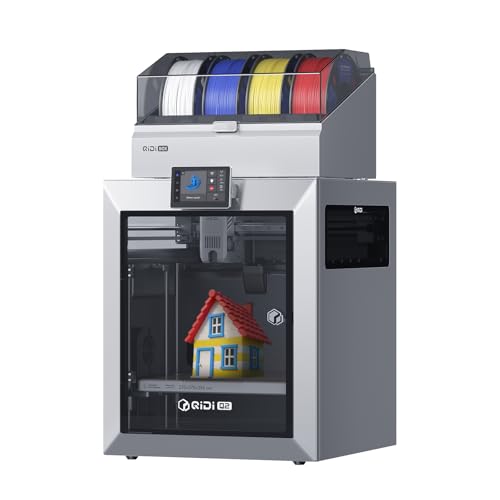
QIDI Q2 Combo 3D Printer
Best for: multi-color and engineering material printing
- Build Volume
- 270x270x256mm
- Print Speed
- 600mm/s
- Multicolor Capacity
- Up to 16-color
- Leveling Type
- Full auto leveling
- Motion Structure
- CoreXY
- Extruder Type
- Hardened steel dual-gear
View on Amazon: QIDI Q2 Combo 3D Printer Affiliate link
The QIDI Q2 Combo is a CoreXY 3D printer featuring a 65℃ heated chamber and a 370℃ nozzle. It supports up to 16-color printing via dry-while-print technology and reaches speeds of 600mm/s. This model suits users who need multi-material flexibility and want to print advanced polymers like PC or carbon-fiber composites with stable extrusion.
Pros
- Supports up to 16-color multi-material printing
- 65℃ heated chamber reduces warping
- 370℃ nozzle handles high-temp materials
- Print speeds up to 600mm/s
- Hardened steel dual-gear extruder
Cons
- Large footprint at 20x21x23 inches
- No mention of mobile app control
- No mention of built-in touchscreen
Good fit if
- You need multi-color prints without manual swapping
- You print engineering materials like PC or carbon fiber
- You want a heated chamber for large parts
Skip if
- You have limited desk space for a 20-inch width
- You only print basic PLA at low speeds
- You require a compact desktop footprint
Verdict: QIDI Q2 Combo Multi-Color 3D Printer delivers high-speed, multi-material capability for users who need advanced material handling and color variety in a single build.
Specifications side by side
| Spec | QIDI Q2 Combo 3D Printer |
|---|---|
| Build Volume | 270x270x256mm |
| Print Speed | 600mm/s |
| Multicolor Capacity | Up to 16-color |
| Leveling Type | Full auto leveling |
| Motion Structure | CoreXY |
| Extruder Type | Hardened steel dual-gear |
| Chamber Heating | 65℃ |
| Color Printing | Multi-Color |
| Leveling | Auto Leveling |
| Features | High Speed, Built-in Camera, Heated Chamber |
| Dimensions | 21 × 20 × 23 inches |
| Size | Q2 Combo |
| Color | silver |
Frequently asked questions
Is the QIDI Q2 Combo suitable for engineering materials?
Yes, it is designed for advanced polymers like ABS and PC. The heated chamber reaches 65℃ and the nozzle hits 370℃. These specs allow you to print high-temperature materials without warping. This makes it ideal for users needing strong, durable parts for professional or industrial applications.
What is the maximum print speed of this printer?
The QIDI Q2 Combo supports speeds up to 600mm/s. This high velocity allows the extruder head to move quickly across the build plate. You benefit from faster completion times for standard prints. However, you may need to lower speeds for complex geometries to maintain quality.
Does the printer support multi-color printing?
Yes, the QIDI Q2 Combo features multi-color capabilities. It is built for users who need color variety in a single build. The system handles multiple filaments simultaneously. This allows you to create complex, vibrant objects without switching materials manually during the printing process.
How does the automatic filament reloading work?
The printer includes an automatic filament reloading system. This feature reduces the need for manual intervention during long jobs. You can continue printing even if a filament spool runs out. The system manages the transition seamlessly, ensuring uninterrupted production for extended print sessions.
What are the physical dimensions of the Q2 Combo?
The unit measures 20 inches in width, 23 inches in height, and 21 inches in length. It has a silver finish. These dimensions indicate a substantial footprint. You should ensure your workspace has adequate room to accommodate the full-metal CoreXY structure and its associated components.
Is NFC technology included for filament recognition?
Yes, the printer uses NFC technology to recognize QIDI Filament tags. This feature automates material settings when you load specific spools. It simplifies setup by applying correct parameters instantly. You benefit from consistent print quality without needing to manually adjust profiles for each new material type.
What ventilation is required for this machine?
You should ensure your workspace has adequate ventilation. The triple filtration system manages odors but does not eliminate them entirely. The heated chamber and high-temperature nozzle support advanced materials that may emit fumes. Proper airflow is necessary to maintain a safe and comfortable printing environment.