R QIDI Technology PLA Rapido 1.75mm Filament vs R QIDI Technology 1.75mm ASA Filament: Spec Comparison
As an Amazon Associate we earn from qualifying purchases. Links on this page are affiliate links.
You are comparing r qidi technology pla rapido filament 1 75mm vs asa 3d printer materials from the same brand. Both spools weigh 1 kg and offer 1.75 mm diameter with ±0.02 mm dimensional accuracy. They share tangle-free mechanical winding and vacuum-sealed packaging. The main difference lies in their chemical composition and intended use. One is designed for high-speed indoor printing, while the other provides weather resistance for outdoor parts.
Key differences
| Aspect | R QIDI Technology PLA Rapido 1.75mm Filament | R QIDI Technology 1.75mm ASA Filament |
|---|---|---|
| Material Type | PLA Rapido | ASA (Acrylonitrile Styrene Acrylate) |
| Max Print Speed | 400mm/s | not listed |
| Heat Deflection Temperature | not listed | 90°C (1.8 MPa) |
| UV Resistance | not listed | Industry-leading UV stability |
| Recommended Bed Temp | 30-60°C | 90-110°C |
| Tensile Strength | not listed | 47.1 MPa |
Which one should you choose?
Choose R QIDI Technology PLA Rapido 1.75mm Filament if
- You need high-speed printing up to 400mm/s for rapid prototyping.
- You want odorless, eco-friendly prints that do not require a heated bed.
- You are making indoor decorative items or non-functional models.
Choose R QIDI Technology 1.75mm ASA Filament if
- You require parts that withstand outdoor weather and UV exposure.
- You need high heat deflection up to 90°C for functional components.
- You are printing mechanical enclosures or automotive parts that need sanding.
Verdict: Choose the PLA Rapido if you prioritize speed and ease of use for indoor projects. Select the ASA filament if you need durable, weather-resistant parts for outdoor or industrial applications.
PLA Rapido vs ASA Specs
Material Type
The QIDI Technology PLA Rapido 1.75mm Filament uses PLA Rapido, a material derived from renewable plant resources like starch. This composition makes it eco-friendly, odorless, and non-toxic during printing. In contrast, the QIDI Technology 1.75mm ASA Filament is made from Acrylonitrile Styrene Acrylate (ASA). ASA is an engineering-grade plastic known for durability. It offers superior impact resistance and thermal stability compared to standard PLA. While PLA Rapido focuses on ease of use and environmental friendliness, ASA targets functional parts requiring toughness. You choose PLA Rapido for indoor, non-structural items, and ASA for durable, outdoor-ready components.
Print Speed
QIDI Technology positions the PLA Rapido filament specifically for high-speed printing operations. The published specifications state it supports printing speeds of up to 400mm/s. This makes it ideal for rapid prototyping or large, low-detail prints where speed is the priority. The QIDI Technology 1.75mm ASA Filament does not list a maximum print speed in its data. ASA is generally printed at moderate speeds to ensure layer adhesion and minimize warping. If your workflow requires pushing the printer to its maximum velocity, the PLA Rapido filament is the clear choice for speed capabilities.
Heat Resistance
Thermal performance is a key differentiator between these two materials. The QIDI Technology 1.75mm ASA Filament boasts a heat deformation temperature of up to 90°C at 1.8 MPa. This allows it to maintain structural integrity in warmer environments, such as inside a car or in direct sunlight. The QIDI Technology PLA Rapido 1.75mm Filament does not specify a heat deformation temperature in the provided data. PLA materials generally soften at lower temperatures than ASA. For projects exposed to heat, the ASA filament provides significantly better thermal stability and resistance to warping under load.
Outdoor Durability
Exposure to the elements dictates the longevity of your printed parts. The QIDI Technology 1.75mm ASA Filament is engineered with industry-leading UV stability and weatherproof performance. It resists yellowing, fading, and cracking under intense sunlight, making it suitable for outdoor functional parts, garden decorations, and automotive components. The QIDI Technology PLA Rapido 1.75mm Filament is described as eco-friendly and odorless but lacks specific claims regarding UV resistance. PLA degrades faster under UV exposure. For any project intended for outdoor use, the ASA filament is the only viable option for long-term durability.
Bed Temperature
Your printer setup must support the thermal requirements of the filament. The QIDI Technology 1.75mm ASA Filament requires a heated bed temperature between 90°C and 110°C. It also recommends an enclosed chamber for best results to manage heat dissipation and reduce warping. The QIDI Technology PLA Rapido 1.75mm Filament requires a much lower bed temperature of 30°C to 60°C. It even notes that a heated bed is not strictly necessary for PLA. If your printer lacks a high-temperature bed or an enclosure, the PLA Rapido filament is easier to print with on open-frame machines.
Mechanical Strength
Structural integrity matters for functional prototypes and tools. The QIDI Technology 1.75mm ASA Filament provides a tensile strength of 47.1 MPa and an impact resistance of 180 J/m notched. This combination offers the toughness of ABS with reduced warpage, ideal for mechanical prototypes and industrial jigs. The QIDI Technology PLA Rapido 1.75mm Filament does not list specific tensile or impact strength values in the data. PLA is generally more brittle than ASA. For parts that must withstand stress or impact, the ASA filament offers superior mechanical performance and reliability.
Post-Processing
Finishing your prints can enhance their professional appearance. The QIDI Technology 1.75mm ASA Filament supports versatile post-processing techniques, including sanding, painting, and acetone vapor smoothing. This allows for professional finishes on enclosures and functional parts. The QIDI Technology PLA Rapido 1.75mm Filament does not mention specific post-processing methods in its data. While PLA can be sanded and painted, it does not accept acetone smoothing in the same way. If you plan to chemically smooth or heavily finish your prints, the ASA filament offers more advanced post-processing capabilities.
Which QIDI Filament Suits Your Project
Users needing fast, eco-friendly indoor prints
Choose the PLA Rapido if you prioritize speed and safety. It supports printing speeds up to 400mm/s, significantly reducing wait times for small parts. The material is odorless, non-toxic, and derived from renewable plant resources, making it ideal for home or office use without ventilation concerns. It requires no heated bed, simplifying setup for basic FDM printers.
Creators making durable outdoor or mechanical parts
Select the ASA filament for functional items exposed to weather or stress. It offers high UV stability, preventing yellowing or cracking under sunlight. With a tensile strength of 47.1 MPa and heat resistance up to 90°C, it handles mechanical loads better than PLA. It is also suitable for post-processing like sanding or painting, ensuring professional finishes for enclosures or automotive components.
Printers valuing dimensional stability and low warpage
Opt for the ASA filament if your projects demand high precision and minimal deformation. It features excellent dimensional stability, reducing warping on large prints. The formulation minimizes curling, which is critical for accurate mechanical prototypes and jigs. While it requires a higher nozzle temperature of 230-250°C, the resulting structural integrity and smooth layer adhesion justify the slightly more complex printing environment.
The products compared

R QIDI Technology PLA Rapido 1.75mm Filament
Best for: high-speed PLA printing on compatible FDM printers
- Material Type
- PLA
- Filament Diameter
- 1.75mm
- Net Weight
- 1 KG
- Max Print Speed
- 400mm/s
- Dimensional Accuracy
- +/- 0.02mm
- Features
- High Speed
View on Amazon: R QIDI Technology PLA Rapido 1.75mm Filament Affiliate link
This is QIDI Technology's PLA Rapido filament in 1.75mm diameter and blue color. It supports high-speed printing up to 400mm/s. The spool weighs 1 kg with a dimensional accuracy of +/- 0.02mm. It is vacuum sealed with desiccant. You should use it for fast prints on compatible FDM printers. It works well with the X-Smart3 printer.
Pros
- Supports printing speeds up to 400mm/s
- Dimensional accuracy of +/- 0.02mm
- Vacuum sealed with desiccant for moisture protection
- Compatible with most FDM 3D printers
Cons
- Limited to 1 kg spool weight
- Only available in blue in this listing
- Requires specific high-speed printer settings
Good fit if
- You need fast printing speeds up to 400mm/s
- You want vacuum-sealed filament to prevent moisture
- You own a QIDI X-Smart3 printer
Skip if
- You prefer ASA material over PLA
- You need a spool heavier than 1 kg
- You require multi-color spools in one package
Verdict: QIDI PLA Rapido 1.75mm Blue is a high-speed filament for users who prioritize print velocity and dimensional consistency. It fits those using compatible FDM printers who need reliable, moisture-protected material for rapid prototyping.
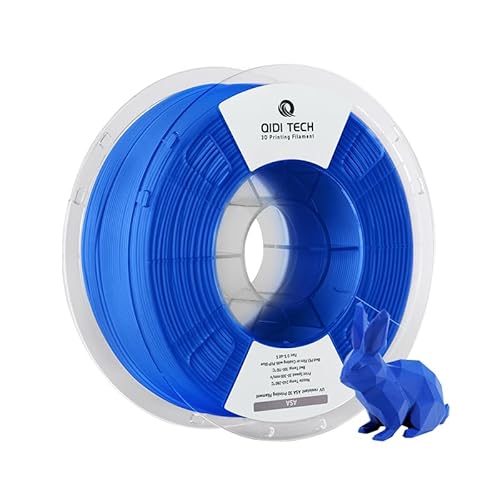
R QIDI Technology 1.75mm ASA Filament
Best for: outdoor functional parts requiring heat resistance
- Material Type
- ASA
- Filament Diameter
- 1.75mm
- Net Weight
- 1kg
- Dimensional Accuracy
- ±0.02mm
- Color
- Blue
- Weight
- 2.2 pounds
View on Amazon: R QIDI Technology 1.75mm ASA Filament Affiliate link
This 1kg spool of QIDI ASA filament is designed for durable, outdoor-ready prints. It features a precise 1.75mm diameter with ±0.02mm tolerance to ensure smooth extrusion and consistent layer adhesion. The material offers high heat resistance up to 90°C and strong impact resistance, making it suitable for functional parts that face weather exposure. You get a tangle-free spool that supports post-processing like sanding or acetone smoothing. It is ideal for users needing UV stability and mechanical strength in their 3D printed objects.
Pros
- High tensile strength of 47.1 MPa for durable mechanical parts
- UV and weather resistance prevents yellowing and cracking outdoors
- Dimensional accuracy of ±0.02mm ensures consistent print quality
- Heat deformation temperature up to 90°C for functional use
Cons
- Requires an enclosed chamber for best printing results
- Needs higher nozzle temperatures between 230-250°C
- Bed temperature must be maintained between 90-110°C
Good fit if
- You need prints that withstand outdoor UV exposure
- You require high heat resistance for functional components
- You want to sand or smooth your final prints
Skip if
- You lack an enclosed 3D printer for printing
- You prefer materials with lower heat resistance
- You want to avoid higher bed temperature requirements
Verdict: QIDI Technology ASA 1.75mm Filament is a robust choice for users who need durable, weather-resistant parts that can withstand heat and sunlight. It fits those with enclosed printers who prioritize mechanical strength and dimensional accuracy in their functional prototypes.
Specifications side by side
| Spec | R QIDI Technology PLA Rapido 1.75mm Filament | R QIDI Technology 1.75mm ASA Filament |
|---|---|---|
| Material Type | PLA | ASA |
| Filament Diameter | 1.75mm | 1.75mm |
| Net Weight | 1 KG | 1kg |
| Max Print Speed | 400mm/s | not stated |
| Dimensional Accuracy | +/- 0.02mm | ±0.02mm |
| Compatible Material | PLA | ASA |
| Features | High Speed | not stated |
| Target Audience | Beginners | not stated |
| Color | Blue | Blue |
| Size | 1.75Mm | 1.75Mm |
| Surface Finish | Smooth | not stated |
| Weight | 2.2 pounds | 2.2 pounds |
Frequently asked questions
Can I use PLA Rapido for outdoor projects?
No, you should not use PLA Rapido for outdoor applications. The product is designed for high-speed printing on compatible FDM printers, prioritizing velocity and dimensional consistency for rapid prototyping. It lacks the weather resistance required for exterior use, unlike ASA which withstands heat and sunlight.
Is the ASA filament safe for indoor printing?
The ASA filament is robust and durable but is best suited for enclosed printers. It is ideal for functional prototypes requiring mechanical strength and dimensional accuracy. While it offers excellent heat resistance, its use in enclosed environments ensures optimal performance for outdoor-style functional parts.
Do both filaments come in the same color?
Yes, both the PLA Rapido and the ASA filament are available in blue. You can choose between these two materials based on your project needs without worrying about color mismatch. Both spools share this specific blue hue, allowing for consistent aesthetics if you mix materials in a single project.
What is the spool weight for these materials?
Both spools weigh 2.2 pounds. This standard weight ensures you have sufficient material for various projects. The consistent weight across both PLA Rapido and ASA filaments helps you plan your printing time accurately, as the volume of material remains identical for both options.
Which filament is better for rapid prototyping?
PLA Rapido is the better choice for rapid prototyping. It is specifically designed for users who prioritize print velocity and dimensional consistency. This material fits those using compatible FDM printers who need reliable, moisture-protected output for fast iteration cycles, making it superior for speed-focused workflows.
Are these filaments suitable for functional outdoor parts?
The ASA filament is suitable for functional outdoor parts. It is a robust choice for users needing durable, weather-resistant components that can withstand heat and sunlight. If your project requires mechanical strength and exposure resistance, ASA is the recommended material over PLA Rapido.