Phrozen 1kg High-Temp Resin vs Phrozen Engineering Series Elastic Resin: Spec Comparison
As an Amazon Associate we earn from qualifying purchases. Links on this page are affiliate links.
This guide compares the Phrozen Ultra-High Temp 3D Printer Resin against the Engineering Series Elastic Resin. Both are 1kg functional materials for 405nm DLP and LCD printers. They share the same brand and basic curing requirements. The main difference lies in their mechanical behavior. One offers extreme heat endurance for rigid parts. The other provides high elasticity for flexible applications. You need to choose based on your specific project demands.
Key differences
| Aspect | Phrozen 1kg High-Temp Resin | Phrozen Engineering Series Elastic Resin 1kg |
|---|---|---|
| Resin Type | Functional | Elastomer |
| Key Property | 190°C Heat Deflection Temperature | 391% Elongation at Break |
| Primary Application | Prototyping, jewelry, ducting | Bicycle seats, shoe cushions |
| Shrinkage | Minimal shrinkage | Low shrinkage |
Which one should you choose?
Choose Phrozen 1kg High-Temp Resin if
- You need parts that withstand high temperatures up to 190°C.
- You are creating rigid functional prototypes or jewelry.
- You require high tensile strength and toughness.
Choose Phrozen Engineering Series Elastic Resin 1kg if
- You need flexible parts with rubber-like elasticity.
- You are printing items that require repeated bending or rebound.
- You need tear-resistant materials for durable use.
Verdict: Choose the Ultra-High Temp resin if your project demands rigid, heat-resistant components. Select the Engineering Series Elastic resin if you need flexible, tear-resistant parts that can endure repeated deformation. Both materials share the same 405nm curing wavelength for compatibility.
Heat Endurance Versus Elasticity
Thermal Resistance
The Phrozen 1kg High-Temp Resin is built for extreme heat. It boasts a heat deflection temperature of 190°C. This allows prints to maintain structural integrity under demanding thermal conditions. It is ideal for engineering mock-ups and industrial parts that face high temperatures. The Phrozen Engineering Series Elastic Resin does not list a specific heat deflection temperature. It focuses on flexibility rather than thermal stability. If your project requires components to survive high heat without deforming, the High-Temp Resin is the clear choice. The Elastic Resin is better suited for parts that need to bend, not withstand heat.
Flexibility and Elasticity
The Phrozen Engineering Series Elastic Resin excels in flexibility. It offers an ultra-high elongation at break of 391%. This rubber-like elasticity allows for significant stretching and bending. It also features a 50–55 Bayshore rebound rate, ensuring parts return to their original shape after deformation. The Phrozen 1kg High-Temp Resin emphasizes toughness and strength. It is designed for dimensional stability and minimal shrinkage. It does not highlight high elongation properties. For applications like shoe cushions or bicycle seats that require repeated bending, the Elastic Resin is superior. The High-Temp Resin is rigid and stable.
Tear Resistance
Durability under stress is a key differentiator. The Phrozen Engineering Series Elastic Resin demonstrates superior tear resistance. In Ross bending fatigue tests at 23 degrees Celsius, it withstood over 60,000 cycles. It has a tear strength of 22 kN/m. This makes it reliable for long-term testing and repeated use. The Phrozen 1kg High-Temp Resin highlights high tensile strength and toughness. However, it does not provide specific data on fatigue cycles or tear strength in kN/m. If your parts will undergo constant flexing or tearing, the Elastic Resin offers verified longevity. The High-Temp Resin is strong but not specified for fatigue resistance.
Print Compatibility
Both resins are designed for broad compatibility with modern resin printers. They both cure at a wavelength of 405nm. The Phrozen 1kg High-Temp Resin is compatible with DLP and LCD technologies. The Phrozen Engineering Series Elastic Resin supports LCD, DLP, and SLA technologies. This means the Elastic Resin works with an additional printing method. If you use an SLA printer, the Elastic Resin is a viable option. Both work seamlessly with DLP and LCD setups. For users with standard LCD or DLP machines, there is no practical difference in compatibility. Both are functional resins for these common technologies.
Application Suitability
The intended use cases differ significantly between the two materials. The Phrozen 1kg High-Temp Resin is suited for prototyping, ducting, molding, and jewelry. Its high heat endurance makes it perfect for functional industrial parts. The Phrozen Engineering Series Elastic Resin is designed for high-durability needs like bicycle seats and shoe cushions. It excels in applications requiring repeated bending and tearing. If you are making rigid prototypes or jewelry, the High-Temp Resin is appropriate. If you are creating flexible components that must endure physical stress, the Elastic Resin is the better fit. Choose based on the mechanical behavior your final part requires.
Choose the right resin for your needs
Engineers needing heat-resistant prototypes
You should choose the Phrozen 1kg High-Temp Resin if your prints must withstand extreme thermal conditions. It features a heat deflection temperature of 190°C. This specification ensures structural integrity for industrial mock-ups and functional parts. The resin also offers high tensile strength and minimal shrinkage, maintaining accuracy during complex engineering applications.
Designers creating flexible, durable parts
Select the Phrozen Engineering Series Elastic Resin for projects requiring rubber-like flexibility. It provides an ultra-high elongation at break of 391%. This elasticity allows parts to return to their original shape after deformation. The material also withstands over 60,000 bending cycles, making it ideal for shoe cushions or bicycle seats that face repeated stress.
Users prioritizing odor-free handling
If you prefer a cleaner workspace, the Phrozen 1kg High-Temp Resin is the better choice. It is formulated to be odorless, enhancing your printing environment. The low viscosity also makes it easy to handle and clean. These practical features combine with its functional strength to support a smoother, more comfortable prototyping workflow for your daily tasks.
The products compared

Phrozen 1kg High-Temp Resin
Best for: High-heat functional prototypes and jewelry
- Resin Type
- Functional
- Curing Wavelength
- 405nm
- Compatible Technology
- DLP, LCD
- Net Weight
- 1KG
- Application
- Prototyping, ducting, molding, jewelry
- Printing Technology
- Resin
View on Amazon: Phrozen 1kg High-Temp Resin Affiliate link
This is a 1 kg functional resin designed for DLP and LCD 3D printers using 405nm light. It offers a high heat deflection temperature of 190°C, making it suitable for parts that face extreme heat. The material provides high tensile strength and minimal shrinkage for accurate prototypes. You will appreciate the low viscosity and odorless formula, which simplifies handling and cleanup. It is ideal for engineering mock-ups and jewelry casting.
Pros
- 190°C heat deflection temperature for high-heat applications
- Low viscosity for easy pouring and cleaning
- Odorless composition for a better workspace
- High tensile strength and exceptional toughness
- Compatible with 405nm DLP and LCD printers
Cons
- Limited to 1 kg bottle size
- Specific to 405nm wavelength only
- Not suitable for flexible or elastomeric parts
Good fit if
- You need parts that withstand high temperatures
- You print rigid functional prototypes or jewelry
- You use 405nm DLP or LCD printers
Skip if
- You require flexible or elastic materials
- You need bulk quantities under 1 kg
- You use UV wavelengths other than 405nm
Verdict: Phrozen TR300 High-Temp Resin delivers the thermal stability and strength needed for demanding engineering and jewelry projects. It fits users who prioritize heat resistance and precision over flexibility.
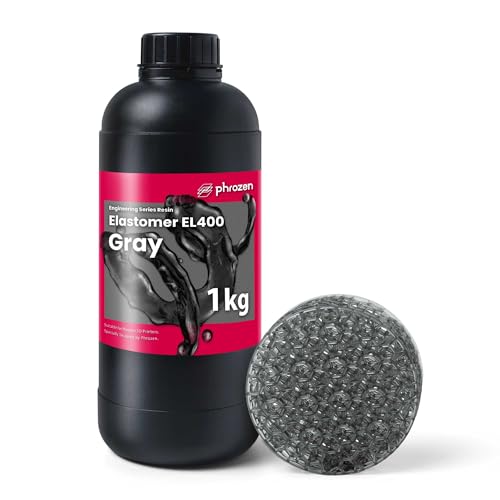
Phrozen Engineering Series Elastic Resin 1kg
Best for: durable flexible parts like shoe cushions
- Resin Type
- Elastomer
- Curing Wavelength
- 405nm
- Compatible Technology
- LCD, DLP, SLA
- Net Weight
- 1KG
- Application
- Bicycle seats, shoe cushions
- Printing Technology
- Resin
View on Amazon: Phrozen Engineering Series Elastic Resin 1kg Affiliate link
Phrozen EL400 is a 1KG elastomer resin designed for high-elasticity prints. It offers 391% elongation at break and a 50–55 Bayshore rebound rate. The material withstands over 60,000 tear cycles with 22 kN/m strength. It cures at 405nm for LCD, DLP, and SLA printers. You should use it for durable items like shoe cushions or bicycle seats that require repeated flexibility.
Pros
- 391% elongation at break for rubber-like flexibility
- 50–55 Bayshore rebound rate for shape recovery
- Withstands over 60,000 cycles in tear tests
- 22 kN/m tear strength for durability
- Works with LCD, DLP, and SLA technologies
Cons
- Limited to 405nm curing wavelength
- 1KG bottle size restricts large batch printing
- Specific to elastomer applications, not general prototyping
Good fit if
- You need prints that withstand repeated bending
- You are making durable items like shoe cushions
- You require high tear strength for functional parts
Skip if
- You need standard rigid resin for quick prototypes
- You require a larger volume than 1KG
- You use printers without 405nm UV light sources
Verdict: Phrozen EL400 Elastomer Resin 1KG is ideal for makers creating flexible, tear-resistant parts like bicycle seats. It delivers high elongation and rebound rates for durable, long-lasting functional prints.
Specifications side by side
| Spec | Phrozen 1kg High-Temp Resin | Phrozen Engineering Series Elastic Resin 1kg |
|---|---|---|
| Resin Type | Functional | Elastomer |
| Curing Wavelength | 405nm | 405nm |
| Compatible Technology | DLP, LCD | LCD, DLP, SLA |
| Net Weight | 1KG | 1KG |
| Application | Prototyping, ducting, molding, jewelry | Bicycle seats, shoe cushions |
| Printing Technology | Resin | Resin |
| Features | High Precision | Low Shrinkage, Non-Brittle |
| Size | 1KG | 1KG |
| Dimensions | 3.54 × 3.54 × 8.66 inches | 3.54 × 3.54 × 8.86 inches |
| Weight | not stated | 1 kilograms |
| Color | TR300 | EL400 |
Frequently asked questions
What is the main difference between Phrozen High-Temp and Elastic Resin?
The primary difference is mechanical behavior. The High-Temp Resin prioritizes heat resistance and strength for rigid functional parts. The Elastic Resin focuses on flexibility and tear resistance for durable, bendable components. You choose based on whether your project requires thermal stability or physical elasticity.
Can I use these resins in any 405nm printer?
Yes, both resins cure at a 405nm wavelength. This standard wavelength is compatible with most DLP and LCD resin 3D printers. You do not need special hardware beyond a standard 405nm machine. Check your printer manual to confirm it supports this specific curing spectrum.
Which resin is best for making shoe cushions?
The Phrozen Engineering Series Elastic Resin is ideal for shoe cushions. It offers high elongation and rebound rates, making it tear-resistant and durable. The High-Temp Resin is too rigid for this application. You need the flexibility provided by the EL400 formulation for comfortable, long-lasting inserts.
Does the High-Temp Resin work for jewelry casting?
Yes, the Phrozen 1kg High-Temp Resin is suitable for jewelry. It delivers the precision and thermal stability needed for demanding jewelry projects. Its ability to withstand heat ensures clean casting results. This makes it a reliable choice for creating intricate patterns that require high-temperature integrity.
Are both resins sold in 1kg containers?
Yes, both products are available in 1kg sizes. The High-Temp Resin comes in a 1KG package. The Elastic Resin is also listed as a 1KG size. This standard volume allows you to buy them in the same quantity for consistent workflow management.
What is the heat deflection temperature of the High-Temp Resin?
The Phrozen 1kg High-Temp Resin has a heat deflection temperature of 190°C. This specification allows prints to maintain structural integrity under demanding thermal conditions. It is significantly higher than standard resins, making it suitable for engineering mock-ups that face high temperatures during use.
Is the Elastic Resin good for bicycle seats?
Yes, the Phrozen Engineering Series Elastic Resin is ideal for bicycle seats. It provides high elongation and rebound rates for durable, long-lasting functional prints. The material is tear-resistant, which is essential for parts that undergo repeated flexing and stress during regular use.
Do these resins require different post-curing times?
The provided specifications do not list post-curing times for either resin. Both require a 405nm curing wavelength for initial solidification. You should consult the official Phrozen technical data sheets for specific post-processing instructions. Standard UV post-curing is generally recommended for all resin prints.