IEMAI Transparent Orange PETG Filament or IEMAI ASA 3D Printer? Which IEMAI Model to Buy
As an Amazon Associate we earn from qualifying purchases. Links on this page are affiliate links.
You are looking at iemai petg filament 1 75mm vs asa 3d printer. Both are 1.75mm spools from IEMAI with tight dimensional accuracy. The main difference is material purpose. One is transparent PETG for light transmission and high speed. The other is opaque ASA for outdoor durability and heat resistance. Choose based on whether you need clarity or weatherproof strength.
Key differences
| Aspect | IEMAI Transparent Orange PETG Filament 1.75mm 1kg | IEMAI ASA 3D Printer Filament 1.75mm |
|---|---|---|
| Material Type | PETG | ASA |
| Color/Finish | Transparent Orange | Yellow |
| Max Print Speed | 600mm/s | 30-50mm/s recommended |
| Heat Resistance | Improved over PLA | High heat resistance |
| UV/Weather Resistance | Not listed | Excellent UV & Weather Resistance |
| Dimensional Accuracy | +/- 0.02mm | +/- 0.02mm |
Which one should you choose?
Choose IEMAI Transparent Orange PETG Filament 1.75mm 1kg if
- You need crystal clear prints for lampshades or display models.
- You want to print at high speeds up to 600mm/s.
- You require a material with good impact resistance and flexibility.
Choose IEMAI ASA 3D Printer Filament 1.75mm if
- You are printing parts that will stay outdoors in sunlight.
- You need high heat resistance for functional automotive or mechanical components.
- You want strong layer adhesion for durable prototypes and tools.
Verdict: Choose the PETG filament if your priority is transparency and fast printing. Choose the ASA filament if your parts must withstand UV light and high temperatures. Both offer precise dimensions for reliable feeding.
PETG Transparency vs ASA Durability
Material Transparency
The IEMAI Transparent Orange PETG Filament is engineered for light transmission. It delivers a glass-like finish with excellent clarity, making it ideal for lampshades, light covers, and decorative displays. The transparency varies with wall thickness, so you can control the light diffusion by adjusting your model design. In contrast, the IEMAI ASA 3D Printer Filament is opaque. It comes in colors like Yellow, Brown, or Black. ASA does not offer light transmission. If you need functional parts that hide internal mechanisms or require specific color coding for outdoor signage, ASA is the practical choice. For visual appeal and light projects, PETG wins.
Print Speed Capability
Speed is a major differentiator between these two filaments. The IEMAI PETG is explicitly engineered for high-speed printing, supporting speeds up to 600mm/s. It maintains stable extrusion and smooth surfaces even at these rapid rates, which significantly reduces print times for larger objects. The IEMAI ASA filament recommends a much slower range of 30-50mm/s. This conservative speed helps manage the material's tendency to warp and ensures strong layer adhesion, especially in non-enclosed environments. If your workflow prioritizes fast turnaround and you have a capable printer, the PETG option offers a clear performance advantage.
Outdoor Durability
When placing prints outside, material stability matters. The IEMAI ASA filament is designed for demanding outdoor applications. It offers reliable resistance to sunlight, rain, and changing temperatures. It maintains its shape, strength, and color during extended exposure, making it suitable for garden accessories, automotive parts, and exterior brackets. The IEMAI PETG filament focuses on toughness and impact resistance but does not highlight UV or weather resistance. While PETG is durable for indoor functional parts, ASA is the superior choice for items that will face the elements over time.
Thermal Resistance
Heat tolerance varies between these materials. The IEMAI PETG filament offers improved heat resistance compared to PLA, combining easy printability with durability. However, the IEMAI ASA filament is designed for higher thermal demands. It provides good dimensional stability and toughness, preventing parts from becoming brittle or deforming under heat. ASA is recommended for mechanical components and tools that may encounter higher temperatures. If your prints will be used in warm environments or near heat sources, ASA provides better structural integrity under thermal stress.
Printing Environment Needs
The required printer setup differs for each material. The IEMAI ASA filament recommends printing inside an enclosed chamber to reduce warping and improve layer adhesion. It also suggests keeping the cooling fan off or at a low setting. It is compatible with enclosed high-temperature printers like Bambu Lab X1/P1S or Creality K1 series. The IEMAI PETG filament does not require an enclosure and can be printed with standard settings. It works well on open-frame printers. If you have an open printer, PETG is easier to use. If you have an enclosed chamber, ASA is viable.
Choose based on your print needs
You need clear, decorative parts
This transparent orange PETG filament offers excellent light transmission and a glass-like finish. It supports high-speed printing up to 600mm/s while maintaining stable extrusion. The material combines PLA ease with ABS toughness, providing impact resistance and flexibility. It is ideal for lampshades, light covers, and display models where visual clarity matters.
You print functional outdoor gear
This ASA filament provides reliable resistance to sunlight, rain, and temperature changes. It maintains strength and shape during extended outdoor use. The material offers high heat resistance and impact strength, making it suitable for garden accessories, equipment housings, and automotive parts. It is less likely to become brittle under outdoor conditions compared to other plastics.
You want consistent, reliable feeds
Both filaments maintain a strict diameter tolerance of +/- 0.02mm for smooth feeding. This specific PETG variant ensures consistent extrusion and strong bed adhesion. It helps minimize warping, shrinkage, and stringing. The vacuum-sealed packaging with desiccant protects against moisture, ensuring reliable print results for both decorative and functional projects without interruptions.
The products compared
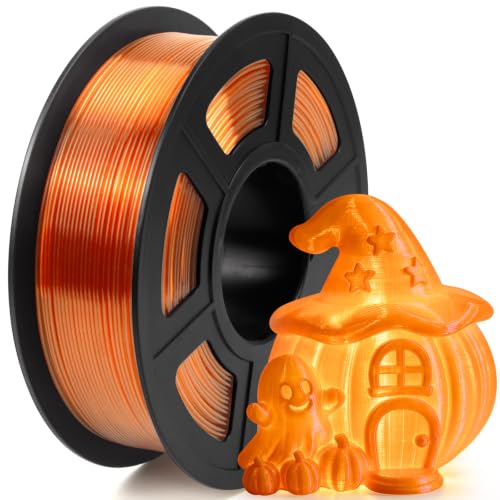
IEMAI Transparent Orange PETG Filament 1.75mm 1kg
Best for: High-speed transparent decorative prints
- Material Type
- PETG
- Filament Diameter
- 1.75mm
- Net Weight
- 1kg
- Max Print Speed
- 600mm/s
- Dimensional Accuracy
- +/- 0.02mm
- Finish
- Transparent
View on Amazon: IEMAI Transparent Orange PETG Filament 1.75mm 1kg Affiliate link
This IEMAI PETG filament features a transparent orange finish designed for light transmission. It supports high-speed printing up to 600mm/s while maintaining dimensional accuracy of +/- 0.02mm. The material offers improved heat and impact resistance compared to standard PLA. You get a 1kg spool suitable for lampshades, light covers, and decorative parts. The consistent extrusion helps minimize warping and stringing for reliable results.
Pros
- Transparent orange finish with high light transmission
- Max print speed of 600mm/s
- Dimensional accuracy of +/- 0.02mm
- Improved heat and impact resistance
Cons
- Transparency varies with wall thickness
- Requires drying at 60°C for 5–8 hours
- Nozzle temperature range is 220–260°C
Good fit if
- You need crystal-clear decorative parts
- You want to print at high speeds
- You require durable functional components
Skip if
- You need opaque colors only
- You cannot dry filament before printing
- You prefer lower temperature printing
Verdict: IEMAI Transparent Orange PETG 1kg delivers high-speed printing and clear aesthetics for light-based projects. It fits users who need durable, transparent parts and can manage specific drying and temperature settings.

IEMAI ASA 3D Printer Filament 1.75mm
Best for: outdoor functional parts and automotive accessories
- Material Type
- ASA
- Filament Diameter
- 1.75mm
- Net Weight
- 1kg
- Max Print Speed
- 50mm/s
- Dimensional Accuracy
- ±0.02 mm
- Color
- Yellow
View on Amazon: IEMAI ASA 3D Printer Filament 1.75mm Affiliate link
This IEMASA ASA filament is designed for outdoor functional parts that need UV and weather resistance. It maintains strength and shape in changing temperatures. The 1.75mm diameter has a tight tolerance of +/- 0.02mm for consistent feeding. You get a 1kg spool of yellow material. It requires a nozzle temperature between 240-270°C and works best in enclosed chambers to reduce warping. It suits users needing durable automotive or garden components.
Pros
- Excellent UV and weather resistance for outdoor use
- High impact strength and heat resistance
- Dimensional accuracy of +/- 0.02mm
- Vacuum sealed with desiccant for moisture protection
Cons
- Requires enclosed chamber to minimize warping
- High nozzle temperature up to 270°C
- Only available in 1kg spool size
Good fit if
- You need parts for outdoor garden accessories
- You require high impact strength for tools
- You have an enclosed 3D printer
Skip if
- You lack an enclosed printing chamber
- You need materials for indoor decorative items
- You prefer low-temperature printing settings
Verdict: IEMAI ASA 1.75mm 1kg Yellow is a robust option for users who need durable, weather-resistant parts for outdoor applications. It fits those with enclosed printers who prioritize impact strength and UV stability over aesthetic variety.
Specifications side by side
| Spec | IEMAI Transparent Orange PETG Filament 1.75mm 1kg | IEMAI ASA 3D Printer Filament 1.75mm |
|---|---|---|
| Material Type | PETG | ASA |
| Filament Diameter | 1.75mm | 1.75mm |
| Net Weight | 1kg | 1kg |
| Max Print Speed | 600mm/s | 50mm/s |
| Dimensional Accuracy | +/- 0.02mm | ±0.02 mm |
| Compatible Material | PETG | ASA |
| Color | Transparent Orange | Yellow |
| Size | 1KG | 1KG |
| Finish | Transparent | not stated |
| Application | not stated | Functional Parts |
| Dimensions | 7.87 × 7.87 × 2.36 inches | not stated |
| Weight | 2.2 pounds | 2.2 pounds |
| Model | PN-09 | not stated |
Frequently asked questions
Is IEMAI Transparent Orange PETG suitable for light boxes?
Yes, it is designed for light transmission. The filament provides a glass-like finish with excellent clarity. This makes it ideal for lampshades and light covers. The transparency varies with wall thickness, allowing you to adjust light diffusion. It supports high-speed printing up to 600mm/s for faster project completion.
Can I use ASA filament for outdoor automotive parts?
Yes, ASA is robust for outdoor functional parts. It offers weather resistance and UV stability. This material is ideal for automotive accessories that face sunlight. You need an enclosed printer to manage the material properly. The filament prioritizes impact strength over aesthetic variety for durable results.
What is the difference between PETG and ASA strength?
PETG combines PLA ease with ABS toughness. It is durable for general use. ASA provides higher impact strength and weather resistance. It is better for harsh outdoor environments. Choose PETG for decorative clarity and ASA for functional durability. Both materials maintain tight dimensional accuracy for precise prints.
Does the orange PETG filament require drying?
You must manage specific drying settings for this material. Proper drying ensures stable extrusion during printing. The filament supports high speeds up to 600mm/s when prepared correctly. Follow the recommended temperature settings to maintain the transparent orange finish. This step is crucial for achieving the best light transmission results.
Is ASA filament opaque or transparent?
ASA filament is opaque. The yellow version is not transparent. It is designed for functional parts rather than light projects. The material focuses on durability and UV stability. You should choose this if you need weather-resistant components. It does not offer the glass-like clarity found in the transparent PETG option.
What printer type is best for ASA?
You need an enclosed printer for ASA. The material requires consistent temperature control to prevent warping. Enclosed chambers help maintain the necessary heat. This setup ensures the filament prints with tight dimensional accuracy. It is essential for achieving the impact strength and weather resistance that ASA provides for outdoor applications.