FLASHFORGE or R QIDI Technology? 3d Printers Compared in 2026
As an Amazon Associate we earn from qualifying purchases. Links on this page are affiliate links.
This FLASHFORGE vs R QIDI Technology 3d printer comparison looks at two distinct approaches to high-speed printing. Both machines use CoreXY motion systems and reach speeds of 600mm/s. They also share auto-leveling features for easier setup. The main difference lies in their chamber design and material capabilities. The QIDI Q2 includes a heated chamber and supports multi-color printing, while the FLASHFORGE Adventurer 5M focuses on a compact, direct-drive setup for standard filaments. You need to decide which feature set fits your workflow.
Key differences
| Aspect | FLASHFORGE Adventurer 5M CoreXY 3D Printer | QIDI Q2 Heated Chamber 3D Printer |
|---|---|---|
| Chamber Heating | Not listed | 65℃ |
| Multi-Color Support | Single color | Up to 16-color |
| Nozzle Temperature | 280℃ | 370℃ |
| Build Volume | 220x220x220mm | Not listed |
| Weight | 22 pounds | 39.9 pounds |
Which one should you choose?
Choose FLASHFORGE Adventurer 5M CoreXY 3D Printer if
- You want a lighter, more compact printer for standard PLA and PETG materials.
- You prefer a lower entry point for basic prototyping without needing a heated chamber.
- You need a machine that fits easily on smaller workspaces.
Choose QIDI Q2 Heated Chamber 3D Printer if
- You plan to print advanced materials like ABS, PC, or carbon-fiber composites.
- You want to create multi-color models without complex manual setups.
- You need a heated chamber to prevent warping on large, technical prints.
Verdict: The FLASHFORGE Adventurer 5M is a solid choice for users who prioritize speed and simplicity with common filaments. The QIDI Q2 is better suited for engineers and makers who require heated chamber stability and multi-color capabilities. Your choice depends on whether you need advanced material handling or straightforward, high-speed output.
FLASHFORGE vs QIDI Q2 Comparison
Print Speed and Motion
Both the FLASHFORGE Adventurer 5M and the QIDI Q2 utilize a CoreXY motion structure to achieve a maximum print speed of 600mm/s. This shared architecture allows for rapid travel movements and high acceleration, which is critical for reducing production cycles in rapid prototyping. The FLASHFORGE specifies an acceleration of 20000mm/s², ensuring efficient material deposition during fast moves. The QIDI Q2 complements its speed with 1.5GT synchronous belts to reduce vibration artifacts and precision linear rails for stability. While both machines offer identical top speeds, the QIDI’s emphasis on vibration reduction through its belt and rail system provides a practical advantage for maintaining surface quality at high velocities, whereas the FLASHFORGE relies on its acceleration metrics for efficiency.
Build Volume and Size
The FLASHFORGE Adventurer 5M offers a cubic build volume of 220x220x220mm, providing a consistent square footprint for your projects. In contrast, the QIDI Q2 data does not explicitly list its build volume dimensions in the provided specifications. However, physical dimensions reveal that the QIDI Q2 is larger, measuring 17.2 inches in width compared to the FLASHFORGE’s 14.3 inches, and stands taller at 19.5 inches versus 17.6 inches. The QIDI also weighs significantly more at 39.9 pounds compared to the FLASHFORGE’s 22 pounds, indicating a more robust frame. If you prioritize a compact footprint and lighter weight for easier placement, the FLASHFORGE has the clear advantage. If you require a larger machine structure, the QIDI is the bigger unit.
Extruder and Temperature
The FLASHFORGE Adventurer 5M features a direct drive extruder capable of reaching 280°C, paired with a high-flow 32mm³/s nozzle and dual-fan cooling. This setup supports quick 3-second nozzle changes and warm-up to 200°C in 35 seconds, facilitating stable high-speed printing for standard materials like PLA and ABS. The QIDI Q2 takes a different approach with a 370°C high-temperature nozzle. This higher thermal limit is specifically designed to unlock advanced engineering materials, including PPS-CF, carbon fiber composites, and polycarbonate. While the FLASHFORGE excels in speed and flow for general-purpose printing, the QIDI’s extruder capability provides a distinct edge for users who need to print high-performance, heat-resistant polymers that require temperatures above 280°C.
Chamber and Environment
A major differentiator between these two printers is the chamber environment. The QIDI Q2 includes a second-generation PTC heated chamber that reaches 65°C. This feature minimizes warping and ensures strong layer adhesion, which is essential for printing materials like ABS, PETG, and Nylon. It also includes a triple filtration system with G3 pre-filter, H12 HEPA, and activated carbon to reduce odors and harmful particles, making it safer for indoor use. The FLASHFORGE Adventurer 5M data does not mention a heated chamber or a comprehensive filtration system. For users printing temperature-sensitive materials or those concerned with air quality, the QIDI Q2 offers superior environmental control and safety features that the FLASHFORGE lacks.
Multi-Material and Features
The QIDI Q2 supports up to 16-color multi-material printing when used with the QIDI BOX accessory, which also enables dry-while-print technology to keep filaments dry for stable extrusion. It includes an AI camera for monitoring, filament run-out and tangle detection, and power-loss recovery. The FLASHFORGE Adventurer 5M focuses on simplicity with one-click automatic printing and real-time monitoring via the Flash Studio app. It accepts optional nozzle sizes from 0.25mm to 0.8mm for varied detail needs. While the FLASHFORGE offers versatile nozzle options, the QIDI’s ability to handle multi-color prints and its integrated smart sensors provide a more feature-rich experience for complex, multi-material projects. The FLASHFORGE is simpler, but the QIDI offers more advanced capabilities.
Leveling and Setup
Both printers feature fully automatic leveling to ensure consistent first layers and save setup time. The FLASHFORGE Adventurer 5M uses standard auto-leveling to guarantee adhesion without manual adjustments. The QIDI Q2 employs a unique approach where the nozzle itself acts as the leveling sensor. This method delivers first-layer accuracy that is unaffected by the bed surface, offering a true plug-and-play experience. This nozzle-based sensing can provide more precise calibration on different build surfaces compared to traditional probe methods. While both achieve the goal of automatic leveling, the QIDI’s specific sensor technology offers a technical advantage in leveling precision and surface independence, making setup potentially more reliable for diverse build plates.
Which 3D Printer Should You Buy
Users needing high-temp engineering materials
The QIDI Q2 features a 370°C nozzle and a 65°C heated chamber. This setup unlocks advanced polymers like PPS-CF, PC, and PA. The heated chamber minimizes warping for large prints. If you require strong, heat-resistant prototypes or industrial-grade parts, this machine provides the thermal stability that the FLASHFORGE Adventurer 5M cannot match.
Makers wanting multi-color printing capabilities
The QIDI Q2 supports up to 16-color multi-material printing when paired with the QIDI BOX. It uses dry-while-print technology to keep filaments stable. This allows for vibrant, complex models without manual filament swaps. If you want to create detailed, multi-colored objects efficiently, this system offers superior material versatility compared to the single-extruder FLASHFORGE.
Users prioritizing compact size and speed
The FLASHFORGE Adventurer 5M is lighter at 22 pounds and measures 14.3 inches wide. It offers rapid 35-second warm-up times and quick 3-second nozzle changes. Its CoreXY structure delivers 600mm/s speeds in a smaller footprint. If you value a compact desktop footprint and fast turnaround for standard PLA or ABS projects, this printer fits your space and workflow.
The products compared

FLASHFORGE Adventurer 5M CoreXY 3D Printer
Best for: Fast prototyping with standard filaments
- Build Volume
- 220x220x220mm
- Print Speed
- Max 600mm/s
- Leveling Type
- Fully Auto Leveling
- Motion Structure
- CoreXY
- Extruder Type
- 280°C Direct Extruder
- Features
- High Speed
View on Amazon: FLASHFORGE Adventurer 5M CoreXY 3D Printer Affiliate link
The Flashforge Adventurer 5M is a CoreXY 3D printer designed for rapid prototyping. It features a maximum print speed of 600mm/s and a 220x220x220mm build volume. The machine includes fully automatic bed leveling and a direct drive extruder capable of reaching 280°C. It also offers real-time monitoring via the Flash Studio app. This printer suits users who need fast output and reliable first-layer adhesion for standard filaments.
Pros
- CoreXY structure with 600mm/s max speed
- Fully automatic bed leveling system
- 280°C direct drive extruder
- Real-time monitoring via Flash Studio app
Cons
- 220x220x220mm build volume is smaller than chamber-heated competitors
- No heated chamber included for advanced materials
- 22-pound weight adds bulk for small desks
Good fit if
- You need fast print cycles for prototyping
- You want automatic leveling to save setup time
- You print with PLA, PETG, or TPU
Skip if
- You require a heated chamber for PPS-CF
- You need a build volume larger than 220mm
- You prefer manual calibration over auto-leveling
Verdict: Flashforge Adventurer 5M High Speed Printer delivers high-speed CoreXY performance and auto-leveling for efficient standard printing. It fits users who prioritize speed and ease of use over high-temperature chamber capabilities.
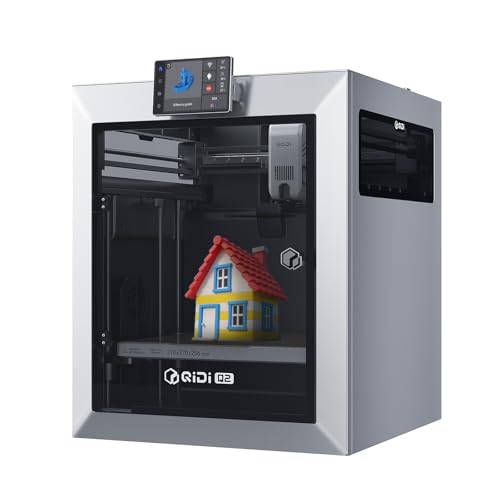
QIDI Q2 Heated Chamber 3D Printer
Best for: Advanced material printing with multi-color support
- Build Volume
- 270x270x256mm
- Print Speed
- 600mm/s
- Multicolor Capacity
- Up to 16-color
- Leveling Type
- Full auto leveling
- Motion Structure
- CoreXY
- Chamber Heating
- 65℃
View on Amazon: QIDI Q2 Heated Chamber 3D Printer Affiliate link
The QIDI Q2 is a CoreXY 3D printer with a 65°C heated chamber and a 370°C nozzle. It supports print speeds up to 600mm/s and offers up to 16-color multi-material printing via the QIDI BOX. This machine suits beginners and engineers who need reliable results for advanced materials like PPS-CF. It includes auto-leveling and AI camera monitoring for consistent quality.
Pros
- 65°C heated chamber minimizes warping
- 370°C high-temp nozzle for advanced materials
- Print speeds up to 600mm/s
- Supports up to 16-color multi-material printing
Cons
- Heavier build at 39.9 pounds
- Larger footprint at 17.2 inches wide
- Multi-color printing requires separate QIDI BOX
Good fit if
- You need a heated chamber for engineering materials
- You want high-speed printing up to 600mm/s
- You plan to use multi-color filaments
Skip if
- You need a compact desktop printer
- You only print with basic PLA
- You want built-in multi-color without extra hardware
Verdict: QIDI Q2 Heated Chamber 3D Printer delivers professional-grade stability and material versatility. It fits users who prioritize heated chamber performance and multi-color capabilities over a compact footprint.
Specifications side by side
| Spec | FLASHFORGE Adventurer 5M CoreXY 3D Printer | QIDI Q2 Heated Chamber 3D Printer |
|---|---|---|
| Build Volume | 220x220x220mm | 270x270x256mm |
| Print Speed | Max 600mm/s | 600mm/s |
| Multicolor Capacity | not stated | Up to 16-color |
| Leveling Type | Fully Auto Leveling | Full auto leveling |
| Motion Structure | CoreXY | CoreXY |
| Extruder Type | 280°C Direct Extruder | not stated |
| Chamber Heating | not stated | 65℃ |
| Structure | CoreXY | not stated |
| Leveling | Auto Leveling | Auto Leveling |
| Features | High Speed | High Speed, Built-in Camera, Heated Chamber |
| Color | Black | Q2 |
| Dimensions | 15.8 × 14.3 × 17.6 inches | 15.8 × 17.2 × 19.5 inches |
| Weight | 22 pounds | 39.9 pounds |
| Model | Adventurer 5M | Q2 |
| Size | not stated | Q2 |
Frequently asked questions
Is the FLASHFORGE Adventurer 5M good for beginners?
Yes, it is designed for ease of use. The printer includes auto-leveling to simplify setup. Its CoreXY structure and direct drive extruder help ensure reliable prints with standard filaments. This makes it a practical choice for users who want fast prototyping without complex calibration steps.
Does the QIDI Q2 support multi-color printing?
Yes, the QIDI Q2 supports multi-color printing. This feature is highlighted in its best-for category. It allows you to create complex, colorful models without manual filament swaps. This capability is paired with a heated chamber for advanced material stability.
What is the main difference in chamber design?
The QIDI Q2 features a heated chamber for temperature control. The FLASHFORGE Adventurer 5M does not list a heated chamber in its specifications. The QIDI setup helps minimize warping for engineering materials, while the FLASHFORGE focuses on speed with standard filaments.
Which printer is heavier and larger?
The QIDI Q2 is larger and heavier. It weighs 39.9 pounds and measures 17.2 inches wide. The FLASHFORGE Adventurer 5M weighs 22 pounds and is 14.3 inches wide. The QIDI’s larger footprint accommodates its heated chamber and professional-grade stability.
Can I print high-temperature materials on the FLASHFORGE 5M?
The FLASHFORGE Adventurer 5M is best for standard filaments. It prioritizes speed and ease of use. It does not list a heated chamber or high-temperature nozzle capabilities in the provided data. For high-temperature polymers, the QIDI Q2 is the more suitable option.
Do both printers use CoreXY motion systems?
Yes, both machines use a CoreXY structure. This design allows for high-speed movement and rapid acceleration. Both models also reach a maximum print speed of 600mm/s. This shared architecture ensures fast travel movements for efficient printing on both devices.