ELEGOO vs R QIDI Technology 3d Printers: Which Brand Fits You?
As an Amazon Associate we earn from qualifying purchases. Links on this page are affiliate links.
When comparing ELEGOO vs R QIDI Technology 3d printer options, you face two distinct CoreXY machines. Both brands prioritize speed and high-temperature printing for advanced materials. The main difference lies in their chamber design and multi-color capabilities. One model features a heated chamber for industrial-grade stability, while the other focuses on a rigid frame with real-time monitoring. This guide breaks down the specs to help you choose the right tool.
Key differences
| Aspect | ELEGOO Centauri Carbon CoreXY 3D Printer | QIDI Q2 Heated Chamber 3D Printer |
|---|---|---|
| Print Speed | 500 mm/s | 600 mm/s |
| Chamber Heating | Not listed | 65℃ |
| Extruder Type | Brass-hardened steel nozzle (320°C) | 370℃ high-temp nozzle |
| Multi-Color | Not listed | Up to 16-color |
| Build Volume | 256x256x256 mm | Not listed |
Which one should you choose?
Choose ELEGOO Centauri Carbon CoreXY 3D Printer if
- You need a large, square build volume for bigger parts.
- You want a rigid die-cast frame for high-speed stability.
- You prefer real-time camera monitoring with dual LED lighting.
Choose QIDI Q2 Heated Chamber 3D Printer if
- You require a heated chamber to prevent warping with technical materials.
- You want to print with up to 16 colors using multi-material support.
- You need a higher maximum nozzle temperature for advanced polymers.
Verdict: Choose the ELEGOO Centauri Carbon if you prioritize a generous build volume and a robust mechanical frame for high-speed prints. Opt for the QIDI Q2 if you need a heated chamber and multi-color capabilities for complex, professional-grade projects.
Speed, Materials, and Chamber Heat
Print Speed
The QIDI Q2 offers a higher maximum print speed of 600 mm/s compared to the ELEGOO Centauri Carbon’s 500 mm/s. Both machines utilize a CoreXY motion structure, which allows for rapid acceleration and deceleration without sacrificing precision. The QIDI Q2 achieves this with a full-metal CoreXY frame and precision linear rails, reducing vibration artifacts. The ELEGOO Centauri Carbon relies on a rigid die-cast aluminum frame with automatic vibration compensation. For users prioritizing the fastest possible output, the QIDI Q2 holds a slight advantage in raw speed specifications.
Chamber Heating
The QIDI Q2 features a 2nd-generation PTC heated chamber capable of reaching 65°C. This enclosed environment minimizes warping and ensures strong layer adhesion, which is critical for printing advanced engineering materials. The ELEGOO Centauri Carbon does not list a heated chamber in its specifications, though it does include an enclosed design with enhanced cooling. A heated chamber allows for more consistent temperatures during long prints, reducing the risk of delamination in temperature-sensitive filaments. This feature gives the QIDI Q2 a clear edge for users working with high-performance polymers.
Nozzle Temperature
The QIDI Q2 is equipped with a high-temperature nozzle that reaches 370°C, while the ELEGOO Centauri Carbon’s nozzle tops out at 320°C. Both nozzles are designed for durability, with the QIDI Q2 supporting advanced materials like PPS-CF and the ELEGOO Centauri Carbon handling carbon fiber reinforced filaments. The higher temperature limit on the QIDI Q2 provides greater flexibility for printing high-heat plastics such as PEEK or PPS, which require sustained heat to extrude properly. If you plan to use exotic high-temperature filaments, the QIDI Q2 offers superior thermal capability.
Multi-Color Printing
The QIDI Q2 supports up to 16-color multi-material printing when paired with the QIDI BOX accessory. This system enables dry-while-print technology, keeping filaments dry for stable extrusion and smooth surfaces. The ELEGOO Centauri Carbon data does not mention multi-color or multi-material capabilities. While the ELEGOO machine is ready for single-material advanced printing out of the box, it lacks the integrated system for vibrant, multi-material projects. For users who want to create colorful models without external modifications, the QIDI Q2 is the only option listed.
Build Volume
The ELEGOO Centauri Carbon provides a build volume of 256x256x256 mm, which equals approximately 10x10x10 inches. The QIDI Q2 specifications do not explicitly list its build volume dimensions in the provided data. Both machines are designed for professional and enthusiast use, but the ELEGOO model offers a known cubic printing area that suits a wide range of part sizes. Without specific dimensions for the QIDI Q2, it is difficult to compare their maximum part sizes directly. The ELEGOO Centauri Carbon provides clearer information regarding physical print capacity.
Choose Your Ideal 3D Printer
Speed-focused makers wanting high acceleration
The QIDI Q2 reaches 600 mm/s with 1.5GT belts and linear rails. This CoreXY setup minimizes vibration artifacts for smoother surfaces at high speeds. Its 370°C nozzle handles advanced filaments, while the 65°C heated chamber ensures strong layer adhesion for demanding materials like PPS-CF. You get professional-grade stability and rapid production cycles.
Users needing multi-color printing capabilities
The QIDI Q2 supports up to 16-color multi-material printing via the QIDI BOX. This dry-while-print technology keeps filaments stable for vibrant, precise models. It handles PLA, ABS, PETG, TPU, and composites. If you want complex, multi-material projects without manual filament swaps, this machine’s integrated system is your best technical choice.
Beginners wanting plug-and-play reliability
The ELEGOO Centauri Carbon arrives fully assembled and pre-calibrated. Its nozzle acts as the leveling sensor for accurate first layers, unaffected by bed surface. The die-cast aluminum frame provides rock-solid stability. With auto bed leveling and an enclosed chamber, you get smooth, frustration-free printing right out of the box for consistent results.
Those prioritizing compact footprint and safety
The ELEGOO Centauri Carbon measures 15.9 x 15.7 x 19.3 inches and weighs 38.6 pounds. It features a built-in chamber camera and dual LED lighting for real-time monitoring. The enclosed design with enhanced cooling ensures safe indoor use. You get reliable PLA printing with minimal warping and excellent adhesion on the dual-sided plate.
The products compared
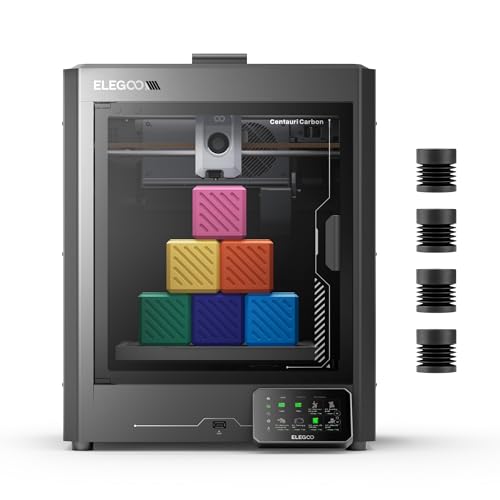
ELEGOO Centauri Carbon CoreXY 3D Printer
Best for: high-speed engineering prints with advanced materials
- Build Volume
- 256x256x256 mm
- Print Speed
- 500 mm/s
- Leveling Type
- Auto bed leveling
- Motion Structure
- CoreXY
- Extruder Type
- Brass-hardened steel nozzle
- Features
- High Speed, Built-in Camera
View on Amazon: ELEGOO Centauri Carbon CoreXY 3D Printer Affiliate link
The ELEGOO Centauri Carbon is a CoreXY 3D printer designed for high-speed production and advanced materials. It reaches 500 mm/s print speeds with 20000 mm/s² acceleration. The build volume is 256x256x256 mm. It features a 320°C nozzle and an enclosed chamber. This setup supports engineering filaments like carbon fiber. You get auto bed leveling and a built-in camera for monitoring. It arrives fully assembled.
Pros
- 500 mm/s print speed with 20000 mm/s² acceleration
- 320°C nozzle handles advanced materials like carbon fiber
- Enclosed chamber with built-in camera for monitoring
- Fully assembled and pre-calibrated out of the box
Cons
- Smaller 256x256x256 mm build volume compared to competitors
- Heavier 38.6 pounds build limits portability
- No mention of Wi-Fi or network connectivity in specs
Good fit if
- You need high-speed printing for detailed parts
- You plan to use carbon fiber or engineering filaments
- You want a fully assembled printer with auto leveling
Skip if
- You require a build volume larger than 256 mm
- You need wireless remote monitoring capabilities
- You prefer a lighter, more portable desktop unit
Verdict: The ELEGOO Centauri Carbon CoreXY 3D Printer suits makers who prioritize speed and material versatility over large build sizes. Its enclosed chamber and high-speed CoreXY structure make it ideal for engineering projects.
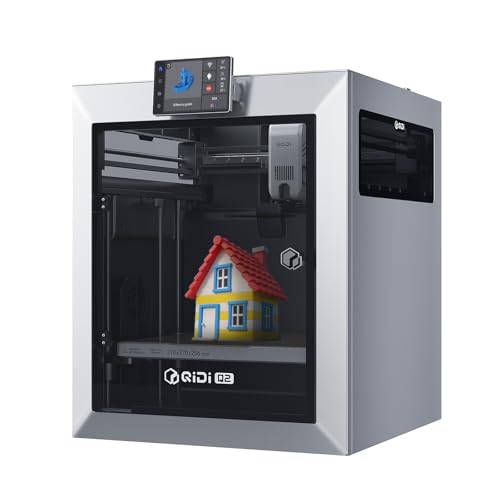
QIDI Q2 Heated Chamber 3D Printer
Best for: Advanced material printing and high-speed stability
- Build Volume
- 270x270x256mm
- Print Speed
- 600mm/s
- Multicolor Capacity
- Up to 16-color
- Leveling Type
- Full auto leveling
- Motion Structure
- CoreXY
- Chamber Heating
- 65℃
View on Amazon: QIDI Q2 Heated Chamber 3D Printer Affiliate link
The QIDI Q2 is a CoreXY printer designed for reliable, high-speed printing up to 600mm/s. It features a 65℃ heated chamber and a 370℃ nozzle, allowing you to print advanced materials like PPS-CF with minimal warping. The system includes auto-leveling and supports up to 16-color multi-material printing when paired with the QIDI BOX. This machine suits makers who need professional-grade stability and advanced material compatibility.
Pros
- CoreXY motion structure with 600mm/s print speed
- 65℃ heated chamber reduces warping
- 370℃ high-temp nozzle for advanced filaments
- Auto-leveling nozzle acts as leveling sensor
- Supports up to 16-color multi-material printing
Cons
- Requires QIDI BOX accessory for multi-color printing
- Heated chamber limited to 65℃ maximum temperature
- Heavy build at 39.9 pounds
Good fit if
- You need to print engineering materials like PPS-CF
- You want high-speed printing with smooth surfaces
- You plan to use multi-color filaments with the accessory
Skip if
- You need a heated chamber above 65℃
- You want multi-color printing without extra hardware
- You prefer a lighter, more portable machine
Verdict: QIDI Q2 Heated Chamber 3D Printer is a robust choice for users who require advanced material capabilities and high-speed precision. It fits those willing to invest in the QIDI BOX for multi-color workflows.
Specifications side by side
| Spec | ELEGOO Centauri Carbon CoreXY 3D Printer | QIDI Q2 Heated Chamber 3D Printer |
|---|---|---|
| Build Volume | 256x256x256 mm | 270x270x256mm |
| Print Speed | 500 mm/s | 600mm/s |
| Multicolor Capacity | not stated | Up to 16-color |
| Leveling Type | Auto bed leveling | Full auto leveling |
| Motion Structure | CoreXY | CoreXY |
| Extruder Type | Brass-hardened steel nozzle | not stated |
| Chamber Heating | not stated | 65℃ |
| Structure | CoreXY | not stated |
| Leveling | not stated | Auto Leveling |
| Features | High Speed, Built-in Camera | High Speed, Built-in Camera, Heated Chamber |
| Color | Black | Q2 |
| Dimensions | 15.7 × 15.9 × 19.3 inches | 15.8 × 17.2 × 19.5 inches |
| Weight | 38.6 pounds | 39.9 pounds |
| Size | Centauri Carbon | Q2 |
| Model | Centauri Carbon | Q2 |
Frequently asked questions
Which brand offers a heated chamber for better material adhesion?
R QIDI Technology provides the Q2 model with a dedicated heated chamber. This feature helps maintain consistent temperatures for advanced engineering materials. It reduces warping and improves layer bonding. ELEGOO’s Centauri Carbon focuses on speed and enclosure rather than active chamber heating. Choose QIDI if thermal stability is your priority.
How do the build volumes compare between these two printers?
The ELEGOO Centauri Carbon measures 15.9 inches wide, 15.7 inches long, and 19.3 inches high. The QIDI Q2 is slightly wider at 17.2 inches and taller at 19.5 inches. Both offer substantial printing areas. The QIDI Q2 is heavier at 39.9 pounds compared to the ELEGOO’s 38.6 pounds. Check your workspace dimensions before deciding.
Is the ELEGOO Centauri Carbon suitable for high-speed printing?
Yes, the ELEGOO Centauri Carbon supports print speeds up to 500mm/s. It uses a CoreXY structure to ensure precision during rapid movements. The machine also includes a built-in camera for monitoring prints. This setup makes it ideal for makers who need fast turnaround times without sacrificing quality on standard materials.
What motion system do both ELEGOO and QIDI printers use?
Both brands utilize a CoreXY motion system. This design allows for high acceleration and deceleration rates. It helps maintain print quality even at faster speeds. The CoreXY setup distributes movement across multiple axes, reducing strain on the frame. This results in smoother surfaces and fewer vibration artifacts during production.
Which printer is better for advanced engineering materials?
The QIDI Q2 is designed for advanced material printing with its heated chamber. It supports high-temperature operations for engineering-grade filaments. The ELEGOO Centauri Carbon also handles advanced materials but focuses on speed. If you frequently print complex polymers, the QIDI Q2’s thermal control offers distinct advantages for consistency and reliability.
Does the ELEGOO Centauri Carbon include visual monitoring features?
The ELEGOO Centauri Carbon comes with a built-in camera. This allows you to monitor your prints remotely or via the interface. It helps you catch issues early without being present. The QIDI Q2 does not list a camera in its specifications. If visual oversight is critical to your workflow, the ELEGOO model includes this feature.