ELEGOO or Heygears? 3d Printers Compared in 2026
As an Amazon Associate we earn from qualifying purchases. Links on this page are affiliate links.
This ELEGOO vs heygears 3d printer comparison highlights two distinct approaches to additive manufacturing. You are choosing between FDM and resin technologies. The ELEGOO Centauri Carbon uses a CoreXY motion system for fast filament printing. The HeyGears Reflex RS Turbo relies on an Amber LCD screen for detailed resin output. Both machines prioritize precision and automated setup. However, their material choices and mechanical designs serve different maker needs.
Key differences
| Aspect | ELEGOO Centauri Carbon CoreXY 3D Printer | HeyGears Reflex RS Turbo Amber Screen Printer |
|---|---|---|
| Printing Technology | FDM (Filament) | Resin (LCD) |
| Structure | CoreXY | not listed |
| Print Speed | 500 mm/s | not listed |
| Extruder Type | Brass-hardened steel nozzle | not listed |
| Leveling Type | Auto bed leveling | Floating Screen Auto-Leveling |
| Features | Built-in Camera | Intelligent Force-Monitoring System |
Which one should you choose?
Choose ELEGOO Centauri Carbon CoreXY 3D Printer if
- You need to print large, durable parts using filament.
- You want high-speed production with a CoreXY motion system.
- You prefer monitoring prints via a built-in chamber camera.
Choose HeyGears Reflex RS Turbo Amber Screen Printer if
- You require extreme detail with resin printing technology.
- You value intelligent force monitoring to prevent print failures.
- You want automated support generation and one-click slicing.
Verdict: Choose the ELEGOO Centauri Carbon if you prioritize speed, large build volumes, and versatile filament printing. Select the HeyGears Reflex RS Turbo if your projects demand high-resolution resin details and advanced failure prevention. Your choice depends on whether you value speed or precision.
ELEGOO vs Heygears Spec Comparison
printing technology
The ELEGOO Centauri Carbon is an FDM printer that melts filament to build parts layer by layer. This method is versatile and handles a wide range of materials. The HeyGears Reflex RS Turbo uses resin printing technology. It cures liquid resin with light to create highly detailed models. You must choose between these two distinct processes based on your project needs. FDM is generally better for functional prototypes and larger parts. Resin is preferred for miniatures and jewelry with fine surface details. Each technology has its own strengths and limitations for different applications.
print speed
Speed is a major differentiator between these two machines. The ELEGOO Centauri Carbon boasts a maximum print speed of 500 mm/s. It also achieves 20,000 mm/s² acceleration, allowing for rapid movement of the print head. This CoreXY structure helps maintain stability at high velocities. The HeyGears Reflex RS Turbo does not list a specific linear speed in mm/s. Instead, it focuses on curing speed and layer times. Its Dynamic Motion Algorithm 3.0 boosts print speed by 33% compared to standard resin printers. However, without a direct mm/s figure, the ELEGOO Centauri Carbon offers a clearer high-speed metric for filament printing.
build volume
The physical size of your prints depends on the build volume. The ELEGOO Centauri Carbon provides a cubic build volume of 256 x 256 x 256 mm. This offers a generous space for larger functional parts or multiple small items. The HeyGears Reflex RS Turbo does not specify its build volume in the provided data. Resin printers often have smaller build areas compared to FDM machines. You will need to check the manufacturer's specifications for the exact resin tank dimensions if you plan to print larger resin objects. For known large filament prints, the ELEGOO Centauri Carbon has the advantage.
leveling
Bed leveling is crucial for print success. The ELEGOO Centauri Carbon features auto bed leveling. This system helps ensure the first layer adheres properly to the build plate without manual adjustment. The HeyGears Reflex RS Turbo uses a Floating Screen Auto-Leveling system. It corrects deviations up to 0.15° to keep the resin screen level. Both systems automate a critical setup step. The ELEGOO approach standardizes FDM bed leveling. The HeyGears method addresses the unique alignment needs of resin screens. Both solutions reduce manual intervention and help achieve consistent first layers.
structure
The mechanical structure affects stability and precision. The ELEGOO Centauri Carbon uses a CoreXY motion system. This configuration allows for high speeds and accelerations while maintaining print quality. It also features a rigid die-cast aluminum frame to minimize vibrations. The HeyGears Reflex RS Turbo utilizes an industrial-grade C5 ball-screw Z-axis. This ensures repeat positioning accuracy of ≤2 μm. The ELEGOO Centauri Carbon is designed for fast horizontal movement. The HeyGears Reflex RS Turbo is engineered for extreme vertical precision. Each structure supports its respective printing technology effectively.
Which 3D Printer Suits Your Needs
Users needing high-speed filament printing
The ELEGOO Centauri Carbon delivers 500 mm/s speeds with CoreXY motion. Its 320°C nozzle handles advanced materials like carbon fiber. The 256 mm cubic build volume and auto bed leveling ensure smooth, reliable prints for large, detailed parts without manual setup.
Printers requiring ultra-fine resin detail
The HeyGears Reflex RS Turbo uses an Amber screen with 566:1 contrast for sharp details. Industrial C5 ball-screw Z-axis ensures ≤2 μm accuracy. Force monitoring and auto-leveling prevent failures, making it ideal for high-precision resin models with consistent tolerances.
Makers wanting enclosed chamber stability
You get an enclosed chamber with enhanced cooling on the ELEGOO Centauri Carbon. The rigid die-cast aluminum frame minimizes vibration at high speeds. Real-time monitoring via built-in camera and dual LED lighting helps you track prints and adjust settings remotely.
The products compared
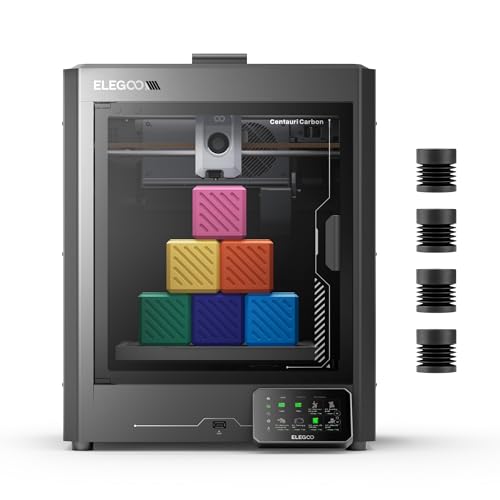
ELEGOO Centauri Carbon CoreXY 3D Printer
Best for: High-speed printing with advanced materials
- Build Volume
- 256x256x256 mm
- Print Speed
- 500 mm/s
- Leveling Type
- Auto bed leveling
- Motion Structure
- CoreXY
- Extruder Type
- Brass-hardened steel nozzle
- Features
- High Speed, Built-in Camera
View on Amazon: ELEGOO Centauri Carbon CoreXY 3D Printer Affiliate link
The ELEGOO Centauri Carbon is a CoreXY 3D printer designed for high-speed output and advanced materials. It features a 256x256x256 mm build volume and reaches speeds of 500 mm/s. The unit arrives fully assembled with auto bed leveling. A 320°C nozzle handles carbon fiber filaments. It includes a built-in camera for remote monitoring. This machine suits makers who need speed and material versatility without complex setup.
Pros
- CoreXY structure supports 500 mm/s print speeds
- 320°C brass-hardened steel nozzle for advanced filaments
- Built-in chamber camera for real-time monitoring
- Fully assembled with auto bed leveling
Cons
- Heavier build at 38.6 pounds
- No mention of Wi-Fi or network connectivity
- Standard PLA surface plate may limit adhesion options
Good fit if
- You need fast printing for prototyping
- You plan to use carbon fiber reinforced filaments
- You want a pre-calibrated machine ready to use
Skip if
- You require a smaller footprint under 15 inches wide
- You need built-in Wi-Fi for remote control
- You only print with standard PLA and ABS
Verdict: ELEGOO Centauri Carbon CoreXY 3D Printer delivers high-speed performance and advanced material support for serious makers. It fits users who prioritize speed and carbon fiber compatibility over compact size.

HeyGears Reflex RS Turbo Amber Screen Printer
Best for: high-precision resin printing with automated support
- Build Volume
- 8.7 × 4.8 × 9.0 Inch
- Printing Technology
- Resin
- Leveling Type
- Floating Screen Auto-Leveling
- Color
- Black
- Dimensions
- 15 × 23 × 15 inches
- Weight
- 50.7 pounds
View on Amazon: HeyGears Reflex RS Turbo Amber Screen Printer Affiliate link
The HeyGears Reflex RS Turbo uses a high-contrast amber screen to deliver fast resin printing with crisp details. It features a precision Z-axis with ≤2 μm repeat positioning accuracy and force monitoring that detects resin residue as small as 0.2 mm. The system includes one-click slicing and auto-leveling to simplify setup. This machine suits users who need consistent tolerances and automated defect repair for complex models.
Pros
- High contrast amber screen with 566:1 ratio for faster curing
- Industrial-grade C5 ball-screw Z-axis ensures ≤2 μm repeat positioning accuracy
- Force sensors detect resin residue as fine as 0.2 mm to auto-pause prints
- One-click slicing automatically detects and repairs model defects
Cons
- Large footprint at 23 inches wide
- Heavy build at 50.7 pounds
- No mention of mobile app or remote connectivity
Good fit if
- You need high precision for detailed resin models
- You want automated support generation and defect repair
- You prioritize print consistency and tolerance control
Skip if
- You need a compact desktop printer
- You prefer lightweight equipment for easy transport
- You require wireless remote operation capabilities
Verdict: HeyGears Reflex RS Turbo Resin Printer offers industrial-grade precision and automated workflows for detailed resin printing. It fits users who value consistency and error prevention over compact size.
Specifications side by side
| Spec | ELEGOO Centauri Carbon CoreXY 3D Printer | HeyGears Reflex RS Turbo Amber Screen Printer |
|---|---|---|
| Build Volume | 256x256x256 mm | 8.7 × 4.8 × 9.0 Inch |
| Print Speed | 500 mm/s | not stated |
| Printing Technology | not stated | Resin |
| Leveling Type | Auto bed leveling | Floating Screen Auto-Leveling |
| Motion Structure | CoreXY | not stated |
| Extruder Type | Brass-hardened steel nozzle | not stated |
| Structure | CoreXY | not stated |
| Leveling | not stated | Auto Leveling |
| Features | High Speed, Built-in Camera | not stated |
| Color | Black | Black |
| Dimensions | 15.7 × 15.9 × 19.3 inches | 15 × 23 × 15 inches |
| Weight | 38.6 pounds | 50.7 pounds |
| Size | Centauri Carbon | Reflex RS Turbo |
| Model | Centauri Carbon | not stated |
Frequently asked questions
Which printer is better for high-speed filament printing?
The ELEGOO Centauri Carbon is the superior choice for speed. It features a CoreXY structure that enables print speeds up to 500mm/s. This motion system reduces moving mass for faster acceleration. You also get a built-in camera for remote monitoring. It is designed for users who prioritize rapid production cycles over compact footprints.
Does the HeyGears Reflex RS Turbo support automated workflows?
Yes, the HeyGears Reflex RS Turbo supports automated support generation. It is designed for high-precision resin printing with industrial-grade consistency. The system helps prevent errors during the build process. This makes it ideal for users who value precision and automated handling. You get detailed parts without manual intervention for supports.
What is the build volume difference between these two models?
The ELEGOO Centauri Carbon offers a 256mm cubic build volume. The HeyGears Reflex RS Turbo has a larger physical footprint. Its dimensions are 23 inches wide, 15 inches high, and 15 inches long. The ELEGOO measures 15.9 inches wide, 19.3 inches high, and 15.7 inches long. You should choose based on your part size requirements.
Which printer uses CoreXY motion technology?
The ELEGOO Centauri Carbon uses a CoreXY structure. This design allows for high-speed printing with improved accuracy. It moves the print head rather than the gantry. The HeyGears Reflex RS Turbo uses resin technology. It does not utilize this specific motion system. You get faster speeds and advanced material support with the ELEGOO model.
Is the HeyGears Reflex RS Turbo suitable for detailed resin work?
Yes, it is built for high-precision resin printing. The Reflex RS Turbo delivers industrial-grade precision for detailed parts. It uses an Amber LCD screen for consistent exposure. Automated support generation helps maintain quality. You get reliable results for complex geometries. This model fits users who need consistency and error prevention in resin workflows.
How much does each printer weigh?
The ELEGOO Centauri Carbon weighs 38.6 pounds. The HeyGears Reflex RS Turbo is heavier at 50.7 pounds. The difference reflects their internal components and build structures. You should ensure your workspace can support the heavier unit. The ELEGOO is lighter and potentially easier to move. Both units are black in color.
Can the ELEGOO Centauri Carbon print with carbon fiber materials?
Yes, it supports advanced materials like carbon fiber. The printer features a 320°C nozzle to handle high-temperature filaments. This capability allows you to use reinforced polymers. You get increased strength and durability in your prints. The high-speed performance complements these advanced material requirements. It is ideal for serious makers needing robust parts.