ELEGOO Centauri Carbon CoreXY 3D Printer vs ELEGOO Saturn 3 12K Resin (2026): Key Differences
As an Amazon Associate we earn from qualifying purchases. Links on this page are affiliate links.
The elegoo centauri carbon corexy 3d printer vs saturn 3 12k resin comparison highlights two distinct manufacturing methods. Both devices come from ELEGOO and feature 10-inch screens for monitoring. The Centauri Carbon uses FDM technology for high-speed plastic printing. The Saturn 3 12K uses MSLA resin printing for high detail. You need to choose based on whether you prioritize speed and strength or surface finish and resolution.
Key differences
| Aspect | ELEGOO Centauri Carbon CoreXY 3D Printer | ELEGOO Saturn 3 12K Resin Printer |
|---|---|---|
| Printing Technology | FDM | MSLA |
| Print Speed | 500 mm/s | up to 70mm/h |
| Build Volume | 256x256x256 mm | 218.88x122.88x250 mm |
| Structure | CoreXY | not listed |
| Weight | 38.6 pounds | 24.3 pounds |
Which one should you choose?
Choose ELEGOO Centauri Carbon CoreXY 3D Printer if
- You need fast production of functional parts using standard filaments.
- You want a rigid CoreXY frame that supports high acceleration.
- You prefer a larger square build volume for wider objects.
Choose ELEGOO Saturn 3 12K Resin Printer if
- You require high-resolution surface details for miniatures or jewelry.
- You want a lighter machine that is easier to move.
- You are comfortable handling liquid resin and its associated cleanup.
Verdict: The Centauri Carbon is the better choice for users who need speed and structural strength with dry materials. The Saturn 3 12K suits those who prioritize fine detail and smooth finishes over print speed. Your material preference should drive this decision.
Core Differences: FDM vs Resin
printing technology
The ELEGOO Centauri Carbon uses FDM technology, extruding melted filament layer by layer. This method is ideal for creating durable, functional parts using standard thermoplastics. In contrast, the ELEGOO Saturn 3 12K utilizes MSLA resin printing. It cures liquid resin with UV light to produce highly detailed models. This distinction defines their primary use cases. You choose the Centauri Carbon for structural components and everyday objects. You select the Saturn 3 12K for miniatures, jewelry, or intricate prototypes requiring fine surface resolution. The technology choice dictates the material workflow and post-processing needs for your projects.
print speed
Speed metrics differ significantly between these two machines. The Centauri Carbon boasts a maximum print speed of 500 mm/s with 20,000 mm/s² acceleration. This allows for rapid production of larger parts. The Saturn 3 12K lists a print speed of up to 70 mm/h. This figure refers to the vertical layer deposition rate typical for resin printers. While the Centauri Carbon moves fast horizontally, the Saturn 3 focuses on curing precision. If you need to produce large volumes quickly, the Centauri Carbon’s high-speed motion system offers a clear advantage. For detailed small parts, the resin printer’s speed is measured differently.
build volume
Both printers offer substantial build areas, but in different shapes. The Centauri Carbon provides a cubic build volume of 256x256x256 mm. This square footprint is versatile for printing multiple items or larger single objects. The Saturn 3 12K offers a volume of 218.88x122.88x250 mm. This rectangular shape is optimized for arranging multiple small models side-by-side on the build plate. The Centauri Carbon allows for taller, wider parts. The Saturn 3 12K excels at batch printing smaller items. Your choice depends on whether you prioritize volume symmetry or high-density part arrangement.
structure
The mechanical design impacts stability and precision. The Centauri Carbon features a CoreXY motion structure combined with a die-cast aluminum frame. This rigid construction minimizes vibration, which is crucial for maintaining quality at high speeds. It also includes automatic vibration compensation. The Saturn 3 12K uses a dual linear guideway design for its Z-axis movement. This ensures quieter and more stable vertical motion during the resin curing process. The Centauri Carbon’s frame is built for dynamic high-speed movement. The Saturn 3 12K is built for static precision and stability during long curing cycles.
leveling
Setup ease varies between the two systems. The Centauri Carbon includes auto bed leveling. It arrives fully assembled and pre-calibrated, ready to print immediately. This feature reduces the initial learning curve for beginners. The Saturn 3 12K data does not specify an automatic leveling mechanism. It relies on a laser-carved platform for strong adhesion. Users may need to perform manual adjustments to ensure the build plate is level relative to the resin tank. The Centauri Carbon’s automated leveling provides a more hassle-free start for new users.
Which 3D Printer Fits Your Needs
Users needing strong functional parts
The Centauri Carbon supports advanced filaments like carbon fiber reinforced materials. Its 320°C nozzle and enclosed chamber handle heat-resistant plastics for durable components. You get a rigid die-cast frame that minimizes vibration, ensuring precision even at high speeds. This makes it ideal for drones or automotive parts requiring strength and reliability.
Those prioritizing high-speed plastic printing
With a CoreXY structure, this printer achieves speeds up to 500 mm/s and 20,000 mm/s² acceleration. You can produce large, detailed parts rapidly. The auto bed leveling and pre-calibrated setup allow you to start printing immediately. This speed and ease of use make it perfect for makers who value quick turnaround times.
Users seeking detailed resin models
The Saturn 3 12K features a 12K mono LCD screen with high resolution for realistic model details. Its COB UV light source ensures over 92% uniformity. You benefit from a stable dual linear guideway Z-axis and a laser-carved platform for strong adhesion. This setup is best for intricate, high-detail resin prints.
The products compared
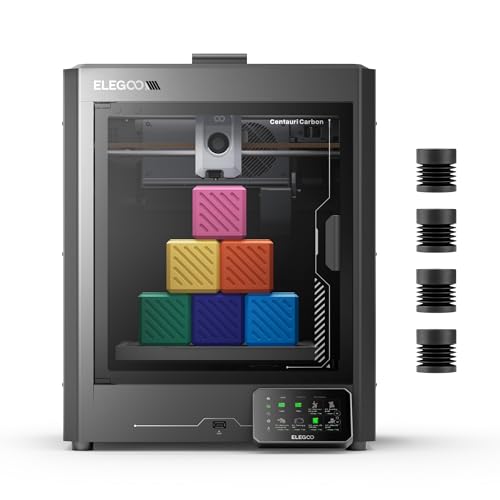
ELEGOO Centauri Carbon CoreXY 3D Printer
Best for: high-speed FDM printing
- Build Volume
- 256x256x256 mm
- Print Speed
- 500 mm/s
- Leveling Type
- Auto bed leveling
- Motion Structure
- CoreXY
- Extruder Type
- Brass-hardened steel nozzle
- Features
- High Speed, Built-in Camera
View on Amazon: ELEGOO Centauri Carbon CoreXY 3D Printer Affiliate link
The ELEGOO Centauri Carbon is a CoreXY 3D printer designed for high-speed production. It reaches 500 mm/s print speeds with 20,000 mm/s² acceleration. The build volume is 256x256x256 mm. It features a 320°C nozzle for advanced materials like carbon fiber. This model arrives fully assembled with auto bed leveling. It suits makers needing speed and material versatility.
Pros
- CoreXY structure for 500 mm/s speed
- 320°C nozzle for advanced filaments
- 256x256x256 mm build volume
- Fully assembled and pre-calibrated
- Built-in chamber camera for monitoring
Cons
- Heavier at 38.6 pounds
- Smaller build volume than resin options
- No mention of remote app control
Good fit if
- You need high-speed FDM printing
- You print with carbon fiber materials
- You want a ready-to-use machine
Skip if
- You prefer resin printing
- You need a large build volume
- You want a lightweight portable unit
Verdict: ELEGOO Centauri Carbon CoreXY Printer delivers rapid output for technical parts. It fits users who prioritize speed and material strength over resin detail.

ELEGOO Saturn 3 12K Resin Printer
Best for: Large, high-resolution resin prints
- Build Volume
- 218.88mm*122.88mm*250mm
- Print Speed
- up to 70mm/h
- Printing Technology
- MSLA
- Resolution
- 12K
- Dimensions
- 26 × 16.1 × 15 inches
- Weight
- 24.3 pounds
View on Amazon: ELEGOO Saturn 3 12K Resin Printer Affiliate link
The ELEGOO Saturn 3 12K is a resin 3D printer featuring a 10-inch monochrome LCD with 11520x5120 resolution. It offers a build volume of 218.88 x 122.88 x 250 mm and a print speed of up to 70 mm/h. The unit uses a COB UV light source with 92% uniformity for detailed models. It weighs 24.3 pounds and measures 16.1 x 15 x 26 inches. This machine suits users needing high-resolution resin prints with a large build area.
Pros
- 10-inch 12K monochrome LCD screen for high resolution
- Large build volume of 218.88 x 122.88 x 250 mm
- COB UV light source with 92% light uniformity
- Dual linear guideway design for stable Z-axis movement
Cons
- Print speed is limited to 70 mm/h
- Requires specific resin cleaning and parameter debugging
- Uses proprietary GOO slice format alongside standard support
Good fit if
- You need high-resolution resin prints with a large build volume
- You prioritize light uniformity for realistic model details
- You want a stable Z-axis with dual linear guideways
Skip if
- You require high-speed printing capabilities
- You prefer FDM printing technology over resin
- You need a compact printer under 20 inches in length
Verdict: ELEGOO Saturn 3 12K Resin 3D Printer is a high-resolution resin printer for users who need large, detailed prints. It fits those who value build volume and light uniformity over speed.
Specifications side by side
| Spec | ELEGOO Centauri Carbon CoreXY 3D Printer | ELEGOO Saturn 3 12K Resin Printer |
|---|---|---|
| Build Volume | 256x256x256 mm | 218.88mm*122.88mm*250mm |
| Print Speed | 500 mm/s | up to 70mm/h |
| Printing Technology | not stated | MSLA |
| Leveling Type | Auto bed leveling | not stated |
| Motion Structure | CoreXY | not stated |
| Extruder Type | Brass-hardened steel nozzle | not stated |
| Structure | CoreXY | not stated |
| Features | High Speed, Built-in Camera | not stated |
| Color | Black | Saturn 3 |
| Resolution | not stated | 12K |
| Dimensions | 15.7 × 15.9 × 19.3 inches | 26 × 16.1 × 15 inches |
| Weight | 38.6 pounds | 24.3 pounds |
| Size | Centauri Carbon | not stated |
| Model | Centauri Carbon | Saturn 3 |
Frequently asked questions
Is the Centauri Carbon faster than the Saturn 3 12K?
Yes, the Centauri Carbon is built for speed. It features a maximum print speed of 500mm/s. This CoreXY structure allows for rapid movement of the print head. The Saturn 3 12K focuses on resolution rather than speed. You will see a significant difference in output time for large parts.
Which printer has the larger build volume?
The Saturn 3 12K offers a larger footprint for your prints. It measures 26 inches in length. The Centauri Carbon is more compact at 15.7 inches long. If you need to print wide objects, the resin printer provides more space. The FDM model is better for dense, smaller batches.
Does the Centauri Carbon include a camera?
Yes, the Centauri Carbon comes with a built-in camera. This feature lets you monitor your prints remotely. The Saturn 3 12K does not list a camera in its attributes. You will need to rely on the screen or external tools to watch the resin curing process on the resin unit.
How much do these printers weigh?
The Centauri Carbon is heavier at 38.6 pounds. Its die-cast frame adds stability but increases weight. The Saturn 3 12K weighs 24.3 pounds. This makes the resin printer easier to move. You should consider your workspace stability when placing the heavier FDM unit on your table.
What is the main difference in printing technology?
The Centauri Carbon uses FDM technology. It extrudes melted filament to build layers. The Saturn 3 12K uses LCD-based resin printing. It cures liquid resin with light. FDM is better for strength. Resin is better for fine detail and smooth surface finishes on your models.
Which printer is better for large functional parts?
The Centauri Carbon is the better choice for functional parts. It supports high-speed printing and strong materials. Its enclosed chamber helps manage heat. The Saturn 3 12K excels in detail but uses brittle resin. You should choose the FDM printer for durable, mechanical components.
Do both printers have 10-inch screens?
Yes, both devices feature 10-inch screens. This allows you to monitor job progress easily. The Centauri Carbon screen helps manage filament runs. The Saturn 3 12K screen displays resin levels and curing status. You get a clear view of operations on both machines without needing a separate monitor.