Creality vs R QIDI Technology 3d Printers: Which Brand Fits You?
As an Amazon Associate we earn from qualifying purchases. Links on this page are affiliate links.
You are comparing creality vs R QIDI Technology 3d printer options to find the right tool for your needs. Both brands offer automated leveling and high-speed capabilities. The main difference lies in their approach to performance and materials. Creality focuses on accessible speed and ease of use. R QIDI Technology provides advanced features like a heated chamber and multi-color printing for more demanding projects. This guide breaks down the specs to help you decide.
Key differences
| Aspect | Creality Ender 3 V3 SE | QIDI Q2 Heated Chamber 3D Printer |
|---|---|---|
| Print Speed | 250mm/s | 600mm/s |
| Motion Structure | not listed | CoreXY |
| Chamber Heating | not listed | 65℃ |
| Extruder Type | not listed | 370℃ high-temp nozzle |
| Leveling Type | CR Touch Auto Leveling | Auto-leveling |
Which one should you choose?
Choose Creality Ender 3 V3 SE if
- You want a printer with a simpler setup and lower weight for easier placement.
- You prioritize fast printing speeds for standard materials like PLA or ABS without needing advanced chamber heating.
- You prefer a compact footprint that fits well in smaller workspaces.
Choose QIDI Q2 Heated Chamber 3D Printer if
- You need to print with engineering materials like PPS-CF or PC that require high temperatures and a heated chamber.
- You want to use multi-color printing capabilities with up to 16 colors.
- You require a CoreXY structure and linear rails for higher stability and precision at faster speeds.
Verdict: The Creality Ender 3 V3 SE is a practical choice for users who want reliable, fast printing for everyday materials with a straightforward setup. The QIDI Q2 is better suited for makers who need advanced material compatibility, multi-color options, and higher precision for professional results.
Creality vs QIDI Tech Comparison
Print Speed
The QIDI Q2 offers a maximum print speed of 600mm/s. This is significantly faster than the Creality Ender 3 V3 SE, which tops out at 250mm/s. The QIDI achieves this high speed through its full-metal CoreXY structure and precision linear rails. This setup allows for ultra-stable movement even at rapid velocities. In contrast, the Ender 3 V3 SE focuses on a more moderate speed of 250mm/s with 2500mm/s² acceleration. While the Creality machine saves time compared to older models, the QIDI Q2 provides nearly double the speed capability for faster production.
Heated Chamber
The QIDI Q2 features a 2nd-generation PTC heated chamber that reaches 65℃. This heated chamber minimizes warping and ensures strong layer adhesion, which is critical for engineering materials. The Creality Ender 3 V3 SE does not list a heated chamber in its specifications. Without a heated chamber, the Creality machine is better suited for standard materials like PLA and basic PETG. The QIDI Q2 allows you to print advanced materials like PPS-CF and PC with greater reliability due to the controlled temperature environment.
Nozzle Temperature
The QIDI Q2 is equipped with a high-temperature nozzle capable of reaching 370℃. This allows you to process advanced engineering filaments that require higher extrusion temperatures. The Creality Ender 3 V3 SE specifications do not specify a maximum nozzle temperature, implying a standard range suitable for common plastics. If you plan to use carbon-fiber composites or high-temp polymers, the QIDI Q2 provides the necessary thermal capability. For standard PLA or ABS printing, both machines can handle the task, but the QIDI offers more flexibility.
Multi-Color Printing
The QIDI Q2 supports up to 16-color multi-material printing when used with the QIDI BOX accessory. It utilizes dry-while-print technology to keep filaments dry during the process. This enables vibrant, multi-material models without complex manual swaps. The Creality Ender 3 V3 SE does not list multi-color capabilities in its data. It is designed as a single-extruder machine focused on speed and auto-leveling. If you need multi-color outputs, the QIDI Q2 is the clear choice for this feature set.
Auto Leveling
Both printers include auto-leveling features to simplify setup. The Creality Ender 3 V3 SE uses a CR Touch sensor for auto leveling and includes a strain sensor for auto Z-offset. This system automates the process so you do not need to participate manually. The QIDI Q2 uses its nozzle as the leveling sensor, delivering first-layer accuracy unaffected by the bed surface. Both systems aim for plug-and-play convenience. Since both offer automated leveling without manual intervention, this aspect is a tie in terms of user benefit.
Build Structure
The QIDI Q2 utilizes a full-metal CoreXY structure with precision linear rails. This design reduces vibration artifacts and delivers ultra-stable movement at high speeds. The Creality Ender 3 V3 SE features dual Z-axis rails for stability but does not specify a CoreXY or linear rail motion system in the provided data. The QIDI Q2 also includes an upgraded 1.5GT synchronous belt to further reduce vibration. The Creality machine focuses on accessible speed rather than high-end motion mechanics. The QIDI Q2 offers a more robust structural foundation.
Size and Weight
The Creality Ender 3 V3 SE is more compact and lighter. It measures 13 inches in width and length, with a height of 16 inches. It weighs 19.8 pounds. The QIDI Q2 is larger and heavier, measuring 17.2 inches wide, 15.8 inches long, and 19.5 inches high. It weighs 39.9 pounds. The Creality machine takes up less desk space and is easier to move. The QIDI Q2 requires more room due to its heated chamber and larger frame. If space is limited, the Creality Ender 3 V3 SE is the better fit.
Which 3D Printer Matches Your Needs
Beginners wanting simple, fast prints
The Creality Ender 3 V3 SE offers 250mm/s speed and CR Touch auto-leveling. This setup removes manual bed leveling tasks. You get reliable results with less effort. The strain sensor helps with Z-offset. It is a practical choice for users who want a straightforward entry into 3D printing without complex setup steps.
Users needing high-temp materials
The QIDI Q2 features a 370℃ nozzle and a 65℃ heated chamber. These specs allow you to print advanced materials like PPS-CF. The heated chamber minimizes warping for difficult plastics. You get strong layer adhesion and professional-grade results. This printer unlocks capabilities that standard printers cannot handle, ensuring precision with high-performance filaments.
Professionals requiring maximum speed
The QIDI Q2 reaches 600mm/s with a CoreXY structure. This speed is more than double the Creality Ender 3 V3 SE. The linear rails reduce vibration artifacts for smoother surfaces. You benefit from ultra-stable high-speed printing. If your workflow demands rapid prototyping and precision, the QIDI Q2 delivers superior performance through its robust mechanical design.
The products compared

Creality Ender 3 V3 SE
Best for: fast prints with auto-leveling
- Print Speed
- 250mm/s
- Leveling Type
- CR Touch Auto Leveling
- Dimensions
- 13 × 13 × 16 inches
- Weight
- 19.8 pounds
View on Amazon: Creality Ender 3 V3 SE Affiliate link
The Creality Ender 3 V3 SE offers a 250mm/s print speed and 2500mm/s² acceleration. It includes CR Touch auto-leveling and a strain sensor for auto Z-offset. The unit measures 13x13x16 inches and weighs 19.8 pounds. This printer suits users who want faster prints without manual leveling adjustments. It fits those seeking reliable automation in a compact frame.
Pros
- 250mm/s maximum print speed
- 2500mm/s² acceleration
- CR Touch auto-leveling sensor
- Strain sensor for auto Z-offset
Cons
- No heated chamber for high-temp materials
- No Wi-Fi or app connectivity listed
- Smaller build volume than chamber-equipped rivals
Good fit if
- You want faster printing speeds
- You prefer auto-leveling convenience
- You need a compact desktop printer
Skip if
- You print high-temp materials like PPS-CF
- You require remote monitoring
- You need a large build volume
Verdict: Creality Ender 3 V3 SE 3D Printer delivers speed and automation for standard filaments. It fits users who prioritize print speed and ease of setup over high-temperature capabilities or remote features.
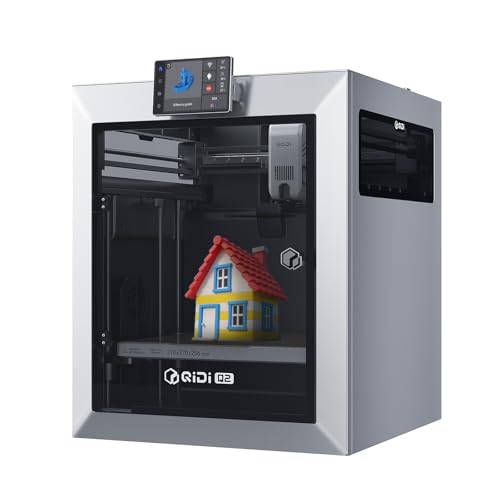
QIDI Q2 Heated Chamber 3D Printer
Best for: Advanced material printing with chamber heating
- Build Volume
- 270x270x256mm
- Print Speed
- 600mm/s
- Multicolor Capacity
- Up to 16-color
- Leveling Type
- Full auto leveling
- Motion Structure
- CoreXY
- Chamber Heating
- 65℃
View on Amazon: QIDI Q2 Heated Chamber 3D Printer Affiliate link
The QIDI Q2 is a CoreXY 3D printer with a 65°C heated chamber and 370°C nozzle. It supports speeds up to 600mm/s and multi-color printing with the QIDI BOX. This setup helps reduce warping and handles advanced materials. You get auto-leveling and AI monitoring for reliable results. It suits makers who need precision and material versatility.
Pros
- 65°C heated chamber minimizes warping
- 370°C high-temp nozzle for advanced materials
- 600mm/s print speed
- CoreXY structure with linear rails
- Supports up to 16-color printing
Cons
- QIDI BOX required for multi-color printing
- No built-in display mentioned in data
- Heavier build at 39.9 pounds
Good fit if
- You need a heated chamber for engineering plastics
- You want high-speed CoreXY printing
- You plan to use multi-color setups
Skip if
- You want a compact desktop printer
- You prefer a simpler single-color workflow
- You need a lighter portable unit
Verdict: QIDI Q2 65C Heated Chamber 3D Printer offers professional-grade chamber heating and speed for advanced users. It fits those prioritizing material versatility and print stability over compactness.
Specifications side by side
| Spec | Creality Ender 3 V3 SE | QIDI Q2 Heated Chamber 3D Printer |
|---|---|---|
| Build Volume | not stated | 270x270x256mm |
| Print Speed | 250mm/s | 600mm/s |
| Multicolor Capacity | not stated | Up to 16-color |
| Leveling Type | CR Touch Auto Leveling | Full auto leveling |
| Motion Structure | not stated | CoreXY |
| Chamber Heating | not stated | 65℃ |
| Leveling | Auto Leveling | Auto Leveling |
| Features | not stated | High Speed, Built-in Camera, Heated Chamber |
| Dimensions | 13 × 13 × 16 inches | 15.8 × 17.2 × 19.5 inches |
| Weight | 19.8 pounds | 39.9 pounds |
| Size | Ender 3 SE Pro | Q2 |
| Color | Ender 3 SE Pro | Q2 |
| Model | Creality Ender 3 V3 SE | Q2 |
Frequently asked questions
Which brand is better for beginners?
Creality is the better choice for beginners. The Ender 3 V3 SE offers auto-leveling and a 250mm/s print speed. This combination simplifies setup and ensures reliable results. You get a straightforward experience without complex configurations. The included strain sensor helps with Z-offset calibration, reducing the learning curve for new users.
Does QIDI Technology offer heated chambers?
Yes, the QIDI Q2 includes a heated chamber. This feature supports advanced material printing and improves print stability. It is ideal for users who need to handle a wider range of filaments. The heated chamber helps prevent warping and ensures consistent layer adhesion for technical projects.
How fast can these printers print?
Print speeds vary by model. The Creality Ender 3 V3 SE reaches up to 250mm/s. The QIDI Q2 achieves significantly higher speeds, up to 600mm/s. This difference allows for faster production runs with the QIDI model. Choose based on whether you prioritize speed or ease of use.
What is the build volume size?
Build volumes differ between the two brands. The Creality Ender 3 V3 SE measures 13x13x16 inches. The QIDI Q2 is larger, measuring 15.8x17.2x19.5 inches. The QIDI model accommodates bigger prints due to its expanded dimensions. Select the size that matches your largest intended projects.
Is auto-leveling included in both?
The Creality Ender 3 V3 SE features auto-leveling. This automates the bed leveling process for consistent first layers. The provided data does not confirm auto-leveling for the QIDI Q2. You should verify this specification for the QIDI model before purchasing if this feature is essential for your workflow.
Which printer is lighter to move?
The Creality Ender 3 V3 SE is lighter. It weighs 19.8 pounds, making it easier to relocate. The QIDI Q2 weighs 39.9 pounds due to its robust construction. The heavier QIDI unit offers stability but requires more effort to move. Consider your workspace layout and mobility needs.