Creality vs ELEGOO 3d Printers: Which Brand Fits You?
As an Amazon Associate we earn from qualifying purchases. Links on this page are affiliate links.
When comparing creality vs ELEGOO 3d printer options, you face two distinct approaches to FDM printing. Both brands offer automated leveling to simplify your workflow. The main difference lies in their mechanical design and speed capabilities. Creality focuses on accessible upgrades to a classic frame, while ELEGOO employs a high-speed CoreXY system with an enclosed chamber. This choice affects your maximum print velocity and material versatility significantly.
Key differences
| Aspect | Creality Ender 3 V3 SE | ELEGOO Centauri Carbon CoreXY 3D Printer |
|---|---|---|
| Print Speed | 250mm/s | 500 mm/s |
| Structure | not listed | CoreXY |
| Leveling | CR Touch Auto Leveling | Auto bed leveling |
| Nozzle Temperature | not listed | 320°C |
| Build Volume | not listed | 256x256x256 mm |
| Monitoring | not listed | Built-in chamber camera |
Which one should you choose?
Choose Creality Ender 3 V3 SE if
- You want a printer with a lighter footprint and lower weight for easier placement.
- You prefer a familiar Cartesian-style frame that prioritizes basic automation like CR Touch leveling.
- You are primarily printing standard PLA or ABS and do not need high-temperature material support.
Choose ELEGOO Centauri Carbon CoreXY 3D Printer if
- You need maximum print speed and acceleration for faster production times.
- You plan to print advanced materials like carbon fiber reinforced filaments requiring high nozzle temperatures.
- You want remote monitoring capabilities via a built-in camera and an enclosed chamber for stability.
Verdict: The Creality Ender 3 V3 SE suits beginners who want a straightforward, lightweight machine with reliable auto-leveling. The ELEGOO Centauri Carbon is better for makers who need high-speed CoreXY performance and advanced material compatibility. Your choice depends on whether you prioritize simplicity or high-performance engineering.
Creality vs ELEGOO Specs
Print Speed
Print speed determines how quickly you can produce parts. The Creality Ender 3 V3 SE supports a maximum print speed of 250mm/s with an acceleration of 2500mm/s². This setup allows for faster output while maintaining quality, reportedly saving time compared to older models. In contrast, the ELEGOO Centauri Carbon pushes performance further. It achieves up to 500mm/s print speeds and 20000mm/s² acceleration. This higher capability is enabled by its advanced CoreXY structure. If you need rapid production for large or complex models, the ELEGOO offers significantly higher velocity limits. The Creality remains capable for standard tasks but lags in raw speed metrics.
Structure
The mechanical design of a printer affects stability and precision. The Creality Ender 3 V3 SE uses a classic frame design typical of its series. It relies on dual Z-axis linear rods for vertical movement. This configuration is reliable but can introduce minor vibrations at higher speeds. The ELEGOO Centauri Carbon utilizes a CoreXY motion system. This belt-driven architecture distributes motor weight, allowing for faster movements with less inertia. It also features a rigid, integrated die-cast aluminum frame. This combination minimizes vibrations and maintains stability even during high-speed printing. For users prioritizing mechanical rigidity and advanced kinematics, the ELEGOO structure is superior. The Creality design is proven but less advanced in this category.
Build Volume
Build volume dictates the maximum size of the objects you can create. The ELEGOO Centauri Carbon provides a generous build volume of 256x256x256 mm. This cubic space is ideal for producing larger functional parts or multiple small items simultaneously. The data for the Creality Ender 3 V3 SE does not explicitly list its build volume in the provided specifications. However, the title mentions 250mm, suggesting a standard footprint similar to the older Ender 3 series. Without explicit confirmation of the Z-axis height or exact dimensions in the specs, it is difficult to compare the total usable space accurately. If the Creality matches the 250mm standard, the ELEGOO offers slightly more volume in X and Y axes.
Leveling
Auto-leveling simplifies the setup process and ensures consistent first layers. Both printers feature automated bed leveling systems to reduce manual intervention. The Creality Ender 3 V3 SE includes a CR Touch sensor for auto-leveling and an additional strain sensor for auto Z-offset. This dual-sensor approach helps calibrate the nozzle distance precisely. The ELEGOO Centauri Carbon also offers auto bed leveling as part of its out-of-the-box calibration. It arrives pre-calibrated and ready to print, with intuitive controls guiding the process. Both systems remove the need for manual paper tests. Since both provide robust auto-leveling features, this aspect is a tie. You can expect a smooth start-up experience with either brand.
Extruder Type
The nozzle type influences material compatibility and heat resistance. The ELEGOO Centauri Carbon is equipped with a 320°C brass-hardened steel nozzle. This high-temperature capability allows you to print advanced materials like carbon fiber reinforced filaments, which require higher melting points. The nozzle is designed for high-flow printing, supporting rapid extrusion. The Creality Ender 3 V3 SE specifications do not explicitly state the nozzle material or maximum temperature in the provided data. While it supports standard PLA and ABS, the lack of explicit high-temp nozzle specs suggests it may not match the ELEGOO's capability for engineering materials. If you plan to use specialized filaments, the ELEGOO's hardened steel nozzle is the clear advantage.
Features
Additional features enhance usability and monitoring. The ELEGOO Centauri Carbon includes a built-in chamber camera with dual LED lighting. This allows you to monitor prints in real time and capture time-lapse videos remotely. It also features an upgraded dual-sided build plate with a specific surface for excellent PLA adhesion. The Creality Ender 3 V3 SE focuses on core printing functions. It includes the CR Touch and strain sensors but does not list a built-in camera or advanced monitoring tools in the provided specs. The ELEGOO offers more smart features for remote oversight and material versatility. For users who want to watch their prints remotely, the ELEGOO provides superior functionality.
Choose Your Next 3D Printer
Beginners wanting quick setup
The ELEGOO Centauri Carbon arrives fully assembled and pre-calibrated. You can start printing immediately without manual leveling. Its intuitive touchscreen and auto bed leveling reduce initial friction. This makes it ideal if you want a hassle-free start with reliable results right out of the box.
Users needing high speed
You should pick the ELEGOO Centauri Carbon for its CoreXY structure and 500 mm/s print speed. It offers 20,000 mm/s² acceleration for rapid production. The rigid die-cast frame minimizes vibrations at high speeds. This ensures consistent quality even when pushing the limits of speed for large parts.
Budget-conscious makers on a budget
The Creality Ender 3 V3 SE is a lighter, more compact option at 19.8 pounds. It features 250 mm/s speed and CR Touch auto leveling. This model suits you if you prefer a smaller footprint and simpler automation. It delivers solid performance for standard prints without the complexity of a CoreXY system.
Advanced material users
If you print with advanced filaments, choose the ELEGOO Centauri Carbon. It supports a 320°C nozzle and includes an enclosed chamber for better heat management. This setup is optimized for carbon fiber reinforced materials. You get strong, heat-resistant parts suitable for drones or automotive applications with minimal warping.
The products compared

Creality Ender 3 V3 SE
Best for: Beginners wanting auto leveling and moderate speed
- Print Speed
- 250mm/s
- Leveling Type
- CR Touch Auto Leveling
- Dimensions
- 13 × 13 × 16 inches
- Weight
- 19.8 pounds
View on Amazon: Creality Ender 3 V3 SE Affiliate link
The Creality Ender 3 V3 SE offers 250mm/s print speeds and 2500mm/s² acceleration to save time. It includes CR Touch auto leveling and a strain sensor for automatic Z-offset. This machine measures 13x13x16 inches and weighs 19.8 pounds. It suits users who want automated bed leveling and faster prints without manual intervention.
Pros
- 250mm/s maximum print speed
- 2500mm/s² acceleration
- CR Touch auto leveling
- Strain sensor for auto Z-offset
Cons
- 250mm/s speed is slower than the 500mm/s on the ELEGOO Centauri Carbon
- 13x13x16 inch build volume is smaller than the Centauri Carbon
- 19.8 pounds weight adds bulk compared to lighter competitors
Good fit if
- You want automatic bed leveling to reduce setup time
- You need faster printing speeds than standard Ender 3 models
- You prefer a compact desktop printer under 20 pounds
Skip if
- You require print speeds exceeding 250mm/s
- You need a larger build volume than 13x13x16 inches
- You want the highest speed available in this category
Verdict: Creality Ender 3 V3 SE provides reliable auto leveling and decent speed for beginners, but it lacks the high-speed performance of the ELEGOO Centauri Carbon for advanced users.
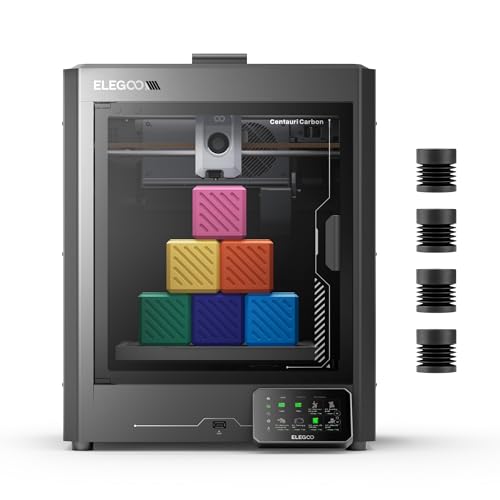
ELEGOO Centauri Carbon CoreXY 3D Printer
Best for: High-speed single-color advanced material prints
- Build Volume
- 256x256x256 mm
- Print Speed
- 500 mm/s
- Leveling Type
- Auto bed leveling
- Motion Structure
- CoreXY
- Extruder Type
- Brass-hardened steel nozzle
- Features
- High Speed, Built-in Camera
View on Amazon: ELEGOO Centauri Carbon CoreXY 3D Printer Affiliate link
The ELEGOO Centauri Carbon is a CoreXY 3D printer with a 256x256x256 mm build volume. It reaches speeds of 500 mm/s with 20000 mm/s² acceleration. The unit features a 320°C nozzle and an enclosed chamber for advanced materials. It arrives fully assembled with auto bed leveling. This model suits users seeking high-speed performance and rigid stability for detailed prints.
Pros
- CoreXY motion structure for high speed
- 500 mm/s print speed capability
- 320°C brass-hardened steel nozzle
- Built-in chamber camera for monitoring
- Fully assembled and pre-calibrated
Cons
- Smaller 256x256x256 mm build volume
- No multicolor printing support
- Heavier 38.6 pound build
Good fit if
- You need high-speed printing for detailed parts
- You want to print with advanced filaments like carbon fiber
- You prefer a fully assembled machine ready to use
Skip if
- You require multicolor printing capabilities
- You need a build volume larger than 256 mm
- You prefer a lighter and more compact footprint
Verdict: ELEGOO Centauri Carbon CoreXY 3D Printer delivers high-speed precision and material versatility for makers who prioritize performance and stability over large build volumes or color options.
Specifications side by side
| Spec | Creality Ender 3 V3 SE | ELEGOO Centauri Carbon CoreXY 3D Printer |
|---|---|---|
| Build Volume | not stated | 256x256x256 mm |
| Print Speed | 250mm/s | 500 mm/s |
| Leveling Type | CR Touch Auto Leveling | Auto bed leveling |
| Motion Structure | not stated | CoreXY |
| Extruder Type | not stated | Brass-hardened steel nozzle |
| Structure | not stated | CoreXY |
| Leveling | Auto Leveling | not stated |
| Features | not stated | High Speed, Built-in Camera |
| Color | Ender 3 SE Pro | Black |
| Dimensions | 13 × 13 × 16 inches | 15.7 × 15.9 × 19.3 inches |
| Weight | 19.8 pounds | 38.6 pounds |
| Size | Ender 3 SE Pro | Centauri Carbon |
| Model | Creality Ender 3 V3 SE | Centauri Carbon |
Frequently asked questions
Which printer is better for beginners?
The Creality Ender 3 V3 SE is the better choice for beginners. It offers auto leveling and moderate speeds up to 250mm/s. This setup simplifies your first prints. The ELEGOO Centauri Carbon is also beginner-friendly due to its pre-calibration. However, the Creality model focuses on accessible upgrades for those new to the hobby.
Which printer has faster print speeds?
The ELEGOO Centauri Carbon delivers higher print speeds. It supports a maximum speed of 500mm/s. This is double the 250mm/s speed of the Creality Ender 3 V3 SE. The higher speed makes the ELEGOO unit ideal for advanced users who prioritize performance and rapid output over basic functionality.
What is the build volume difference?
The ELEGOO Centauri Carbon offers a slightly larger build area. Its dimensions are 15.9 inches wide, 15.7 inches long, and 19.3 inches high. The Creality Ender 3 V3 SE measures 13 inches in width and length, with a height of 16 inches. You gain more space for larger parts with the ELEGOO model.
Which printer is lighter to move?
The Creality Ender 3 V3 SE is significantly lighter. It weighs 19.8 pounds. The ELEGOO Centauri Carbon weighs 38.6 pounds due to its CoreXY structure and heavier frame. If you need to transport your printer frequently, the Creality unit is easier to handle and move around your workspace.
Does ELEGOO include a camera?
Yes, the ELEGOO Centauri Carbon includes a built-in camera. This feature allows you to monitor your prints remotely. The Creality Ender 3 V3 SE does not list this feature in its specifications. If remote monitoring is important to you, the ELEGOO model provides this capability out of the box.
Which printer uses a CoreXY structure?
The ELEGOO Centauri Carbon utilizes a CoreXY mechanical structure. This design contributes to its high-speed performance and stability. The Creality Ender 3 V3 SE does not specify a CoreXY frame in its attributes. The CoreXY system is beneficial for advanced users seeking precision at higher speeds.