ANYCUBIC ABS-Like Resin 3.0 1kg vs ANYCUBIC Plant-Based Rapid Resin 2.0 (2026): Key Differences
As an Amazon Associate we earn from qualifying purchases. Links on this page are affiliate links.
You are comparing anycubic abs like resin 3 0 vs 3d printer resin 2 0 for your 3D printing needs. Both products are 1kg grey resins compatible with LCD and DLP printers using 405nm wavelengths. They share low-odor formulations and high compatibility with standard machines. The main difference lies in their material composition and mechanical properties. One focuses on strength and crack resistance, while the other emphasizes speed and plant-based origins.
Key differences
| Aspect | Anycubic ABS-Like Resin 3.0 1kg | ANYCUBIC Plant-Based Rapid Resin 2.0 Grey |
|---|---|---|
| Resin Type | ABS-Like | Plant-Based |
| Shore Hardness | 86D | not listed |
| Curing Wavelength | 365-405nm | 355-410nm |
| Key Feature | High Strength & Crack Resistance | High-speed Solidification |
Which one should you choose?
Choose Anycubic ABS-Like Resin 3.0 1kg if
- You need prints with enhanced strength and toughness for functional parts
- You want to avoid cracking during post-processing like drilling
- You prefer a resin with lower viscosity for faster curing times
Choose ANYCUBIC Plant-Based Rapid Resin 2.0 Grey if
- You prioritize eco-friendly materials derived from soybean oil
- You require a wider curing wavelength band for broader printer compatibility
- You want ultra-low odor without BPA or harmful chemicals
Verdict: Choose the ABS-Like Resin 3.0 if you need durable, crack-resistant parts for functional applications. Select the Plant-Based Rapid Resin 2.0 if you prefer environmentally friendly materials and faster print speeds. Both options offer low odor and broad compatibility with standard LCD and DLP printers.
ABS-Like 3.0 vs Plant-Based 2.0
Strength and toughness
The ANYCUBIC ABS-Like Resin 3.0 focuses heavily on mechanical durability. It features a Shore Hardness of 86D and offers 30% elongation at break. This combination allows the printed parts to withstand significant bending stress and drill operations without cracking or deforming. In contrast, the ANYCUBIC Plant-Based Rapid Resin 2.0 emphasizes high-speed solidification and general strength without excessive shrinkage. It does not list specific hardness or elongation metrics. If you need prints that resist impact and physical stress, the ABS-Like formula provides clearer technical advantages for tough functional parts.
Print speed and viscosity
Speed is a key differentiator between these two resins. The ABS-Like Resin 3.0 boasts lower viscosity and high fluidity, which allows it to reflow quickly to the print area. This reduces overall print time by ensuring the resin spreads efficiently between layers. The Plant-Based Rapid Resin 2.0 is marketed as a rapid resin that shortens curing time while maintaining precision. However, it does not explicitly cite viscosity levels. For users prioritizing faster layer adhesion and fluid dynamics, the specific viscosity data of the ABS-Like resin suggests a more optimized flow for rapid printing.
Material composition
The source of the resin affects environmental impact and handling. The Plant-Based Rapid Resin 2.0 uses soybean oil as its raw material. It is certified to EN 71-3:2013 safety standards and contains no BPA or irritating chemicals. This makes it a greener option for eco-conscious users. The ABS-Like Resin 3.0 is described as an upgraded ABS-like photopolymer with minimal odor. While it also promotes a cleaner environment, it does not highlight plant-based ingredients or specific safety certifications. If sustainable sourcing is a priority, the plant-based formulation has a clear advantage.
Wavelength compatibility
Both resins are designed to work with standard LCD and DLP 3D printers. The ABS-Like Resin 3.0 operates within a 365-405nm wavelength range. The Plant-Based Rapid Resin 2.0 supports a slightly wider band of 355nm-410nm. Both cover the standard 405nm requirement, ensuring compatibility with most machines on the market. The difference in range is minimal for typical users. Since both handle the core 405nm spectrum effectively, neither holds a significant edge in general printer compatibility for standard hardware.
Print accuracy and finish
Detail resolution is critical for many projects. The ABS-Like Resin 3.0 highlights a lower shrinkage rate, which helps capture intricate contours and delicate features. It aims for a smooth texture that feels polished. The Plant-Based Rapid Resin 2.0 also ensures high precision and smoothness without excessive shrinkage during the high-speed solidification process. Both products promise excellent detail and pure color effects. Since both emphasize low shrinkage and high precision without providing measurable tolerance data, they appear equal in their ability to produce detailed models.
Which resin fits your needs
Users needing durable, drill-ready parts
The ABS-Like Resin 3.0 offers 86D Shore Hardness and 30% elongation at break. This allows printed models to withstand significant bending stress and drill operations without cracking. If you require mechanical toughness and resistance to deformation, this upgraded formula provides the necessary strength for functional prototypes and durable end-use parts.
Printers prioritizing speed and eco-materials
The Plant-Based Rapid Resin 2.0 uses soybean oil as a raw material, ensuring an eco-friendly profile with ultra-low odor and no BPA. Its high-speed solidification shortens curing time while maintaining high precision. This resin is ideal for users who value rapid production cycles and environmentally conscious materials in their workflow.
Those seeking high detail and smoothness
ABS-Like Resin 3.0 features lower viscosity and high fluidity, allowing it to reflow quickly to the print area. This reduces overall print time while ensuring exceptional detail capture. The resin delivers a remarkably smooth texture with minimal shrinkage, making it suitable for intricate contours and delicate features that require high accuracy.
The products compared
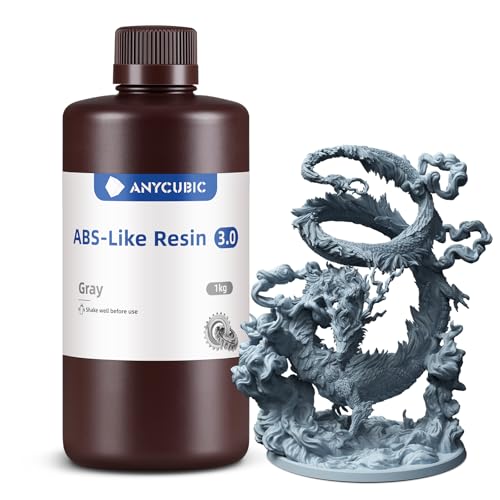
Anycubic ABS-Like Resin 3.0 1kg
Best for: Durable functional parts and engineering prototypes
- Resin Type
- ABS-Like
- Curing Wavelength
- 365-405nm
- Compatible Technology
- LCD, DLP
- Net Weight
- 1kg
- Shore Hardness
- 86D
- Printing Technology
- Resin
View on Amazon: Anycubic ABS-Like Resin 3.0 1kg Affiliate link
This is a grey ABS-like resin designed for high strength and toughness. It features a Shore Hardness of 86D and 30% elongation at break, making it resistant to cracking and bending. The low viscosity allows for faster curing and reduced print times. It works with LCD and DLP printers using 365-405nm wavelengths. This 1kg bottle suits users needing durable prints with minimal odor.
Pros
- Shore Hardness of 86D for crack resistance
- 30% elongation at break for flexibility
- Low viscosity for faster reflow and curing
- Compatible with 365-405nm LCD and DLP printers
Cons
- Limited to grey color in this specific listing
- No mention of specific curing time per layer
- Heavier shipping weight than net resin weight
Good fit if
- You need prints that withstand drilling or bending
- You use LCD or DLP printers with 405nm light
- You prefer low-odor printing environments
Skip if
- You require transparent or multi-color prints
- You use SLA printers outside the 365-405nm range
- You need a smaller 500ml or larger 4kg option
Verdict: ANYCUBIC ABS-Like Resin 3.0 Grey 1kg is a practical choice for makers who need durable, crack-resistant parts. It fits users who prioritize mechanical strength and faster print cycles over aesthetic variety.

ANYCUBIC Plant-Based Rapid Resin 2.0 Grey
Best for: Low-odor rapid printing on LCD/DLP
- Resin Type
- Plant-Based
- Curing Wavelength
- 405nm, 355nm-410nm
- Compatible Technology
- LCD, DLP
- Net Weight
- 1kg
- Printing Technology
- Resin
- Features
- High Speed, Low Odor
View on Amazon: ANYCUBIC Plant-Based Rapid Resin 2.0 Grey Affiliate link
This 1kg bottle of ANYCUBIC Plant-Based Rapid Resin 2.0 cures at 405nm with a wide 355nm-410nm band for LCD and DLP printers. It uses soybean oil to reduce odor and shrinkage while maintaining high precision. The grey resin delivers pure color effects. It suits users who need fast, low-odor prints on compatible light-curing machines.
Pros
- Plant-based soybean oil formulation
- Low odor and no BPA
- Fast solidification speed
- Wide 355nm-410nm compatibility
Cons
- Limited to grey color option
- Not compatible with SLA laser curing
- Requires sealed storage to prevent quality loss
Good fit if
- You want low-odor printing
- You use LCD or DLP printers
- You need fast curing times
Skip if
- You require multi-color prints
- You use SLA laser printers
- You prefer white or black resin
Verdict: ANYCUBIC Plant-Based Rapid Resin 2.0 delivers fast, low-odor prints for LCD and DLP users. It fits those prioritizing speed and environmental safety over color variety.
Specifications side by side
| Spec | Anycubic ABS-Like Resin 3.0 1kg | ANYCUBIC Plant-Based Rapid Resin 2.0 Grey |
|---|---|---|
| Resin Type | ABS-Like | Plant-Based |
| Curing Wavelength | 365-405nm | 405nm, 355nm-410nm |
| Compatible Technology | LCD, DLP | LCD, DLP |
| Net Weight | 1kg | 1kg |
| Shore Hardness | 86D | not stated |
| Printing Technology | Resin | Resin |
| Compatible Material | ABS | not stated |
| Features | High Precision, Low Odor | High Speed, Low Odor |
| Color | Grey | Grey |
| Size | 1KG | not stated |
| Resolution | 14K | not stated |
| Dimensions | 4.33 × 4.33 × 10.3 inches | 3.94 × 3.94 × 3.94 inches |
| Weight | 2.2 pounds | not stated |
Frequently asked questions
Which resin is better for functional prototypes?
The ANYCUBIC ABS-Like Resin 3.0 is the better choice for functional prototypes. It is designed for durable, crack-resistant parts that withstand mechanical stress. This makes it ideal for engineering applications where strength matters more than visual finish. You can rely on its ABS-like properties for practical use.
Does either resin have a low odor?
Both resins feature low-odor formulations suitable for indoor use. The ANYCUBIC Plant-Based Rapid Resin 2.0 emphasizes environmental safety and reduced smell during printing. The ABS-Like Resin 3.0 also offers a practical, less pungent experience. You will find both options comfortable for home or office workshops without strong fumes.
Are these resins compatible with 405nm printers?
Yes, both resins work with standard 405nm wavelength printers. The Plant-Based Rapid Resin 2.0 explicitly lists 405nm compatibility. The ABS-Like Resin 3.0 is also designed for LCD and DLP systems using this wavelength. You can use either in your existing machine without needing new hardware.
Which resin prints faster?
The ANYCUBIC Plant-Based Rapid Resin 2.0 is built for speed. It features high-speed printing capabilities, allowing you to complete jobs quickly. The ABS-Like Resin 3.0 prioritizes durability over print speed. If your project demands rapid turnaround times, the Plant-Based 2.0 is the more efficient option.
What colors are available for these resins?
Both products are currently available in grey. The ABS-Like Resin 3.0 comes in a 1kg grey container. The Plant-Based Rapid Resin 2.0 is also listed in grey. If you need other colors, you may need to look for other variants, as these specific SKUs are grey only.
Which resin is safer for the environment?
The ANYCUBIC Plant-Based Rapid Resin 2.0 is marketed as environmentally safer. It uses plant-based ingredients to reduce environmental impact. The ABS-Like Resin 3.0 focuses on mechanical performance rather than ecological sourcing. If sustainability is a priority for your workflow, the Plant-Based 2.0 aligns better with those values.