3d Printers Buying Guide (2026): What Matters and 8 Picks
As an Amazon Associate we earn from qualifying purchases. Links on this page are affiliate links.
This 3d printer buying guide helps you choose the right machine for your workspace and skill level. You will decide between high-speed enclosed models, multi-color systems, and compact entry-level units. We evaluated 8 printers based strictly on their published specifications. This approach ensures you understand the hardware capabilities before making a purchase. The list includes options for professionals, families, and beginners.
You can compare dimensions, weight, and printing technologies to find a fit for your desk. Some models prioritize speed and advanced materials, while others focus on safety for children or ease of use for novices. Each entry highlights key specs like build volume, structure type, and special features. This data allows you to match technical requirements with your specific projects. The selections reflect current market offerings without personal testing bias. Use these details to narrow your choices effectively.
Our top pick: Bambu Lab P1S Enclosed 3D Printer.
Key Specs for Choosing 3D Printers
Printing Technology
Most modern consumer printers use FDM technology, which melts thermoplastic filament layer by layer. This method is reliable and supports a wide range of materials. You should verify the technology type to ensure compatibility with your preferred filaments. Some models prioritize speed and enclosure, while others focus on compactness. For example, the Bambu Lab P1S uses FDM to deliver professional-grade speed in an enclosed chassis. This structure helps manage heat and fumes, making it suitable for advanced materials. Understanding the core technology helps you predict print quality and maintenance needs. It is the foundation for all other specifications. Choose based on your material requirements and safety preferences.
- Confirm FDM compatibility for your filaments
- Check if the chamber is enclosed
- Verify temperature limits for advanced plastics
Color Printing Capability
Multi-color printing allows you to create complex prototypes and models without manual filament swaps. This feature requires specific hardware, such as multiple extruders or mixing systems. If you need single-color prints for functional parts, this may be unnecessary. However, for visual projects, it adds significant value. The Snapmaker U1 offers a 4-toolhead system for rapid multi-material output. The Bambu Lab A1 Mini Combo provides a compact solution for small-space efficiency. The Anycubic Kobra X also supports multi-color output in a compact footprint. Consider if the added complexity and cost of multi-color systems align with your project needs. Single-color printers are often simpler and more reliable for basic tasks.
- Identify the multi-color mixing system
- Check toolhead count for color variety
- Verify if multi-color is optional
Compatible Material Types
The range of compatible materials determines what you can print. PLA is the most common and easiest to use, suitable for beginners and kids. Advanced users may need support for PETG, ABS, or flexible filaments. Check the manufacturer's list to ensure the printer handles your preferred materials. The AOSEED Kids Printer is optimized for PLA, prioritizing safety and ease of use. The Entina Tina2C Mini also focuses on PLA for simple home projects. High-speed models like the ELEGOO Centauri Carbon often support durable advanced materials. Matching the printer to your material needs prevents frustration and failed prints. Always verify temperature and extruder requirements for specific filaments.
- List supported filament types like PLA
- Check max nozzle temperature limits
- Verify extruder strength for flexible filaments
Print Speed
Print speed affects how quickly you can finish projects. High-speed printers use advanced motion systems to reduce print times significantly. This is crucial for prototyping and production runs. However, higher speeds may impact surface quality if not calibrated correctly. The Flashforge Adventurer 5M boasts a speed of 600mm/s for fast prototyping. The ELEGOO Centauri Carbon also delivers high-speed CoreXY performance. The Bambu Lab P1S is known for professional-grade speed. Consider if speed is your priority or if you value precision over time. Faster machines often require more robust components and maintenance. Evaluate your typical project size against the speed benefits.
- Check maximum mm/s speed rating
- Verify acceleration and jerk settings
- Review speed at different layer heights
Frame Structure
The printer structure influences rigidity, speed, and print quality. CoreXY designs are popular for high-speed printing because they reduce moving mass. This allows for faster acceleration and better detail. Traditional Cartesian printers may be slower but are often simpler. The ELEGOO Centauri Carbon and Flashforge Adventurer 5M both use CoreXY structures. This design choice supports their high-speed capabilities. The Bambu Lab P1S uses a different approach focused on stability and enclosure. Your choice depends on whether you prioritize speed or simplicity. CoreXY systems often require more complex calibration. Understand the mechanical advantages of the structure for your skill level.
- Identify CoreXY or Cartesian design
- Check frame material for rigidity
- Review belt tensioning mechanisms
Bed Leveling Method
Automatic leveling simplifies setup and ensures consistent first layers. Manual leveling can be tedious and prone to error. Most modern printers include auto-leveling features to save time. This is especially helpful for beginners or frequent users. The Flashforge Adventurer 5M includes auto-leveling for efficient setup. The Entina Tina2C Mini also features auto-leveling for convenience. This feature reduces the learning curve and improves print success rates. Check if the system uses sensors or mechanical probes. Some systems require frequent calibration, while others are more stable. Consider how often you plan to print when weighing this factor. Automated systems add reliability to your workflow.
- Confirm auto-leveling sensor type
- Check calibration frequency requirements
- Verify probe accuracy range
Extruder Type
The extruder type affects material feeding and reliability. Direct drive extruders are closer to the nozzle, making them better for flexible filaments. Bowden setups can offer higher speeds but may struggle with flexibility. The Flashforge Adventurer 5M features a direct drive extruder. This design supports better control over filament flow. It is particularly useful for materials that require precise feeding. Check if the extruder is geared for higher torque. This helps prevent clogs and slipping. The choice depends on the materials you plan to use. Direct drive is generally preferred for versatility. Bowden may suffice for rigid plastics like PLA.
- Identify direct drive or Bowden
- Check gear ratio for torque
- Verify filament diameter compatibility
Printer Features
Additional features enhance usability and monitoring. Built-in cameras allow you to check prints remotely. Wi-Fi connectivity enables file transfer and monitoring. The ELEGOO Centauri Carbon includes a built-in camera for remote oversight. The Entina Tina2C Mini offers Wi-Fi and comes fully assembled. These features reduce the need for physical interaction with the printer. Check if the software supports remote management. Some models include AI monitoring for print failure detection. Consider if these conveniences justify the potential cost increase. Features like auto-leveling and Wi-Fi streamline the printing process. Evaluate which tools are essential for your workflow.
- Check for built-in camera
- Verify Wi-Fi connectivity options
- Review software monitoring capabilities
Types of 3D Printers
High-speed enclosed FDM
These printers prioritize rapid production and material versatility within a secure chassis. The Bambu Lab P1S exemplifies this category with its 18 by 15.3 by 15.3 inch footprint and 39-pound build. It supports advanced filaments while maintaining professional-grade quality. You benefit from reduced fumes and consistent temperatures. The trade-off is a higher price point and larger weight compared to open-frame models. This type suits makers who value speed and reliability over budget constraints.
Multi-color systems
Multi-color printers allow you to create complex prototypes without manual filament changes. The Snapmaker U1 offers a 4-toolhead setup for fast color output, measuring 13 by 14.2 by 22.6 inches. The Bambu Lab A1 Mini Combo provides a compact 14.8 by 19.5 by 16.8 inch option for small spaces. The Anycubic Kobra X also delivers grey multi-color printing in a 20.9-pound frame. You gain visual complexity and production efficiency. The main trade-off is increased mechanical complexity and potential maintenance requirements for multiple extruders.
Compact entry-level units
Entry-level printers focus on ease of use and small footprints for beginners or children. The AOSEED Kids Printer is an enclosed white unit weighing 8.82 pounds, designed for safe PLA printing. The Entina Tina2C Mini offers auto-leveling and Wi-Fi in a colorful 8.6 by 8.6 by 11.4 inch box. These machines fit easily on desks and require minimal setup. You benefit from low barriers to entry and simple operation. The trade-off is limited build volume and restricted material compatibility, making them unsuitable for large or industrial-grade projects.
Common Mistakes to Avoid
Ignoring actual build volume dimensions
Many buyers overlook the total build volume when comparing models. You must check both the physical dimensions and the usable print area. A large chassis does not guarantee a larger print zone. Measure your intended objects against the actual X, Y, and Z axes to ensure they fit.
Assuming universal material compatibility
Assuming all printers handle the same materials is risky. Some machines require high temperatures or specific airflow for advanced filaments. Check the nozzle temperature limits and chamber heating capabilities. Verify that your chosen printer supports the specific plastic type you plan to use for your projects.
Forgetting post-processing tool requirements
Overlooking the need for post-processing tools can cause frustration. Printed parts often require support removal, sanding, or curing. Ensure you have the necessary tools for finishing. Plan your workflow around the post-production steps required for your chosen material and printing technology before making your purchase.
Prioritizing speed over print quality
Choosing a printer based solely on speed can lead to quality issues. High-speed models may sacrifice surface finish or precision. Balance your speed requirements with layer resolution specs. Review the minimum layer height to ensure the machine meets your detail needs before prioritizing rapid production capabilities.
Quick picks
Our 8 picks

Bambu Lab P1S Enclosed 3D Printer
Best for: High-speed printing with advanced materials
- Print Speed
- 500mm/s
- Printing Technology
- FDM
- Multicolor Capacity
- Up to 16 Colors
- Leveling Type
- Automatic Bed Leveling
- Motion Structure
- CoreXY
- Features
- High Speed, Enclosed
The Bambu Lab P1S is a ready-to-use FDM printer designed for speed and reliability. It prints at 500mm/s with 20,000 mm/s² acceleration. The enclosed build volume supports advanced materials like ABS and PC. It includes automatic bed leveling and a 15-minute setup. You can achieve multi-color prints up to 16 colors when using the optional AMS unit. This model suits users who want high performance without complex assembly.
Pros
- 500mm/s print speed and 20,000 mm/s² acceleration
- Fully enclosed design for advanced filament support
- Automatic bed leveling for consistent first layers
- Supports PLA, PETG, TPU, ABS, ASA, PA, and PC
Cons
- Multi-color printing requires purchasing the separate AMS unit
- Carbon and glass fiber reinforced polymers are not recommended
- Weighs 39 pounds, making it less portable than open-frame models
Good fit if
- You need high-speed prints with a fully enclosed chamber
- You want to print with engineering materials like ABS or PC
- You prefer a machine that is ready to use in 15 minutes
Skip if
- You require multi-color printing without buying an additional AMS unit
- You plan to use carbon fiber or glass fiber reinforced filaments
- You need a lightweight printer for frequent travel or relocation
Verdict: The Bambu Lab P1S FDM 3D Printer delivers professional-grade speed and material versatility in a compact, enclosed chassis. It is ideal for makers who prioritize print quality and advanced filament support over budget constraints.

Snapmaker U1 4-Toolhead 3D Printer
Best for: multi-color prototypes and fast production
- Build Volume
- 270 X 270 X 270 mm
- Print Speed
- 500 mm/s
- Multicolor Capacity
- 4-Toolhead
- Motion Structure
- CoreXY
- Color Printing
- Multi-Color
- Target Audience
- Beginners
The Snapmaker U1 is a CoreXY 3D printer with a 270 x 270 x 270 mm build volume. It features a 4-toolhead system with a 5-second tool changer for multi-color printing. Speeds reach 500 mm/s. The unit includes automatic calibration and AI monitoring. It suits makers who need fast, multi-material output without manual filament swaps.
Pros
- 4-toolhead system with 5-second automatic tool changes
- CoreXY motion system reaches 500 mm/s print speed
- 270 x 270 x 270 mm build volume
- Supports mixed materials like TPU, PLA, and PVA
- Includes 3.5-inch touchscreen and remote app control
Cons
- 270 mm build volume is smaller than many competitors
- 59.1 pounds weight makes it less portable
- 1-year warranty is shorter than industry standards
Good fit if
- You need true multi-color printing without purging waste
- You want fast speeds for functional prototypes
- You prefer automatic toolhead calibration
Skip if
- You require a build volume larger than 270 mm
- You need a printer under 50 pounds
- You prefer a warranty longer than one year
Verdict: Snapmaker U1 4-Toolhead 3D Printer delivers rapid multi-material output for users who prioritize speed and color complexity over maximum build size.

Bambu Lab A1 Mini Combo Multi-Color 3D Printer
Best for: compact multi-color printing
- Multicolor Capacity
- Multi-Color
- Leveling Type
- Full-Auto Calibration
- Extruder Type
- 1-Clip quick swap nozzle
- Dimensions
- 16.8 × 14.8 × 19.5 inches
- Weight
- 22 pounds
View on Amazon: Bambu Lab A1 Mini Combo Multi-Color 3D Printer
The Bambu Lab A1 Mini Combo includes the A1 Mini printer and AMS lite for multi-color printing. It features 10,000 mm/s² acceleration and full-auto calibration. The unit measures 14.8 x 16.8 x 19.5 inches and weighs 22 pounds. It uses a 1-clip quick swap nozzle and maintains noise levels at or below 48 dB. This setup suits users who want reliable multi-color results without manual calibration hassles.
Pros
- 10,000 mm/s² acceleration for fast printing
- Full-auto calibration including Z-offset and bed-leveling
- AMS lite enables multi-color printing
- Active flow rate compensation for smooth prints
- Quiet operation at ≤48 dB
Cons
- Smaller build volume compared to full-size models
- AMS lite required for multi-color capability
- No mention of remote control or app connectivity
Good fit if
- You want multi-color printing without complex setup
- You need a compact printer for small spaces
- You prefer automatic calibration over manual adjustments
Skip if
- You require a large build volume for big parts
- You want to print in multiple colors without extra hardware
- You need remote monitoring or control features
Verdict: Bambu Lab A1 Mini Combo delivers fast, accurate multi-color printing in a compact footprint. It fits users who value convenience and small-space efficiency over large build volumes.

AOSEED Enclosed Kids 3D Printer
Best for: Safe, single-color printing for children
- Print Speed
- Up to 400 mm/s
- Multicolor Capacity
- Single-color
- Leveling Type
- Leveling-free
- Extruder Type
- Quick-release nozzle
- Compatible Material
- PLA
- Features
- Enclosed, Wi-Fi
The AOSEED AI is an enclosed 3D printer built for kids and beginners. It supports single-color PLA printing with peak speeds up to 400 mm/s. The device features a compact footprint measuring 10.6 by 11.4 by 12.2 inches. You get access to 12,000+ print-tested models and AI design tools. The enclosed design ensures safety with pinch-resistant walls and quiet operation.
Pros
- Enclosed, pinch-resistant design for safe kid use
- Peak print speed of 400 mm/s
- Access to 12,000+ print-tested models
- Built-in camera for real-time monitoring
- Auto-leveling platform requires no manual adjustment
Cons
- Supports single-color printing only
- No multi-color toolhead included
- Smaller build volume than adult printers
Good fit if
- You want a safe, enclosed printer for children
- You prefer automatic leveling and simple setup
- You need access to a large library of pre-made models
Skip if
- You require native multi-color printing capabilities
- You need to print with materials other than PLA
- You want a large build volume for big projects
Verdict: The AOSEED AI Kids 3D Printer offers a safe, enclosed environment with high speeds for young creators. It is ideal for families who prioritize safety and ease of use over multi-color printing.

Entina Tina2C Mini 3D Printer
Best for: beginners and small home projects
- Build Volume
- 3.9" x 3.9" x 3.9"
- Leveling Type
- Auto Leveling
- Compatible Material
- PLA
- Features
- Wi-Fi, Fully Assembled
- Target Audience
- Beginners, Kids
- Dimensions
- 11.4 × 8.6 × 8.6 inches
The Entina Tina2C is a compact, fully assembled 3D printer designed for beginners and kids. It features a 3.9 x 3.9 x 3.9-inch build volume and auto-leveling for easy setup. You get WiFi connectivity and a magnetic build plate for simple maintenance. The bundle includes four PLA filament colors, allowing you to start printing immediately. Its small footprint fits well on home desks or in small studios.
Pros
- Fully assembled for quick setup
- Auto-leveling reduces manual effort
- WiFi and offline app control
- Includes 4 PLA filament colors
- Magnetic flexible build plate
Cons
- Small 3.9-inch cubic build volume
- Compatible only with PLA filament
- No multi-color tool changer
Good fit if
- You need a small printer for a desk
- You are a beginner or parent buying for kids
- You want a fully assembled unit to start quickly
Skip if
- You require large build volumes for big projects
- You need to print with engineering materials like ABS
- You want multi-color printing without manual swapping
Verdict: The Entina Tina2C Mini 3D Printer is a practical entry point for families and novices who value convenience and compact size over large print capacity or material versatility.
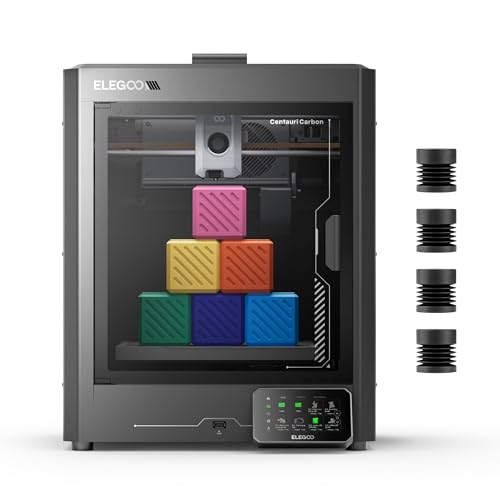
ELEGOO Centauri Carbon CoreXY 3D Printer
Best for: High-speed printing of durable advanced materials
- Build Volume
- 256x256x256 mm
- Print Speed
- 500 mm/s
- Leveling Type
- Auto bed leveling
- Motion Structure
- CoreXY
- Extruder Type
- Brass-hardened steel nozzle
- Features
- High Speed, Built-in Camera
The ELEGOO Centauri Carbon is a CoreXY 3D printer designed for high-speed output and advanced materials. It features a 256x256x256 mm build volume and reaches speeds of 500 mm/s with 20,000 mm/s² acceleration. The unit arrives fully assembled and pre-calibrated, featuring auto bed leveling and a 320°C nozzle capable of handling carbon fiber reinforced filaments. It includes a built-in chamber camera for remote monitoring. This machine suits makers who need rigid stability and fast production cycles for durable parts.
Pros
- CoreXY motion system with 500 mm/s print speed
- 320°C nozzle supports advanced materials like carbon fiber
- Die-cast aluminum frame minimizes vibration at high speeds
- Built-in chamber camera for real-time monitoring
Cons
- 256 mm build volume is smaller than many competitors
- Heavy build at 38.6 pounds limits portability
- No mention of multi-color printing capabilities
Good fit if
- You need high-speed printing for durable parts
- You want a machine that is fully assembled and ready to use
- You require a rigid frame for stable high-speed output
Skip if
- You need a large build volume for oversized projects
- You require automatic multi-color printing without manual swaps
- You prefer a lightweight desktop printer for easy transport
Verdict: ELEGOO Centauri Carbon 3D Printer delivers high-speed CoreXY performance and material versatility for makers who prioritize speed and rigidity over large build volumes.

FLASHFORGE Adventurer 5M CoreXY 3D Printer
Best for: Fast prototyping and automated setup
- Build Volume
- 220x220x220mm
- Print Speed
- Max 600mm/s
- Leveling Type
- Fully Auto Leveling
- Motion Structure
- CoreXY
- Extruder Type
- 280°C Direct Extruder
- Features
- High Speed
The Flashforge Adventurer 5M uses a CoreXY motion structure to reach a maximum travel speed of 600mm/s. It features a 220x220x220mm build volume and a direct extruder capable of 280°C. Fully automatic bed leveling simplifies setup. This printer suits users who need fast prototyping and reliable first layers without manual calibration.
Pros
- CoreXY structure for high-speed printing up to 600mm/s
- Fully automatic bed leveling for consistent adhesion
- 280°C direct drive extruder for versatile material use
- 220x220x220mm build volume for medium-sized projects
Cons
- 220x220x220mm build volume is smaller than many competitors
- No enclosed chamber listed for temperature control
- No multi-color printing system included in base model
Good fit if
- You want fast print speeds for rapid prototyping
- You prefer automatic leveling to save setup time
- You need a direct drive for flexible filaments
Skip if
- You require a build volume larger than 220mm
- You need multi-color printing without extra hardware
- You want an enclosed chamber for high-temp materials
Verdict: Flashforge Adventurer 5M CoreXY Printer delivers high speed and auto-leveling for users who prioritize efficiency and ease of use over large build volumes or enclosed environments.

Anycubic Kobra X Multicolor 3D Printer
Best for: Compact multi-color printing with high speed
- Build Volume
- 260mm x 260mm x 260mm
- Print Speed
- 600mm/s
- Printing Technology
- FDM
- Multicolor Capacity
- Native 4-color, up to 19-color
- Leveling Type
- LeviQ 3.0 auto-leveling
- Extruder Type
- Hardened steel nozzle
The Anycubic Kobra X is a 260mm x 260mm x 260mm FDM printer with native 4-color support. It reaches 600mm/s speeds and uses a hardened steel nozzle for 300°C printing. LeviQ 3.0 auto-leveling ensures flat beds. It supports PLA, PETG, TPU, and ASA. You get remote app control and dual-band Wi-Fi. This unit suits makers wanting multi-color prints without complex setups.
Pros
- Native 4-color printing with expansion to 19 colors
- High speed of 600mm/s with vibration compensation
- LeviQ 3.0 49-point auto bed leveling
- Hardened steel nozzle supports 300°C temperatures
- Dual-band Wi-Fi and LAN connectivity
Cons
- Smaller 260mm build volume than competitors
- Filament not included in the package
- No physical display screen mentioned in data
Good fit if
- You want native multi-color printing without extra hardware
- You need high-speed printing for faster turnaround
- You print flexible materials like TPU or ASA
Skip if
- You require a large build volume over 260mm
- You prefer printers with included filament spools
- You need a display screen for local control
Verdict: The Anycubic Kobra X 260mm Multicolor 3D Printer fits users who prioritize multi-color output and speed in a compact footprint. It is a solid choice for makers who want to print flexible materials and use remote app monitoring.
Specifications side by side
| Spec | Bambu Lab P1S Enclosed 3D Printer | Snapmaker U1 4-Toolhead 3D Printer | Bambu Lab A1 Mini Combo Multi-Color 3D Printer | AOSEED Enclosed Kids 3D Printer | Entina Tina2C Mini 3D Printer | ELEGOO Centauri Carbon CoreXY 3D Printer | FLASHFORGE Adventurer 5M CoreXY 3D Printer | Anycubic Kobra X Multicolor 3D Printer |
|---|---|---|---|---|---|---|---|---|
| Build Volume | not specified | 270 X 270 X 270 mm | not specified | not specified | 3.9" x 3.9" x 3.9" | 256x256x256 mm | 220x220x220mm | 260mm x 260mm x 260mm |
| Print Speed | 500mm/s | 500 mm/s | not specified | Up to 400 mm/s | not specified | 500 mm/s | Max 600mm/s | 600mm/s |
| Printing Technology | FDM | not specified | not specified | not specified | not specified | not specified | not specified | FDM |
| Multicolor Capacity | Up to 16 Colors | 4-Toolhead | Multi-Color | Single-color | not specified | not specified | not specified | Native 4-color, up to 19-color |
| Leveling Type | Automatic Bed Leveling | not specified | Full-Auto Calibration | Leveling-free | Auto Leveling | Auto bed leveling | Fully Auto Leveling | LeviQ 3.0 auto-leveling |
| Motion Structure | CoreXY | CoreXY | not specified | not specified | not specified | CoreXY | CoreXY | not specified |
| Extruder Type | not specified | not specified | 1-Clip quick swap nozzle | Quick-release nozzle | not specified | Brass-hardened steel nozzle | 280°C Direct Extruder | Hardened steel nozzle |
| Color Printing | not specified | Multi-Color | Multi-Color | not specified | not specified | not specified | not specified | Multi-Color |
| Compatible Material | not specified | not specified | not specified | PLA | PLA | not specified | not specified | not specified |
| Structure | CoreXY | not specified | not specified | not specified | not specified | CoreXY | CoreXY | not specified |
| Leveling | not specified | not specified | not specified | not specified | Auto Leveling | not specified | Auto Leveling | not specified |
| Features | High Speed, Enclosed | not specified | not specified | Enclosed, Wi-Fi | Wi-Fi, Fully Assembled | High Speed, Built-in Camera | High Speed | Built-in Camera |
| Target Audience | Beginners | Beginners | not specified | Kids | Beginners, Kids | not specified | not specified | Beginners |
| Color | Black | not specified | Silver | White (JOY AI+) + 1 PLA | Orange/Yellow/Pink/Purple | Black | Black | Grey |
| Dimensions | 15.3 × 18 × 15.3 inches | 22.6 × 13 × 14.2 inches | 16.8 × 14.8 × 19.5 inches | 11.4 × 10.6 × 12.2 inches | 11.4 × 8.6 × 8.6 inches | 15.7 × 15.9 × 19.3 inches | 15.8 × 14.3 × 17.6 inches | 23 × 13 × 22 inches |
| Weight | 39 pounds | 59.1 pounds | 22 pounds | 8.82 pounds | not specified | 38.6 pounds | 22 pounds | 20.9 pounds |
| Size | P1S (Without AMS) | not specified | A1 mini Combo (with AMS lite) | not specified | not specified | Centauri Carbon | not specified | not specified |
| Model | P1S | not specified | PF002-M+SA005-AU | not specified | not specified | Centauri Carbon | Adventurer 5M | not specified |
If you want to compare outdoor cooking equipment, the griddle buying guide covers surface materials and heating specs.
Frequently asked questions
Which 3d printer is best for high-speed printing?
The Bambu Lab P1S and ELEGOO Centauri Carbon stand out for speed. The P1S offers an enclosed chassis for advanced materials. The Centauri uses a CoreXY structure for rigidity. Both machines prioritize rapid production over large build volumes. You get professional-grade output with these high-performance options.
How do I choose a multi-color 3d printer?
Select a model with a multi-toolhead or AMS system. The Snapmaker U1 provides four toolheads for complex color prototypes. The Bambu Lab A1 Mini Combo fits small spaces while delivering accurate multi-color prints. These units handle color complexity without requiring maximum build size.
What is the smallest 3d printer for beginners?
The Entina Tina2C Mini is a practical entry point for novices. It measures 8.6 by 8.6 by 11.4 inches and weighs very little. It features auto-leveling and Wi-Fi connectivity for convenience. This compact unit is ideal for families and small home projects.
Is there a safe 3d printer for kids?
The AOSEED Enclosed Kids 3D Printer offers a safe environment for young creators. It features an enclosed design to prevent contact with hot parts. The unit is lightweight at 8.82 pounds and supports PLA filament. It prioritizes safety and ease of use for children.
Which printer has the fastest print speed?
The Flashforge Adventurer 5M reaches up to 600mm/s. The ELEGOO Centauri also delivers high-speed CoreXY performance. Both machines include direct drive extruders and auto-leveling features. These specs ensure efficient prototyping and rapid production for users who value speed.
What dimensions should I check for build volume?
Check the width, height, and length of the print area. The Bambu Lab P1S measures 18 by 15.3 by 15.3 inches. The Snapmaker U1 is larger at 22.6 by 13 by 14.2 inches. Compare these dimensions against your object sizes to ensure compatibility.